North America Superfood Market Research Report – Segmentation by Product Type (Fruits, Vegetables, Seeds and Nuts, Ancient Grains); By Distribution Channel (Supermarkets and Hypermarkets, Specialty Health Food Stores, Online Retailers, Farmers Markets); and Region; - Size, Share, Growth Analysis | Forecast (2024– 2030)
North America Superfood Market Size (2024-2030)
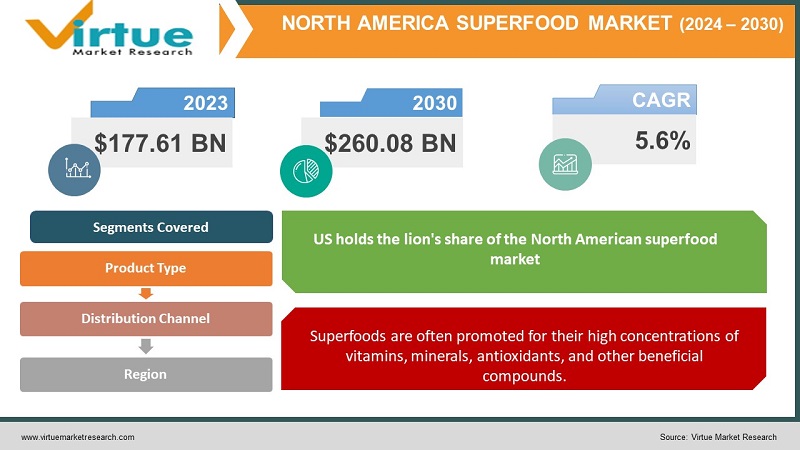
The North America Superfood Market was valued at USD 177.61 Billion in 2024 and is projected to reach a market size of USD 260.08 Billion by the end of 2030. Over the forecast period of 2024-2030, the market is projected to grow at a CAGR of 5.6%.
Superfoods are understood as nutrient-dense foods considered exceptionally beneficial for health and well-being. They often boast high concentrations of vitamins, minerals, antioxidants, or other health-promoting compounds. Consumers are increasingly prioritizing preventative health and seeking natural, whole-food ways to support overall wellness. Social media, blogs, and online resources have democratized information about superfoods, their potential benefits, and ways to incorporate them into diets. Once found primarily in health food stores, superfoods are now readily available in mainstream supermarkets and online retailers. Superfoods are incorporated into a wide variety of convenient formats – powders, smoothies, snack bars, and supplements – catering to busy lifestyles. The rise of vegetarian, vegan, and flexitarian diets increases demand for nutrient-packed plant-based options, which superfoods naturally fit. Growing culinary curiosity and globalization of flavors expose North Americans to exotic superfoods from different parts of the world. Health-conscious seniors, a significant demographic, may seek superfoods for their potential anti-aging properties and disease-prevention benefits.
Key Market Insights:
The superfood market in North America is a vibrant subset of the broader health and wellness sector. Superfoods are frequently marketed as being rich in antioxidants, vitamins, minerals, and other health-promoting substances. Their high nutrient density makes them an appealing option for people who are concerned about their health. Superfoods typically provide special or uncommon nutrients, such as unusual forms of fiber, certain phytochemicals, or polyphenols. This appeals to a desire for a more varied and effective diet. Superfoods are seen by consumers as a component of a larger wellness toolset. This comprises immune system stimulation, proactive health management, and support for certain health objectives (digestion, energy, etc.). Whole-food sources of nourishment are strongly preferred by consumers over highly processed supplementation. Superfoods satisfy this demand for unprocessed, natural ingredients. Superfoods go in well with the trend towards eating foods that provide advantages over simple nourishment. The desire to enhance well-being through every day dietary decisions propels the intake of superfoods. Superfoods with unusual provenance or historical usage have enthralling backstories that appeal to customers looking for genuineness and alternatives to conventional fare. Superfoods are becoming more and more like supplements, incorporating things like collagen peptides, probiotic-rich meals, and bee pollen. Superfoods are no longer only found in niche retailers. Their addition to smoothies, granola bars, snacks, and other foods makes them more easily accessible and convenient.
North America Superfood Market Drivers:
Superfoods are often promoted for their high concentrations of vitamins, minerals, antioxidants, and other beneficial compounds.
Wellness now encompasses not just physical health, but also encompasses mental well-being, emotional resilience, spiritual fulfillment, and a sense of vitality. Superfoods, with their diverse nutrients and potential adaptogenic properties, align with this multi-dimensional view of health. Rather than a reactive approach to health issues, consumers are motivated to invest in preventative solutions. Superfoods, laden with antioxidants and protective compounds, are seen as proactive tools to bolster the body's defenses and potentially reduce long-term disease risk. Individuals seek autonomy in their health journeys, desiring to play an active role. Superfoods represent a tangible step they can take daily, offering a sense of control and proactive contribution to their overall well-being. Growing skepticism towards extensively refined foods, artificial ingredients, and the potential side effects of some pharmaceutical solutions fuels a back-to-basics approach. Superfoods, often minimally processed and derived from whole-food sources, resonate with the desire for natural nourishment.
Consumers see superfoods as part of a broader wellness toolkit. This includes proactive health management, boosting immunity, and supporting specific health goals driving market growth.
Cooking shows, celebrity chefs, and a flood of food content on social media elevate food beyond necessity and into the realm of entertainment and a medium for creativity. A generation raised on globalized food options and tantalizing online food imagery hungry for new tastes, textures, and ingredients. Superfoods become the culinary 'treasures' to be discovered. Home cooking is experiencing a renaissance but with a focus on both mastery and adventure. Superfoods allow people to expand their repertoire, try complex recipes, and impress friends and family with their culinary prowess. Diet choices increasingly reflect personal values– ethical eating, sustainability, and prioritizing a plant-centric approach. Superfoods symbolize a conscious choice and advertise one's commitment to a specific lifestyle. Food-centered niches form strong bonds. Sharing superfood recipes, farmer’s market finds, or 'secret' sources creates a sense of belonging and insider knowledge that fuels the market. Online platforms for recipe sharing, food blogs, and influential wellness personalities foster a global community focused on superfoods. This bypasses geographic limitations and fuels a constant exchange of ideas. Wellness no longer means deprivation. Superfoods allow for healthy eating that is also delicious, colorful, and Instagram-worthy. This combats the notion of diet as a restriction.
North America Superfood Market Restraints and Challenges:
Because of their manufacturing, sourcing, or uniqueness, several superfoods fetch higher costs. As a result, there is an economic barrier that can prevent access to a larger market.
Many superfoods, due to their sourcing, production, or novelty, command higher prices. This creates an economic barrier, potentially limiting access to a wider market. Consumers might become skeptical if they perceive superfoods as primarily driven by marketing hype rather than providing tangible value at their price point. The superfood narrative often centers on trendy, expensive ingredients. Ensuring access and inclusivity in the wellness movement requires broadening the definition of nutrient-dense, beneficial foods. While many superfoods have traditional usage or promising initial research, some claims outpace the available scientific evidence. This can erode consumer trust long-term. It's crucial to walk the line between enthusiasm for the potential of superfoods and avoiding unsubstantiated or exaggerated claims that could fuel skepticism or regulatory action. The wellness industry can be vulnerable to short-lived fads. Superfoods need to demonstrate lasting value based on sound science and tangible benefits to avoid this cyclical trend. Superfoods sourced from various regions need to meet North American food safety standards, with potential delays and additional costs for testing and compliance. Changes in the classification of supplements, import restrictions on specific ingredients, or stricter labeling requirements could disrupt the market and impact availability. Growing demand puts pressure on ensuring superfoods are grown and harvested sustainably without exploiting local resources or communities in their regions of origin. Consumers are increasingly demanding to know where their food comes from. Building a transparent supply chain enhances trust and aligns with ethical consumption values.
North America Superfood Market Opportunities:
While early adopters were likely affluent and deeply health-focused, there's massive potential in making superfoods appealing and accessible to a broader demographic. Focusing on a few core benefits of superfoods (energy, immunity, etc.) that resonate with everyday needs can widen their appeal and combat the "too complex" perception. Developing product ranges with both premium superfoods and more affordable options helps expand access without diluting the core appeal for discerning consumers. Incorporating superfoods into everyday items like granola bars, snacks, yogurt mixes, etc., lowers the barrier to trial and makes them part of regular dietary patterns. Highlighting lesser-known but nutrient-dense foods indigenous to North America (berries, certain ancient grains, specific leafy greens) taps into both sustainability and a sense of discovery. Locally sourced superfoods can offer lower environmental impact, support regional farmers, and create a unique selling point driven by freshness and provenance. Reviving awareness of foods consumed by indigenous communities, with respect for their cultural context, adds a layer of heritage and potential health benefits that resonate with consumers. Consumers are demanding personalized solutions in many areas of life, and superfoods can be part of this. Powdered blends tailored for specific needs (gut health, athletic performance) offer an avenue for growth. Wearable technology and at-home health tracking could integrate insights with personalized superfood recommendations, creating a more targeted and data-supported approach.
NORTH AMERICA SUPERFOOD MARKET REPORT COVERAGE:
REPORT METRIC
DETAILS
Market Size Available
2023 - 2030
Base Year
2023
Forecast Period
2024 - 2030
CAGR
5.6%
Segments Covered
By Product Type, Distribution Channel and Region
Various Analyses Covered
Regional & Country Level Analysis, Segment-Level Analysis, DROC, PESTLE Analysis, Porter’s Five Forces Analysis, Competitive Landscape, Analyst Overview on Investment Opportunities
North America Superfood Market Segmentation: By Product Type -
Fruits
Vegetables
Seeds and Nuts
Ancient Grains
Fruits hold the largest share of the superfood market, estimated at roughly 40-45%. Wide popularity, ease of consumption in both fresh and processed forms, familiarity, and strong scientific backing for the benefits of many berry varieties. Vegetables comprise a significant segment, accounting for approximately 25-30% of the market. Rising emphasis on plant-based nutrition, increased use of green powders for convenience, and recognition of the diverse phytonutrients in vegetables all boost this segment. Seeds and Nuts hold a substantial 15-20% share of the superfood market. Versatility in product formats (whole, nut butter, meal additions), compatibility with numerous dietary trends, and their role as functional snacking options contribute to growth. Ancient Grains is a smaller but steadily growing segment, accounting for around 5-8% of the market. This segment appeals to those seeking gluten-free or low-gluten options, interest in diversifying grain intake, and their culinary versatility fuels interest in this niche. Fruits, particularly berries, hold the most substantial market share due to their familiarity, accessibility, and established research base.
North America Superfood Market Segmentation: By Distribution Channel -
Supermarkets and Hypermarkets
Specialty Health Food Stores
Online Retailers
Farmers Markets
Supermarkets and Hypermarkets- These hold the largest market share due to their widespread presence, vast product selection, and the integration of superfoods across various categories (produce, snack aisles, frozen sections). They cater to a broad consumer base, from the highly health-conscious to everyday shoppers seeking convenient options. Specialty Health Food Stores- Known for natural, organic, and less-processed products, they attract consumers specifically prioritizing health and wellness. Online Retailers- E-commerce is surging within the superfood market, fuelled by convenience, unparalleled choice, price comparison, and access to niche products. Consumer reviews, detailed product information, and subscription services enhance the online buying journey. Farmers Markets- Offer fresh, locally sourced superfoods, appealing to those prioritizing origin and seasonality. Direct interaction with farmers strengthens the connection to food sources. Supermarkets and Hypermarkets are still the dominant sections, while the Online Retailers section is rapidly becoming the fastest-growing section in the industry.
North America Superfood Market Segmentation: Regional Analysis:
US
Canada
Mexico
The US holds the lion's share of the North American superfood market, with an estimated 70-75% dominance. The US is a major hub for health and wellness trends, with a large consumer base receptive to superfoods. Greater spending power fuels interest in premium superfoods and innovative products. Well-developed supermarket chains, natural food stores, and online channels offer diverse distribution avenues. The US is home to influential voices in the wellness space, driving superfood awareness and adoption. Canada boasts the second-largest share, accounting for approximately 20-25% of the market. Canadians exhibit an increasing focus on preventative health and proactive nutrition, aligning with superfood benefits. A multicultural population drives demand for exotic superfoods and flavors. Canada's regulatory framework generally facilitates the introduction of new superfood products. Trends from the US often permeate into the Canadian market, influencing superfood preferences. Mexico represents a smaller but rapidly expanding segment, holding an estimated 5-10% share. A growing middle class in Mexico is driving a shift towards proactive health management and interest in superfood concepts. Mexico possesses a rich tradition of nutritious foods (chia, amaranth, etc.), and renewed interest fuels the market. Increased availability of superfoods in supermarkets and online platforms widens market access for Mexican consumers. Currently, Mexico exhibits the highest potential for rapid growth within the North American superfood market. While starting from a smaller base, the combination of a burgeoning middle class, evolving health focus, and the potential to leverage its own 'local' superfoods position it for significant expansion in the coming years.
COVID-19 Impact Analysis on the North America Superfood Market:
The worldwide food business was rocked by the introduction of COVID-19, and the North American superfood market was no exception. Tight border restrictions and lockdowns interfered with long-established trade lines, making it more difficult to import and export superfoods on time from different parts of the globe. Price swings and product shortages resulted from this, especially for superfoods that were uncommon or in great demand. Superfoods may not be as high on the short-term buying list as they were before many consumers redirected their immediate spending priorities towards necessities as the pandemic spread. Superfood sales may have been momentarily damaged by the first panic buying, but soon there was a greater emphasis on individual wellness. Foods thought to support the immune system became more popular, which may have helped several superfood categories. Lockdowns and social distancing policies drove the expansion of online shopping sites. This change made it possible for customers to conveniently acquire a greater selection of superfoods from home, providing superfood sellers with a much-needed lifeline. People cooked more meals at home while restaurants were closed or were partially open. This could have increased demand for convenient formats like snack bars, ingredients to add to home-cooked meals and superfood powders.
Latest Trends/ Developments:
Consumers are moving away from a 'one-size-fits-all' superfood approach towards seeking ingredients with targeted benefits. Emphasis on superfoods with research supporting benefits for gut health, brain function, athletic performance, or specific health concerns. The idea of using targeted superfoods to potentially lower risk factors for chronic diseases is gaining traction. Renewed interest in superfoods used traditionally in various cultures (e.g., Ayurvedic herbs, African baobab, traditional Chinese medicinal mushrooms). Ancient superfoods offer novel antioxidants, and phytochemicals, and offer a way to diversify nutrient intake. The rich histories and traditional usage narratives behind these superfoods add a layer of authenticity and intrigue for consumers. Superfoods align perfectly with the plant-forward eating trend. Fruits, leafy greens, algae, seeds, and nuts remain cornerstones of the market. High-protein plant-based superfoods (hemp seeds, certain algae) appeal to both vegetarians/vegans and those seeking to reduce meat intake. Superfoods like kimchi, sauerkraut tap into the booming interest in probiotics and gut health optimization. Historically, some superfoods suffered from unpalatable flavors. Innovations address this with better extraction techniques and combining superfoods in balanced blends.
Key Players:
Navitas Organics
Nutiva
Sunfood
Terrasoul Superfoods
Amazing Grass
Organifi
Superfoods Company
To Learn more about this report,
Global automotive lighting refers to all vehicle lighting systems, from headlamps that illuminate the road to taillights that communicate movements. They guarantee motorists and other road users alike safety, visibility, and style. While taillights frequently use LEDs for improved visibility, headlights are available in a variety of technologies, including LED and laser. Interior illumination, DRLs, and signal lights all have a role to play. This market, which was estimated to be worth $33.64 billion in 2022, is anticipated to rise to $67.39 billion by 2030 because of laws, luxury tastes, safety concerns, and technological developments like OLED taillights and adaptive headlights. Anticipate a future dominated by intelligent, connected, personalized, and sustainable lighting systems that enhance the safety, efficiency, and aesthetic appeal of automobiles.
Key Market Insights:
Car lighting works its magic to provide safety, visibility, and style. Headlights cut through the night, taillights express intent, and interiors shine with comfort. The billion-dollar global business is expected to rise due to consumer demand for high-end experiences, safer roads, and cutting-edge technology. Imagine dynamic messages being painted by taillights, headlights that adjust to the road, and interiors that customize their atmosphere. Driven by technological advancements like linked systems and laser beams, this future is calling. Anticipate even more visually attractive, environmentally friendly, and intelligent lighting to illuminate the way ahead, making cars safer, more efficient, and unquestionably cooler.
Global Automotive Lighting Market Drivers:
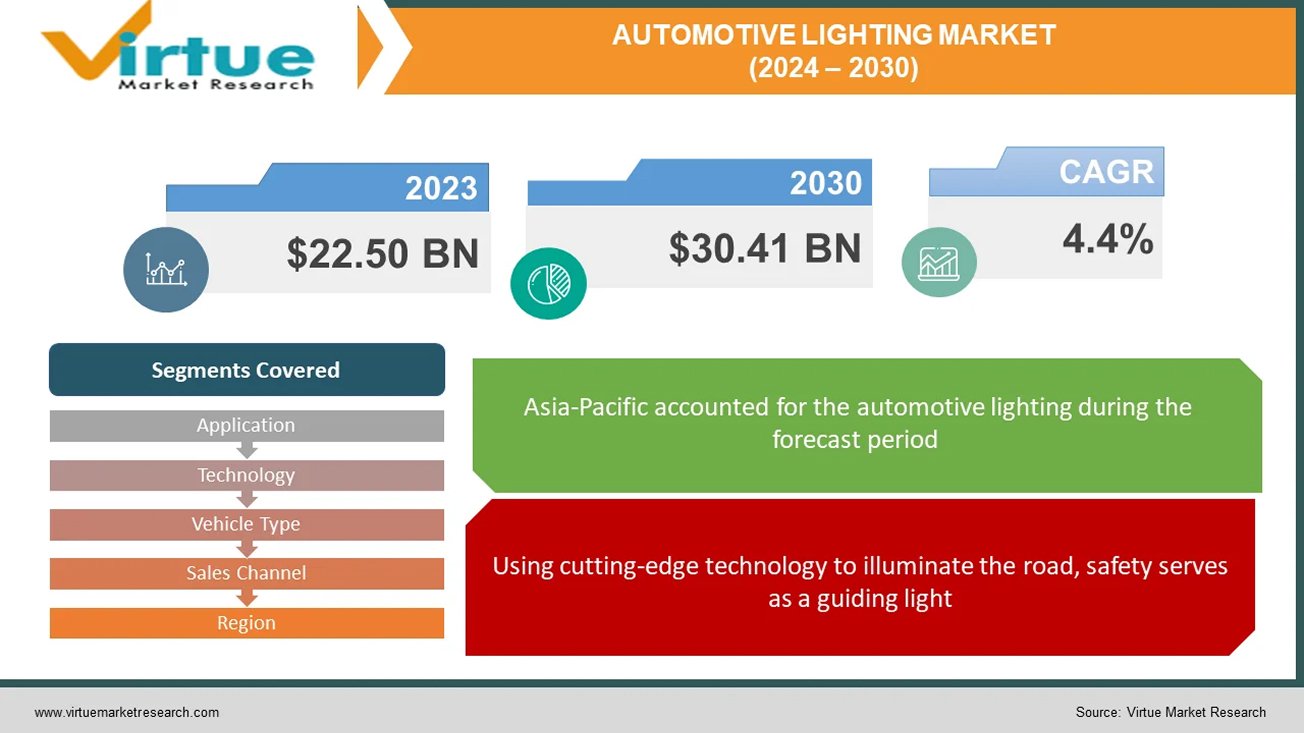
Using cutting-edge technology to illuminate the road, safety serves as a guiding light.
In the market for automobile lighting, safety is the driving force behind demand from the public and laws. While automated high beams smoothly react to traffic, adaptive headlights modify their beams so as not to blind other people. With visually striking displays, dynamic taillights convey intentions for braking and turning. Beyond these developments, integrated pedestrian identification and lane departure alerts will soon make roads safer and brighter for everyone.
Beyond Performance-Based Luxuries Redefined by Light.
Luxurious automobile lighting creates a distinct visual identity that goes beyond simple illumination. Personalized interior lighting customizes the driving experience by setting the mood with a range of colours and intensities, while intricate designs and distinctive DRLs modify exteriors. As you approach your automobile at night, welcoming lights lead the way, resulting in an interior that is perfectly lit. Not only is this symphony of light aesthetically pleasing, but it also stands as a tribute to luxury. Upcoming developments like gesture-controlled lighting and holographic displays promise to further enhance the experience.
Fuel Efficiency Takes the Lead: Illuminating Sustainability
The worldwide automotive lighting market is undergoing a significant transition towards energy-efficient solutions, as environmental concerns gain prominence. LED technology is leading the way, providing a ray of hope for the environment and drivers alike. LED lights beam brighter and use a lot less energy than conventional halogen lamps. There are some tangible advantages to this. For drivers, this translates to increased fuel economy, which lowers petrol prices and lessens reliance on fossil fuels. Greater air quality and a reduction in the transport sector's contribution to climate change are the results of reduced overall emissions.
To Learn more about this report,
Global Automotive Lighting Market Restraints and Challenges:
Although the global automotive lighting business is booming, there are still unknowns. Difficulties impede growth even as innovation propels it with eye catching features like laser beams and adaptable headlights. These technologies are luxury items due to their high cost and difficult integration, which puts producers' abilities to the test. The worldwide patchwork created by unclear legislation limits the potential of innovation. Durability issues persist, particularly when complex systems are subjected to challenging conditions. Ultimately, a lot of drivers still don't fully understand how these improvements can help them. Together, we can overcome these obstacles. The keys to reducing costs are improved production, more seamless integration, and unified regulations. Their full potential can be realized by educating customers about the safety, efficiency, and aesthetic value of these lighting wonders. By working together, we can pave the way for an even brighter and safer future for vehicle lighting.
Global Automotive Lighting Market Opportunities:
It is made possible by advanced LED technology, which gives drivers the ability to customize their illumination for the highest level of comfort and flair. Consumers that care about the environment want greener products, and vehicle lighting complies. While solar- and self-powered lighting technologies offer a future powered by clean energy, energy-efficient LEDs lower pollution. The advent of connected lighting systems heralds a new age. Envision automobiles interacting with infrastructure and one another to minimize accidents and enhance traffic efficiency. Integrated headlights with pedestrian recognition provide unmatched safety, while dramatic taillights with eye-catching displays alert onlookers to your intentions. The possibilities are endless in the future. Gesture-controlled interior illumination, holographic displays projected onto the road, and even light fixtures with self-healing capabilities.
AUTOMOTIVE LIGHTING MARKET REPORT COVERAGE:
To Learn more about this report,
Global Automotive Lighting Market Segmentation: By Application
Exterior Lighting
Interior Lighting
Due to laws requiring safety features like headlights, taillights, and brake lights, exterior lighting presently holds the most market share in the vehicle lighting industry. The dominance of this market is partly attributed to advancements in safety-focused technologies such as adaptive headlights and daytime running lights. The market value of external lighting is increased by the quick adoption of technology like LED bulbs and laser lights, which improve performance and aesthetics. Conversely, the interior lighting market is expected to increase at the fastest rate in the upcoming years. Innovations like ambient lighting and technology breakthroughs like LED and OLED displays, driven by consumer demand for comfort and personalisation, open new possibilities. The spread of sophisticated interior lighting systems is further driven by the growing emphasis on safety and the expansion of the luxury car market.
Global Automotive Lighting Market Segmentation: By Technology
Halogen
LED (Light-Emitting Diode)
Xenon
Emerging Technologies
The worldwide vehicle lighting market is currently dominated by halogen because of its more affordable price, advanced technology, and useful illumination. With its dependable supply chain and affordable option for manufacturers and cost-conscious customers, halogen holds the biggest market share. The fastest-growing market right now is LEDs, which are predicted to shortly overtake halogen. The rapid expansion of LEDs is driven by their higher efficiency, longer lifespan, flexibility in design, and technological breakthroughs including enhanced brightness. Because LEDs use less energy and produce fewer emissions and better fuel economy, they are becoming more and more popular in the changing automotive lighting market.
Global Automotive Lighting Market Segmentation: By Vehicle Type
Passenger Cars
Commercial Vehicles
Passenger automobiles rule the worldwide automotive lighting market. The sheer number of passenger cars produced which surpasses that of business vehicles and fuels the need for lighting systems is the primary cause of this popularity. The growing demand for personal automobiles in developing nations is a result of rising disposable income, which in turn drives the rise of the passenger car market. The importance that consumers place on safety and aesthetics elements helps to drive market expansion. But in the upcoming years, the market for electric and hybrid cars is expected to develop at the quickest rate. The exponential rise of the worldwide electric car market, which is still expanding and shows no signs of slowing down, is what is driving this surge. Specialised lighting solutions are required since electric and hybrid vehicles have different lighting requirements because of their specific functionality and design aesthetics.
Global Automotive Lighting Market Segmentation: By Sales Channel
OEM (Original Equipment Manufacturers)
Aftermarket
Most lighting systems sold nowadays are sold by OEMs (Original Equipment Manufacturers), primarily because manufacturers pre-install lighting systems in new cars. But in the next years, the aftermarket is expected to develop at the quickest rate. This spike in demand for replacement parts, especially lighting systems, can be linked to several variables, one of them being the average age of cars. The industry is expanding because of consumers' growing desire to personalise their cars with aftermarket lighting upgrades such LED upgrades and decorative lighting. The availability and affordability of technologies like adaptive headlights and laser lights in the aftermarket, together with other advancements in lighting technology, are driving demand even more. Moreover, the growing market for electric cars (EVs).
To Learn more about this report,
Global Automotive Lighting Market Segmentation: By Region
North America
Asia-Pacific
Europe
South America
Middle East and Africa
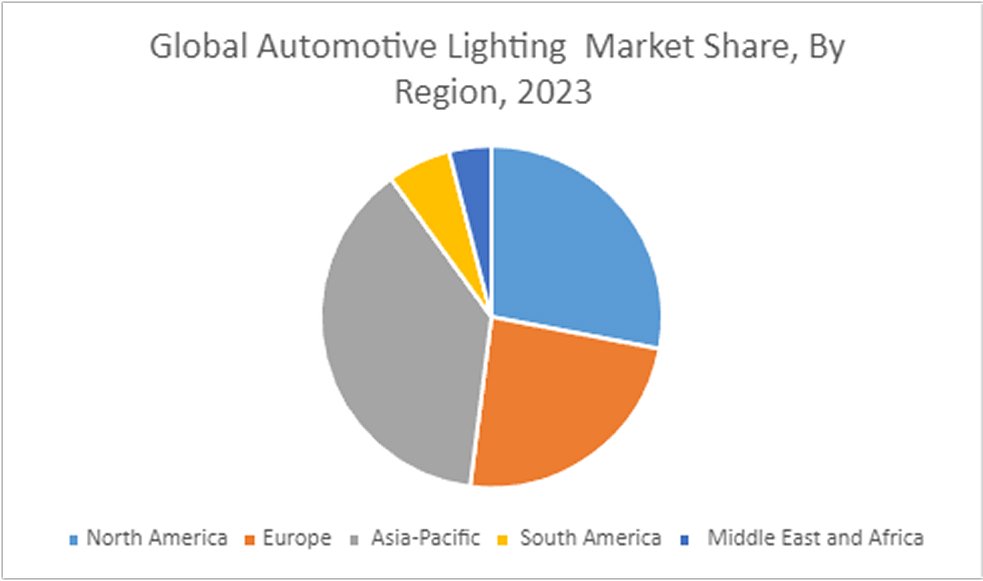
Throughout the forecast period, Asia Pacific is anticipated to be the automotive lighting market with the highest profitability. Over the past few years, Asia Pacific countries like China and India have seen notable increases in automotive manufacturing and sales, primarily in the medium-to premium luxury car segment. Asia Pacific is predicted to see an increase in the manufacturing of passenger cars, with India experiencing the strongest growth rate. Depending on the state of the national economy, the area offers a suitable selection of both high-end and cheap cars. For instance, there is a substantial demand for halogen, Xenon/HID, and LED since China and India produce more economy and mid-range automobiles. On the other hand, luxury car adoption rates are greater in South Korea and Japan, where LED lighting is the norm.
COVID-19 Impact Analysis on the Global Automotive Lighting Market:
A brief shadow was thrown by COVID-19 over the worldwide automotive lighting market. Production was stopped by lockdowns and supply chain disruptions, while luxury lighting upgrades were shelved by consumers on a tight budget. Resources became scarce, and R&D stagnated. Still, the market is recovering thanks to resurgent demand and rearranged priorities. While energy-efficient LEDs are being pushed towards adoption by sustainability, safety concerns are driving interest in features like pedestrian detection and adaptive headlights. The digital push of the epidemic creates opportunities for intelligent, networked lighting systems that may interact with infrastructure and other cars. Ultimately, the industry is positioned to shine brighter, focused on safety, sustainability, and a connected future, even though the pandemic dimmed its brilliance.
Recent Trends and Developments in the Global Automotive Lighting Market:
A development collaboration between OSRAM Continental and REHAU aims to incorporate lighting into external components, providing automobile manufacturers with innovative lighting options that improve functionality and design flexibility. For rear combination lamps, Hella unveiled a revolutionary lighting innovation called Hella FlatLight technology. A Memorandum of Understanding (MoU) was signed by Samvardhana Motherson Automotive Systems Group BV (SMRPBV), a division of Motherson Group, and Marelli Automotive Lighting to investigate a technology collaboration focused on intelligently lighted external body components. Valeo debuted their revolutionary 360° lighting system at the Shanghai Auto Show. This technology surrounds the car with a band of light, projecting instantaneous, clear signs that other drivers can see from a distance. Pedestrians, cyclists, and scooter riders are especially susceptible to these signals
Key Players:
AMS Osram
Cree
Hella
Hyundai Mobis
Koito
Luminus Devices
Magneti Marelli
Osram Licht AG
Stanley Electric
Valeo
Chapter 1. North America Superfood Market– Scope & Methodology
1.1. Market Segmentation
1.2. Scope, Assumptions & Limitations
1.3. Research Methodology
1.4. Primary Sources
1.5. Secondary Sources
Chapter 2. North America Superfood Market – Executive Summary
Fill out the form below and our team will get back to you shortly
FAQ's
Consumers view health as a multifaceted, proactive pursuit encompassing physical and mental well-being. Superfoods align perfectly with this desire for deeply rooted, preventative solutions
Many high-quality superfoods, especially those ethically sourced or with rarer ingredients, command higher prices. This creates an economic barrier, potentially limiting access to a wider demographic.
Report Code: VMR-18738 | Published Date: October 2025 | Format: Excel and PDF
The Middle East and Africa Cold Cuts Market was valued at USD 35.93 billion in 2024 and is projected to reach a market size of USD 110.55 billion by the end of 2030. Over the forecast period of 2025-2030, the market is p...
Report Code: VMR-18663 | Published Date: October 2024 | Format: Excel and PDF
The Arabica Sourced Bioactive Compounds in Coffee Market was valued at USD 340 Million in 2024 and is projected to reach a market size of USD 513 Million by the end of 2030.
Report Code: VMR-15690 | Published Date: August 2023 | Format: Excel and PDF
The Global Online Ready-to-Drink Cocktails Market was valued at USD 8.2 billion in 2024 and will grow at a CAGR of 12% from 2025 to 2030. The market is expected to reach USD 16.2 billion by 2030.
Report Code: VMR-2118 | Published Date: July 2024 | Format: Excel and PDF
The Global Beauty Drinks Market was valued at USD 2.2 billion in 2024 and will grow at a CAGR of 14% from 2025 to 2030. The market is expected to reach USD 4.8 billion by 2030.
Report Code: VMR-1283 | Published Date: March 2024 | Format: Excel and PDF
The global chocolate powdered drinks market was valued at USD 2.92 billion and is projected to reach a market size of USD 5.28 billion by the end of 2030. Over the forecast period of 2024–2030, the market is projected to...
“We received a complex piece of work for our niche market from Virtue Market research in short period of time. I appreciate the quality and content of the final files we received. Thanks for the support”
Medical Devices Company based in Europe
“We received a complex piece of work for our niche market from Virtue Market research in short period of time. I appreciate the quality and content of the final files we received. Thanks for the support”
Medical Devices Company based in Europe
“We received a complex piece of work for our niche market from Virtue Market research in short period of time. I appreciate the quality and content of the final files we received. Thanks for the support”
Medical Devices Company based in Europe
“We received a complex piece of work for our niche market from Virtue Market research in short period of time. I appreciate the quality and content of the final files we received. Thanks for the support”
Medical Devices Company based in Europe
“We received a complex piece of work for our niche market from Virtue Market research in short period of time. I appreciate the quality and content of the final files we received. Thanks for the support”
Medical Devices Company based in Europe
“We received a complex piece of work for our niche market from Virtue Market research in short period of time. I appreciate the quality and content of the final files we received. Thanks for the support”