The Global Online Ready-to-Drink Cocktails Market was valued at USD 8.2 billion in 2024 and will grow at a CAGR of 12% from 2025 to 2030. The market is expected to reach USD 16.2 billion by 2030.
The Online RTD Cocktails Market refers to the digital-first sale and fulfillment of premixed, packaged alcoholic cocktails—such as canned margaritas, spritzes, highballs, and hard seltzer-style offerings—through direct-to-consumer brand sites, online liquor retailers, marketplaces, and on-demand delivery apps. Growth is propelled by convenience, expanding flavor portfolios, premiumization, and evolving alcohol commerce regulations that increasingly accommodate e-commerce and rapid delivery. As consumers seek bar-quality experiences at home and on the go, online channels enable discovery, personalization, and subscription models while giving producers data-rich feedback to optimize portfolio, pricing, and targeted marketing.
Key market insights:
Online RTD cocktail penetration reached about 24% of total RTD value sales in 2024 across leading e-commerce alcohol markets.
Premium and super-premium SKUs represented roughly 38% of online RTD cocktail revenue, outpacing value tiers by more than 2:1 in growth.
Variety packs generated approximately 29% of online volume due to trial behavior and gifting occasions.
Subscription and auto-replenishment programs contributed near 11% of online revenue, with average churn falling below 8% after three months.
Flavored vodka and tequila-based RTDs accounted for about 46% of spirits-based online sales in 2024, led by lime, pineapple, grapefruit, and spicy variants.
Low-calorie and low-sugar claims appeared on about 41% of top-selling online SKUs, supporting health-conscious positioning.
Same-day delivery covered roughly 63% of orders in dense urban zones, with median delivery times under 90 minutes.
Brand-owned DTC stores achieved average order values 18–22% higher than marketplace orders due to bundling, exclusives, and upsell mechanics.
Premiumisation remains one of the leading RTD alcohol trends for 2025, with consumers increasingly looking for sophisticated and complex flavour profiles in ready-to-drink cocktails, as well as innovation in packaging and branding to offer “bar-quality” experiences in canned or bottled formats.
Global Online Ready-to-Drink Cocktails Market Drivers
Accelerating need for ultra-fast, last-mile fulfillment is driving the market growth
Consumer expectations in beverage alcohol have shifted toward immediacy, mirroring food delivery benchmarks. Online buyers increasingly plan consumption within the same day or evening, making speed a competitive differentiator and a key conversion lever. RTD cocktails are well suited to rapid fulfillment because they are shelf-stable, portion-controlled, and typically packaged for safe transport. Operators can densify micro-fulfillment nodes and dark stores with high-velocity SKUs, enabling efficient picking and courier routing. Cold-chain is optional for most SKUs, reducing logistics complexity versus draft cocktails or fresh mixers. As on-demand delivery networks expand coverage and improve batching algorithms, the relative cost to serve per order declines, supporting margin protection even at small basket sizes common to alcohol occasions. Retailers and platforms are also integrating age-verification APIs, ID scanning at drop-off, and restricted-hours delivery windows, streamlining compliance without undermining speed. Festivals, parties, and spontaneous gatherings further benefit from rapid restock capabilities, reinforcing repeat purchase behavior. In suburban and exurban zones, scheduled next-day delivery paired with order-ahead promotions addresses longer route geometries while sustaining experience quality. Altogether, the convergence of compressed delivery windows, product suitability, operational learnings from quick-commerce, and compliance tech has turned last-mile excellence into a structural growth engine for online RTD cocktails during 2025–2030.
Expanding premiumization and flavor innovation online is driving the market growth
Digital shelves make it easy to merchandise higher-margin SKUs, tell brand stories, and rotate limited releases—conditions that favor premiumization. Consumers browsing on mobile or desktop see detailed tasting notes, ABV visibility, calorie counts, and mixology cues that reinforce trade-up. RTDs have evolved from simple spirit-plus-soda formats to cocktail-bar inspirations: spicy margaritas, espresso martinis, palomas, mojito twists, Negroni-style spritzers, and tropical riffs using real juice concentrates. Seasonal drops and collabs with bartenders, influencers, and restaurants drive urgency, while data from click-throughs and reviews informs fast product iteration. Multipacks encourage exploration across flavor flights, boosting basket value and cohort stickiness. The premium trend coincides with better inputs—higher-quality spirits, natural flavors, botanical extracts, and reduced-sugar bases—elevating taste and perceived healthfulness. Packaging upgrades such as matte finishes, sleek slim cans, and recyclable cartons reinforce positioning. Online channels also accommodate broader ABV ladders, from alcohol-free mocktail lines to sessionable 4–6% and spirit-forward 8–12%, allowing precise targeting of occasions. As consumers seek bar-quality experiences at home, premiumized RTDs occupy the middle ground between mixology kits and delivery cocktails, capturing willingness to pay without the prep friction.
Global Online Ready-to-Drink Cocktails Market Challenges and Restraints
Cross-jurisdiction complexity, compliance costs, and channel conflict are restricting the market growth
The alcohol category remains one of the most regulated consumer markets, and rules differ widely by country, state, and municipality. Brands face a patchwork of licensing, shipping restrictions, dry hours, and proof-of-age standards that complicate national online rollouts. Building compliant paths-to-consumer often requires juggling DTC, three-tier retail partners, local delivery intermediaries, and click-and-collect. Each route adds cost layers, data fragmentation, and operational overhead. Channel conflict also emerges as suppliers pursue DTC margins while needing retailer support for scale and in-store visibility. Retailers may resist marketplace participation or prefer private-label RTDs with better unit economics. Marketing is constrained by platform policies and audience gating, raising customer acquisition costs compared with non-restricted categories. Returns handling and failed deliveries are costly due to re-verification and restocking requirements. In cross-border contexts, excise tax treatment, labeling mandates, and recycling deposits (for cans) further complicate assortments. Collectively, compliance management, channel governance, and the need to maintain equitable relationships across the value chain act as brakes on otherwise robust online growth, especially for smaller producers without dedicated legal and regulatory resources.
Market opportunities
A substantial opportunity lies in building differentiated, data-driven portfolios that align ABV, calories, flavor intensity, and pack sizes with specific occasions and cohorts. Online journeys surface first-party signals—browse depth, flavor affinities, time-of-day ordering, and responsiveness to bundle prompts—that can inform agile innovation calendars and limited releases calibrated to demand spikes. Subscription programs can be tiered by discovery intensity: rotating seasonal flights for explorers, foundational classics for dependable replenishment, and guest collaborations for social buzz. Another opportunity is omnichannel orchestration. Brands that harmonize DTC exclusives with retailer marketplace presence can maximize reach while segmenting assortments to avoid conflict, for example reserving high-ABV or craft collaborations for owned channels and sending mainstream flavors to national e-retailers. Partnerships with music festivals, sports, and streaming platforms create shoppable moments synced to live events, while recipe content and mix-and-match builders increase average order value. International expansion offers runway where regulation permits, especially with portable, compliant packaging and multilingual PDPs. Sustainability is an expanding growth wedge: light-weighting cans, increasing recycled content, and transparent carbon disclosures resonate with eco-minded shoppers and win retail media features. Finally, advanced last-mile design—micro-fulfillment, regional 3PL nodes, and dynamic ETA messaging—can elevate experience and reduce cost-to-serve, unlocking durable retention advantages over less integrated competitors.
Global, Regional & Country Level Analysis, Segment-Level Analysis, DROC, PESTLE Analysis, Porter’s Five Forces Analysis, Competitive Landscape, Analyst Overview on Investment Opportunities
Regional Scope
North America, Europe, APAC, Latin America, Middle East & Africa
Key Companies Profiled
Diageo, Bacardi, Pernod Ricard, AB InBev (Cutwater), E. & J. Gallo (High Noon), Beam Suntory, Brown-Forman, Boston Beer, Mark Anthony Brands, Molson Coors, Campari, Sazerac.
Functional and better-for-you RTDs (low sugar, natural)
The most dominant product segment is spirits-based canned cocktails. Their leadership reflects broad flavor range, clear occasion fit, and strong brand equity transferred from parent spirits labels. Online, these SKUs benefit from high search intent for classic cocktails, compelling PDP storytelling, and bundling flexibility across ABV tiers and flavor flights, which lifts conversion and repeat. (120 words)
Online Ready-to-Drink Cocktails Market By Application
Brand direct-to-consumer online stores
Online liquor retailers and marketplaces
On-demand delivery apps and quick-commerce
Subscription boxes and curated clubs
Corporate gifting and event party packs
Click-and-collect and retail ship-from-store
The most dominant application segment is on-demand delivery apps and quick-commerce. This channel wins because it compresses the decision-to-consumption gap for social occasions, supports ID-verified handoff, and offers wide coverage through courier networks. For RTD cocktails, immediacy outweighs assortment breadth, and algorithmic merchandising surfaces high-velocity SKUs at peak times. Integrated promos, dynamic ETAs, and localized assortments further drive frequency.
• North America
• Europe
• Asia‑Pacific
• Latin America
• Middle East & Africa
North America is the dominant region for online RTD cocktails through 2025–2030. The region combines high digital grocery penetration, advanced last-mile networks, and strong brand portfolios across spirits and FMBs. State-level reforms and delivery-friendly policies have broadened lawful channels, while investment in retail media accelerates trial at the digital shelf. Consumers show strong receptivity to premium flavors and variety packs, supporting trade-up and basket expansion. Robust data infrastructure lets brands optimize assortments by city, occasion, and season, aligning inventory with demand spikes around holidays, sports, and festivals. Mature 3PL ecosystems enable two-hour and same-day fulfillment in dense metros and scheduled next-day service in suburbs. Meanwhile, collaborations between major suppliers, convenience chains, and delivery platforms extend reach and convenience. Collectively, these dynamics anchor North America’s leadership during the forecast horizon.
COVID-19 Impact Analysis on the Online Ready-to-Drink Cocktails Market
The pandemic materially accelerated at-home cocktail occasions and normalized alcohol e-commerce behavior. Lockdowns closed bars and compressed out-of-home socializing, pushing consumers toward convenient, mixology-quality formats they could store and serve with minimal effort. RTD cocktails matched the moment: portion-controlled cans, familiar flavors, and consistent quality without equipment. On the supply side, brands shifted innovation roadmaps toward portable formats and broadened flavor lines to capture new palates. Retailers built curbside pickup and ship-from-store capabilities, while delivery platforms scaled age-verified handoff, expanding coverage to additional neighborhoods. As restrictions eased, the category retained a significant share of its gains because shoppers formed habits around digital discovery, subscriptions, and spontaneous reorders before gatherings. Importantly, the pandemic prompted regulators to pilot temporary allowances for delivery and to clarify rules for adult-beverage e-commerce, laying groundwork for longer-term frameworks. It also exposed fragility in glass supply and canning capacity, nudging brands to diversify packaging and logistics partners. While on-premise channels reopened, hybrid behaviors persisted: consumers alternated between bar visits and home entertaining, keeping RTDs relevant across weeks. The net effect was a structural uplift in online penetration, a richer innovation cadence, and improved logistics tooling that together established a new baseline from which the category continues to grow.
Latest trends/Developments
Flavor architecture is getting bolder, with heat-plus-citrus profiles, tropical riffs, espresso and dessert-inspired variants, and bitters-forward spritzers showing sustained momentum. Producers are refining sweetness balance and carbonation to elevate sessionability, while introducing premium inputs such as barrel-aged bases, real juices, and botanical distillates. Packaging innovation centers on slim-can ergonomics, textured finishes, and recyclable secondary cartons; QR-enabled cans unlock tasting notes, playlist tie-ins, and loyalty enrollment at scan. Health-minded lines are expanding, including low-sugar, gluten-free, and lower-ABV options positioned for weekday occasions, alongside zero-proof mocktails targeting sober-curious communities. On the commercial side, retail media and creator collaborations are powering limited drops and timed bundles. Operators are adopting contribution-margin analytics, geo-segmented assortments, and AI-assisted demand shaping to defend profitability amid rising media costs. Rapid delivery is moving to hybrid models: micro-fulfillment for urban cores complemented by regional 3PL nodes for broader reach. Sustainability is graduating from claims to measurable targets, with can light-weighting, recycled content, and transparent carbon reporting influencing retail placement. Internationally, cross-border compliant assortments and localized copy are helping brands test new markets with controlled risk. Together, these developments point to a category maturing in taste, brand building, and operational discipline, while keeping discovery and convenience at its core.
Key Players:
Diageo
Bacardi Limited
Pernod Ricard
Anheuser-Busch InBev (Cutwater Spirits)
E. & J. Gallo Winery (High Noon)
Beam Suntory
Brown-Forman
The Boston Beer Company (Truly)
Mark Anthony Brands (White Claw)
Molson Coors Beverage Company
Campari Group
Sazerac Company
Market News
Coca-Cola Company – Dec 2024
Coca-Cola acquired the RTD spirits range from Australian brand Billson’s. This acquisition gives Coca-Cola a stronger foothold in the domestic RTD market in Australia as it seeks to expand its alcoholic ready-to-drink portfolio.
To Learn more about this report,
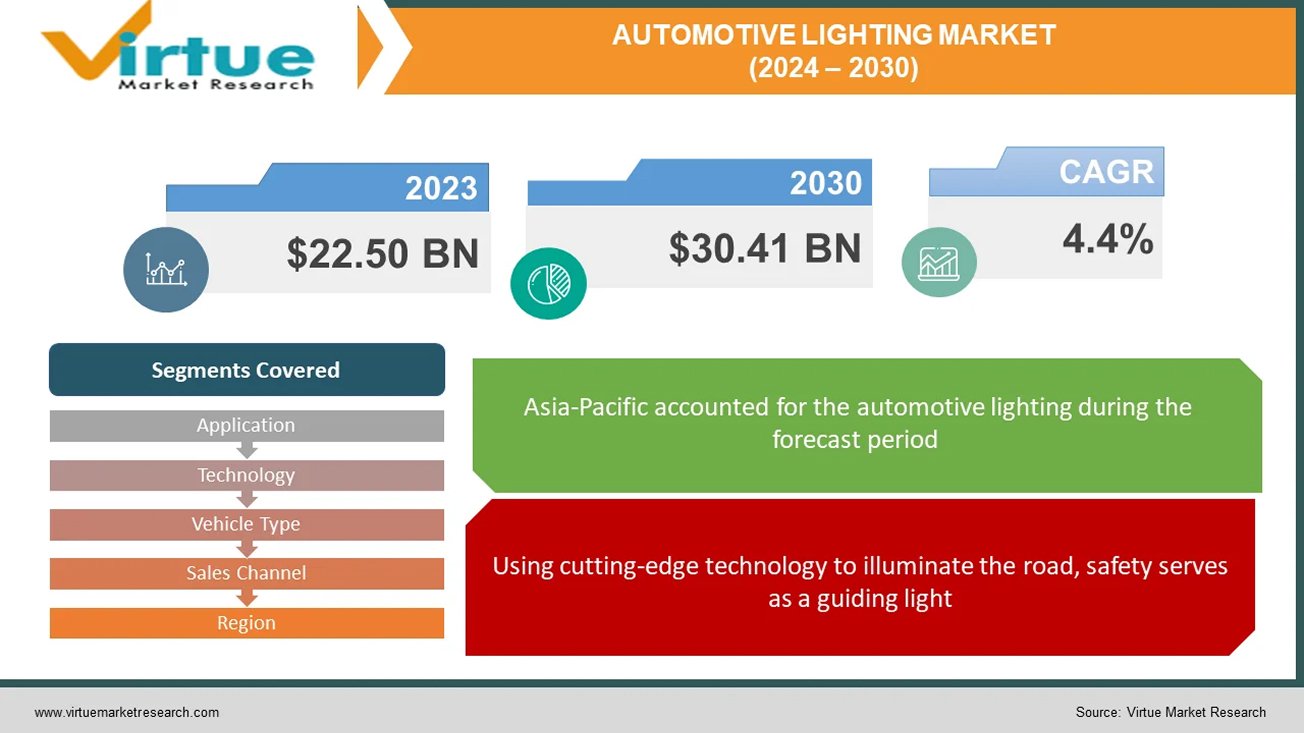
Global automotive lighting refers to all vehicle lighting systems, from headlamps that illuminate the road to taillights that communicate movements. They guarantee motorists and other road users alike safety, visibility, and style. While taillights frequently use LEDs for improved visibility, headlights are available in a variety of technologies, including LED and laser. Interior illumination, DRLs, and signal lights all have a role to play. This market, which was estimated to be worth $33.64 billion in 2022, is anticipated to rise to $67.39 billion by 2030 because of laws, luxury tastes, safety concerns, and technological developments like OLED taillights and adaptive headlights. Anticipate a future dominated by intelligent, connected, personalized, and sustainable lighting systems that enhance the safety, efficiency, and aesthetic appeal of automobiles.
Key Market Insights:
Car lighting works its magic to provide safety, visibility, and style. Headlights cut through the night, taillights express intent, and interiors shine with comfort. The billion-dollar global business is expected to rise due to consumer demand for high-end experiences, safer roads, and cutting-edge technology. Imagine dynamic messages being painted by taillights, headlights that adjust to the road, and interiors that customize their atmosphere. Driven by technological advancements like linked systems and laser beams, this future is calling. Anticipate even more visually attractive, environmentally friendly, and intelligent lighting to illuminate the way ahead, making cars safer, more efficient, and unquestionably cooler.
Global Automotive Lighting Market Drivers:
Using cutting-edge technology to illuminate the road, safety serves as a guiding light.
In the market for automobile lighting, safety is the driving force behind demand from the public and laws. While automated high beams smoothly react to traffic, adaptive headlights modify their beams so as not to blind other people. With visually striking displays, dynamic taillights convey intentions for braking and turning. Beyond these developments, integrated pedestrian identification and lane departure alerts will soon make roads safer and brighter for everyone.
Beyond Performance-Based Luxuries Redefined by Light.
Luxurious automobile lighting creates a distinct visual identity that goes beyond simple illumination. Personalized interior lighting customizes the driving experience by setting the mood with a range of colours and intensities, while intricate designs and distinctive DRLs modify exteriors. As you approach your automobile at night, welcoming lights lead the way, resulting in an interior that is perfectly lit. Not only is this symphony of light aesthetically pleasing, but it also stands as a tribute to luxury. Upcoming developments like gesture-controlled lighting and holographic displays promise to further enhance the experience.
Fuel Efficiency Takes the Lead: Illuminating Sustainability
The worldwide automotive lighting market is undergoing a significant transition towards energy-efficient solutions, as environmental concerns gain prominence. LED technology is leading the way, providing a ray of hope for the environment and drivers alike. LED lights beam brighter and use a lot less energy than conventional halogen lamps. There are some tangible advantages to this. For drivers, this translates to increased fuel economy, which lowers petrol prices and lessens reliance on fossil fuels. Greater air quality and a reduction in the transport sector's contribution to climate change are the results of reduced overall emissions.
To Learn more about this report,
Global Automotive Lighting Market Restraints and Challenges:
Although the global automotive lighting business is booming, there are still unknowns. Difficulties impede growth even as innovation propels it with eye catching features like laser beams and adaptable headlights. These technologies are luxury items due to their high cost and difficult integration, which puts producers' abilities to the test. The worldwide patchwork created by unclear legislation limits the potential of innovation. Durability issues persist, particularly when complex systems are subjected to challenging conditions. Ultimately, a lot of drivers still don't fully understand how these improvements can help them. Together, we can overcome these obstacles. The keys to reducing costs are improved production, more seamless integration, and unified regulations. Their full potential can be realized by educating customers about the safety, efficiency, and aesthetic value of these lighting wonders. By working together, we can pave the way for an even brighter and safer future for vehicle lighting.
Global Automotive Lighting Market Opportunities:
It is made possible by advanced LED technology, which gives drivers the ability to customize their illumination for the highest level of comfort and flair. Consumers that care about the environment want greener products, and vehicle lighting complies. While solar- and self-powered lighting technologies offer a future powered by clean energy, energy-efficient LEDs lower pollution. The advent of connected lighting systems heralds a new age. Envision automobiles interacting with infrastructure and one another to minimize accidents and enhance traffic efficiency. Integrated headlights with pedestrian recognition provide unmatched safety, while dramatic taillights with eye-catching displays alert onlookers to your intentions. The possibilities are endless in the future. Gesture-controlled interior illumination, holographic displays projected onto the road, and even light fixtures with self-healing capabilities.
AUTOMOTIVE LIGHTING MARKET REPORT COVERAGE:
To Learn more about this report,
Global Automotive Lighting Market Segmentation: By Application
Exterior Lighting
Interior Lighting
Due to laws requiring safety features like headlights, taillights, and brake lights, exterior lighting presently holds the most market share in the vehicle lighting industry. The dominance of this market is partly attributed to advancements in safety-focused technologies such as adaptive headlights and daytime running lights. The market value of external lighting is increased by the quick adoption of technology like LED bulbs and laser lights, which improve performance and aesthetics. Conversely, the interior lighting market is expected to increase at the fastest rate in the upcoming years. Innovations like ambient lighting and technology breakthroughs like LED and OLED displays, driven by consumer demand for comfort and personalisation, open new possibilities. The spread of sophisticated interior lighting systems is further driven by the growing emphasis on safety and the expansion of the luxury car market.
Global Automotive Lighting Market Segmentation: By Technology
Halogen
LED (Light-Emitting Diode)
Xenon
Emerging Technologies
The worldwide vehicle lighting market is currently dominated by halogen because of its more affordable price, advanced technology, and useful illumination. With its dependable supply chain and affordable option for manufacturers and cost-conscious customers, halogen holds the biggest market share. The fastest-growing market right now is LEDs, which are predicted to shortly overtake halogen. The rapid expansion of LEDs is driven by their higher efficiency, longer lifespan, flexibility in design, and technological breakthroughs including enhanced brightness. Because LEDs use less energy and produce fewer emissions and better fuel economy, they are becoming more and more popular in the changing automotive lighting market.
Global Automotive Lighting Market Segmentation: By Vehicle Type
Passenger Cars
Commercial Vehicles
Passenger automobiles rule the worldwide automotive lighting market. The sheer number of passenger cars produced which surpasses that of business vehicles and fuels the need for lighting systems is the primary cause of this popularity. The growing demand for personal automobiles in developing nations is a result of rising disposable income, which in turn drives the rise of the passenger car market. The importance that consumers place on safety and aesthetics elements helps to drive market expansion. But in the upcoming years, the market for electric and hybrid cars is expected to develop at the quickest rate. The exponential rise of the worldwide electric car market, which is still expanding and shows no signs of slowing down, is what is driving this surge. Specialised lighting solutions are required since electric and hybrid vehicles have different lighting requirements because of their specific functionality and design aesthetics.
Global Automotive Lighting Market Segmentation: By Sales Channel
OEM (Original Equipment Manufacturers)
Aftermarket
Most lighting systems sold nowadays are sold by OEMs (Original Equipment Manufacturers), primarily because manufacturers pre-install lighting systems in new cars. But in the next years, the aftermarket is expected to develop at the quickest rate. This spike in demand for replacement parts, especially lighting systems, can be linked to several variables, one of them being the average age of cars. The industry is expanding because of consumers' growing desire to personalise their cars with aftermarket lighting upgrades such LED upgrades and decorative lighting. The availability and affordability of technologies like adaptive headlights and laser lights in the aftermarket, together with other advancements in lighting technology, are driving demand even more. Moreover, the growing market for electric cars (EVs).
To Learn more about this report,
Global Automotive Lighting Market Segmentation: By Region
North America
Asia-Pacific
Europe
South America
Middle East and Africa
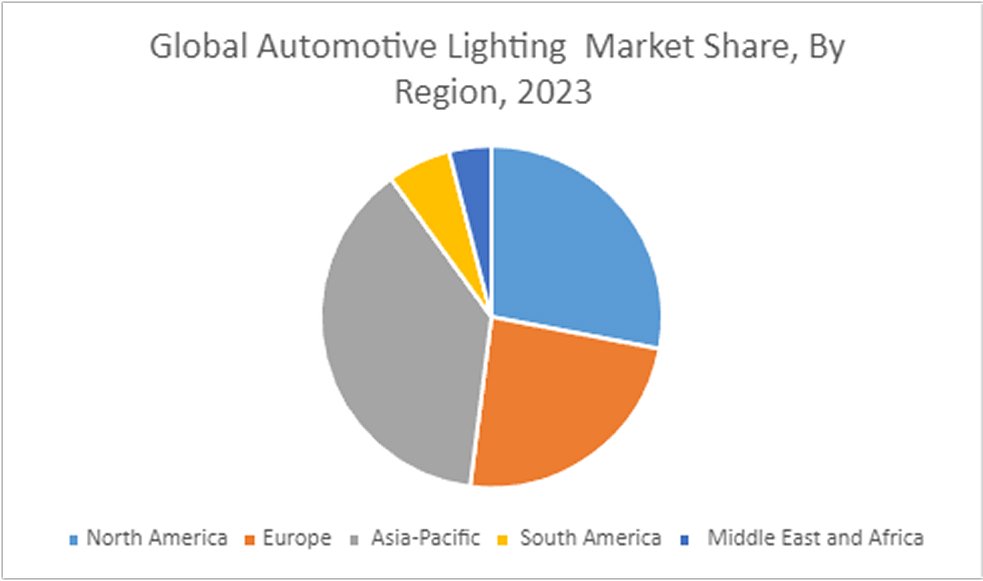
Throughout the forecast period, Asia Pacific is anticipated to be the automotive lighting market with the highest profitability. Over the past few years, Asia Pacific countries like China and India have seen notable increases in automotive manufacturing and sales, primarily in the medium-to premium luxury car segment. Asia Pacific is predicted to see an increase in the manufacturing of passenger cars, with India experiencing the strongest growth rate. Depending on the state of the national economy, the area offers a suitable selection of both high-end and cheap cars. For instance, there is a substantial demand for halogen, Xenon/HID, and LED since China and India produce more economy and mid-range automobiles. On the other hand, luxury car adoption rates are greater in South Korea and Japan, where LED lighting is the norm.
COVID-19 Impact Analysis on the Global Automotive Lighting Market:
A brief shadow was thrown by COVID-19 over the worldwide automotive lighting market. Production was stopped by lockdowns and supply chain disruptions, while luxury lighting upgrades were shelved by consumers on a tight budget. Resources became scarce, and R&D stagnated. Still, the market is recovering thanks to resurgent demand and rearranged priorities. While energy-efficient LEDs are being pushed towards adoption by sustainability, safety concerns are driving interest in features like pedestrian detection and adaptive headlights. The digital push of the epidemic creates opportunities for intelligent, networked lighting systems that may interact with infrastructure and other cars. Ultimately, the industry is positioned to shine brighter, focused on safety, sustainability, and a connected future, even though the pandemic dimmed its brilliance.
Recent Trends and Developments in the Global Automotive Lighting Market:
A development collaboration between OSRAM Continental and REHAU aims to incorporate lighting into external components, providing automobile manufacturers with innovative lighting options that improve functionality and design flexibility. For rear combination lamps, Hella unveiled a revolutionary lighting innovation called Hella FlatLight technology. A Memorandum of Understanding (MoU) was signed by Samvardhana Motherson Automotive Systems Group BV (SMRPBV), a division of Motherson Group, and Marelli Automotive Lighting to investigate a technology collaboration focused on intelligently lighted external body components. Valeo debuted their revolutionary 360° lighting system at the Shanghai Auto Show. This technology surrounds the car with a band of light, projecting instantaneous, clear signs that other drivers can see from a distance. Pedestrians, cyclists, and scooter riders are especially susceptible to these signals
Key Players:
AMS Osram
Cree
Hella
Hyundai Mobis
Koito
Luminus Devices
Magneti Marelli
Osram Licht AG
Stanley Electric
Valeo
Chapter 1. Online Ready-to-Drink (RTD) Cocktails Market – SCOPE & METHODOLOGY
1.1. Market Segmentation
1.2. Scope, Assumptions & Limitations
1.3. Research Methodology
1.4. Primary Sources.
1.5. Secondary Sources Chapter 2. ONLINE READY-TO-DRINK (RTD) COCKTAILS MARKET – EXECUTIVE SUMMARY
2.1. Market Size & Forecast – (2025 – 2030) ($M/$Bn)
2.2. Key Trends & Insights
2.2.1. Demand Side
2.2.2. Supply Side
2.3. Attractive Investment Propositions
2.4. COVID-19 Impact Analysis Chapter 3. ONLINE READY-TO-DRINK (RTD) COCKTAILS MARKET – COMPETITION SCENARIO
3.1. Market Share Analysis & Company Benchmarking
3.2. Competitive Strategy & Development Scenario
3.3. Competitive Pricing Analysis
3.4. Supplier-Distributor Analysis Chapter 4. ONLINE READY-TO-DRINK (RTD) COCKTAILS MARKET - ENTRY SCENARIO
4.1. Regulatory Scenario
4.2. Case Studies – Key Start-ups
4.3. Customer Analysis
4.4. PESTLE Analysis
4.5. Porters Five Force Model
4.5.1. Bargaining Online Ready-to-Drink (RTD) Cocktails of Suppliers
4.5.2. Bargaining Risk Analytics s of Customers
4.5.3. Threat of New Entrants
4.5.4. Rivalry among Existing Players
4.5.5. Threat of Substitutes Players
4.5.6. Threat of Substitutes Chapter 5. ONLINE READY-TO-DRINK (RTD) COCKTAILS MARKET - LANDSCAPE
5.1. Value Chain Analysis – Key Stakeholders Impact Analysis
5.2. Market Drivers
5.3. Market Restraints/Challenges
5.4. Market Opportunities Chapter 6. ONLINE READY-TO-DRINK (RTD) COCKTAILS MARKET – By Product
6.1 Introduction/Key Findings
6.2 Spirits-based canned cocktails (vodka, tequila, gin, rum)
6.3 Wine-based spritzers and coolers
6.4 Hard seltzer-style cocktail variants
6.5 Low- and no-alcohol RTD mocktails
6.6 Premium craft and limited-release batches
6.7 Functional and better-for-you RTDs (low sugar, natural)
6.8 Y-O-Y Growth trend Analysis By Product
6.9 Absolute $ Opportunity Analysis By Product , 2025-2030
Chapter 7. ONLINE READY-TO-DRINK (RTD) COCKTAILS MARKET – By Application
7.1 Introduction/Key Findings
7.2 Brand direct-to-consumer online stores
7.3 Online liquor retailers and marketplaces
7.4 On-demand delivery apps and quick-commerce
7.5 Subscription boxes and curated clubs
7.6 Corporate gifting and event party packs
7.7 Click-and-collect and retail ship-from-store
7.8 Y-O-Y Growth trend Analysis By Application
7.9 Absolute $ Opportunity Analysis By Application , 2025-2030
Chapter 8. ONLINE READY-TO-DRINK (RTD) COCKTAILS MARKET - By Geography – Market Size, Forecast, Trends & Insights
8.1. North America
8.1.1. By Country
8.1.1.1. U.S.A.
8.1.1.2. Canada
8.1.1.3. Mexico
8.1.2. By Application
8.1.3. By Product
8.1.4. Countries & Segments - Market Attractiveness Analysis
8.2. Europe
8.2.1. By Country
8.2.1.1. U.K.
8.2.1.2. Germany
8.2.1.3. France
8.2.1.4. Italy
8.2.1.5. Spain
8.2.1.6. Rest of Europe
8.2.2. By Product
8.2.3. By Application
8.2.4. Countries & Segments - Market Attractiveness Analysis
8.3. Asia Pacific
8.3.1. By Country
8.3.1.1. China
8.3.1.2. Japan
8.3.1.3. South Korea
8.3.1.4. India
8.3.1.5. Australia & New Zealand
8.3.1.6. Rest of Asia-Pacific
8.3.2. By Product
8.3.3. By Application
8.3.4. Countries & Segments - Market Attractiveness Analysis
8.4. South America
8.4.1. By Country
8.4.1.1. Brazil
8.4.1.2. Argentina
8.4.1.3. Colombia
8.4.1.4. Chile
8.4.1.5. Rest of South America
8.4.2. By Product
8.4.3. By Application
8.4.4. Countries & Segments - Market Attractiveness Analysis
8.5. Middle East & Africa
8.5.1. By Country
8.5.1.1. United Arab Emirates (UAE)
8.5.1.2. Saudi Arabia
8.5.1.3. Qatar
8.5.1.4. Israel
8.5.1.5. South Africa
8.5.1.6. Nigeria
8.5.1.7. Kenya
8.5.1.8. Egypt
8.5.1.8. Rest of MEA
8.5.2. By Product
8.5.3. By Application
8.5.4. Countries & Segments - Market Attractiveness Analysis
9.1 Diageo
9.2 Bacardi Limited
9.3 Pernod Ricard
9.4 Anheuser-Busch InBev (Cutwater Spirits)
9.5 E. & J. Gallo Winery (High Noon)
9.6 Beam Suntory
9.7 Brown-Forman
9.8 The Boston Beer Company (Truly)
9.9 Mark Anthony Brands (White Claw)
9.10 Molson Coors Beverage Company
9.11 Campari Group
9.12 Sazerac Company
Fill out the form below and our team will get back to you shortly
FAQ's
The Global Online Ready-to-Drink Cocktails Market was valued at USD 8.2 billion in 2024 and will grow at a CAGR of 12% from 2025 to 2030. The market is expected to reach USD 16.2 billion by 2030.
Fast last-mile fulfillment, flavor-led premiumization, and regulatory modernization plus mature e-commerce rails.
By product: spirits-based, wine-based, hard-seltzer variants, low/no-alcohol, premium craft, functional. By application: DTC, online retailers/marketplaces, on-demand delivery, subscriptions, gifting, click-and-collect.
North America, supported by strong e-commerce adoption, delivery networks, brand portfolios, and retail media sophistication.
Diageo, Bacardi, Pernod Ricard, AB InBev (Cutwater), E. & J. Gallo (High Noon), Beam Suntory, Brown-Forman, Boston Beer, Mark Anthony Brands, Molson Coors, Campari, Sazerac.
More related reports
Get expert-driven market research reports from a leading research partner to help you navigate the future of the global industry.
Report Code: VMR-18738 | Published Date: October 2025 | Format: Excel and PDF
The Middle East and Africa Cold Cuts Market was valued at USD 35.93 billion in 2024 and is projected to reach a market size of USD 110.55 billion by the end of 2030. Over the forecast period of 2025-2030, the market is p...
Report Code: VMR-18663 | Published Date: October 2024 | Format: Excel and PDF
The Arabica Sourced Bioactive Compounds in Coffee Market was valued at USD 340 Million in 2024 and is projected to reach a market size of USD 513 Million by the end of 2030.
Report Code: VMR-2118 | Published Date: July 2024 | Format: Excel and PDF
The Global Beauty Drinks Market was valued at USD 2.2 billion in 2024 and will grow at a CAGR of 14% from 2025 to 2030. The market is expected to reach USD 4.8 billion by 2030.
Report Code: VMR-1283 | Published Date: March 2024 | Format: Excel and PDF
The global chocolate powdered drinks market was valued at USD 2.92 billion and is projected to reach a market size of USD 5.28 billion by the end of 2030. Over the forecast period of 2024–2030, the market is projected to...
Report Code: VMR-11523 | Published Date: March 2024 | Format: Excel and PDF
The global fermented dairy ingredients market was valued at USD 5.62 billion and is projected to reach a market size of USD 9.95 billion by the end of 2030. Over the forecast period of 2024–2030, the market is projected...
“We received a complex piece of work for our niche market from Virtue Market research in short period of time. I appreciate the quality and content of the final files we received. Thanks for the support”
Medical Devices Company based in Europe
“We received a complex piece of work for our niche market from Virtue Market research in short period of time. I appreciate the quality and content of the final files we received. Thanks for the support”
Medical Devices Company based in Europe
“We received a complex piece of work for our niche market from Virtue Market research in short period of time. I appreciate the quality and content of the final files we received. Thanks for the support”
Medical Devices Company based in Europe
“We received a complex piece of work for our niche market from Virtue Market research in short period of time. I appreciate the quality and content of the final files we received. Thanks for the support”
Medical Devices Company based in Europe
“We received a complex piece of work for our niche market from Virtue Market research in short period of time. I appreciate the quality and content of the final files we received. Thanks for the support”
Medical Devices Company based in Europe
“We received a complex piece of work for our niche market from Virtue Market research in short period of time. I appreciate the quality and content of the final files we received. Thanks for the support”