Smart Traffic Management Market Research Report – Segmentation By Solution (Traffic Monitoring System, Traffic Signal Control System, Traffic Enforcement Camera, Incident Detection & Management, Journey Time Measurement System), By Component (Hardware, Software, Services), By Deployment Mode (Cloud-based, On-premises), By End-Use Industry (Government & Defense, Transport & Logistics, Commercial), and Region - Size, Share, Growth Analysis | Forecast (2025– 2030)
The Global Smart Traffic Management Market was valued at USD 12 billion and is projected to reach a market size of USD 25 billion by the end of 2030. Over the forecast period of 2025-2030, the market is projected to grow at a CAGR of 15.81%.
Driven by demand for real-time analytics and AI-enabled decision-making, software led with around 40% market share in 2024. By way of solution, Traffic Monitoring Systems accounted for over 23 % of revenues, highlighting the essential need for real-time traffic data streams. Driven by supportive policies like the U.S. Infrastructure Investment and Jobs Act and the EU's C-ITS deployment guidelines, interoperable traffic-management solutions are being developed.
Key Market Insights:
Driven by investments in adaptive signal controls and video-based flow analysis, Traffic Monitoring Systems had the biggest share, 21.4 %, in 2024.
As V2X communications and smartphone app integrations mature, the Intelligent Driver Information System will be the fastest-expanding sub-segment.
With 38.7 % of 2024 revenues, North America tops Asia-Pacific is the fastest-growing region expected to reach USD 6.46 billion by 2030, fueled by China's smart-city initiatives and India's metro-corridor deployments.
Smart Traffic Management Market Drivers:
The rising demand for real-time traffic information is driving the growth of this market.
Massive sensor-and-camera networks spanning urban corridors are being driven by transportation authorities and commuters' growing dependence on constant live feeds to reduce congestion and handle occurrences. Strong consumer demand for real-time routing and traffic warnings is highlighted by navigation apps alone generating USD 16.2 billion in revenue in 2022 and projected to reach USD 36.6 billion by 2028 (CAGR 14.8 %). Together, transmitting granular traffic telemetry every second, Google Maps commands 1.8 billion monthly users; Waze adds hundreds of millions more. Intelligent-traffic-camera deployments, integral to these systems, are forecast to grow at a 14.6 % CAGR, hitting USD 23.4 billion by 2030. Beyond mobile, OEM-embedded real-time traffic modules now equip over 40 % of new vehicles, feeding data back to municipal control centers for dynamic signal adjustments. In pilot programs, the use of high-resolution video analytics at junctions accelerates emergency-vehicle preemption, cutting response times by up to 25 %. Compared with minutes with legacy loop detectors, crowd-sourced congestion maps now update central Traffic Management Centers (TMCs) in under five seconds. Robust APIs (e.g., DATEX II, NTCIP) ensure interoperability across multi-vendor ecosystems, fueling expansion into Smart City frameworks.
The recent initiatives taken by the governments for making cities smart are helping to drive the growth of this market.
Intelligent-transportation systems are being funded in unprecedented amounts all around. Including ATMS deployments and corridor-management systems, the Connecting Europe Facility set aside €7 billion in 2023 in the EU for sustainable, safe, and smart transport projects under Horizon Europe's 2021–2027 work programme. Funding research and pilot implementations of traffic-management solutions in 100 cities by 2030, €15.3 billion is dedicated to the The 2021 Infrastructure Investment and Jobs Act in the United States calls for a total infrastructure spending of USD 1.2 trillion, with USD 350 billion set aside for federal highway projects and discretionary grants (e.g., ATTAIN, SMART) for advanced transportation technologies including AI-driven signal systems. Beijing's 2024 "Vehicle-Road-Cloud Integration" pilot, which spans 20 cities (incl. Beijing, Shanghai), aims to standardize V2I platforms by 2026. Through AI-powered signal control, Alibaba's City Brain in Hangzhou has reduced congestion speeds by 15% and improved emergency-response flow by 20%. Ride-hail giant DiDi's smart-transportation lab optimized 30+ intersections near Beijing airport, cutting nighttime delays by 20% and demonstrating scalable ITS solutions.
The rapid urbanization and the growth in the number of vehicles have led to an increased demand for this market.
Traffic patterns are being changed as more people live in cities. With 55 % of the world's population now living in urban areas, expected to rise to 68 % by 2050, and 90 % in Asia and Africa, adding 2.5 billion more urban dwellers will be significant. Driven by unprecedented vehicle demand, the global passenger-vehicle fleet reached 1.7 billion units in 2023 and is projected to exceed 2 billion by 2030, outpacing road capacity expansions. Urban sprawl and secondary cities exacerbate congestion hotspots, with megacities (>10 million) increasing from 31 to over 43, straining legacy signal networks. In London, rush-hour commuters face an average daily delay of 46 minutes, highlighting severe speed reduction (from 24 km/h to 18 km/h). Average commuting times might grow by 20–30 % by 2030 without sophisticated traffic-management countermeasures, therefore driving urgent demand for AI-enabled signal control and dynamic rerouting platforms.
The convergence of AI, IoT, and 5G has helped in revolutionizing the market, being a major market driver.
Smart Traffic Management is being transformed by the conjunction of IoT, AI, and 5 G. By end-2023, enterprise IoT links are projected to grow from 10.7 billion to 38.5 billion by 2030, supporting dense arrays of road sensors, RFID tags, and GPS trackers that provide detailed telemetry into management systems. With 1.6 billion connections expected by end-2023 and projected to cover 56% of global mobile subscriptions by 2030, 5G has outrun all other previous cellular generations and enables ultra-reliable low-latency communications essential for V2X and edge analytics. Edge-compute nodes co-located with RSUs (roadside units) reduce data-round-trip latency by 90% compared to cloud-only systems, thus enabling sub-100-ms AI-driven signal optimizations and real-time AR-guided maintenance. Google's "Project Green Light," live in 70+ intersections across 13 cities, combines AI models with Google Maps driving trends to fine-tune signal timing, thereby reducing stop-and-go events by 30% and intersection emissions by 10% in Seattle pilots and similar gains in Boston. Predictive congestion forecasting using AI analytics layer multi-modal data (vehicles, cyclists, pedestrians) enables signal preemption for transit and emergency vehicles with millisecond-level accuracy. Corporations and municipalities are currently embedding C-V2X modules for direct vehicle-to-infrastructure messaging, therefore augmenting cloud APIs with edge intelligence to create green-wave corridors and support eventual autonomous-vehicle coordination.
Smart Traffic Management Market Restraints and Challenges:
The high level of implementation cost associated with the market acts as a major challenge faced by this market.
Depending on sensor density and system complexity, upfront integration of adaptive-signal hardware and AI analytics can range from USD 50,000 to USD 200,000 each intersection. Basic ACS Lite installations run USD 6,000–8,000; full-scale SCOOT installations could top USD 60,000 per junction. Though big-scale rollouts could negotiate volume discounts, the U.S. DOT estimates an average ACS cost of USD 30,000 each intersection. To handle deployments and maintenance, smaller municipalities may need to employ specialized ITS engineers, costing USD 100,000–300,000 each year, each team member. Coordinated signal systems' maintenance adds annual per-intersection costs ranging from USD 200 to USD 300 to reflect software updates and diagnostics. Annual maintenance should be 2–5% of asset replacement value (RAV), according to industry standards. This amounts to a significant recurring OpEx. Predictive analytics can lower maintenance costs by 30% through proactive issue detection, but more IoT monitoring is needed. State and local governments allocate 44% of highway budgets to operations, maintenance, repairs, and system upkeep—thereby highlighting ongoing financial obligations. Especially in critical infrastructure situations, McKinsey says maintenance can account for 20–60% of total OpEx. Smaller municipalities are put off from adopting ITS due to high combined CAPEX and OpEx and limited local budgets (typically 6–7% of general funds). Daily savings of USD 25,900 from a 13-intersection ACS were shown by AECOM validation in Maricopa County, therefore illustrating that ROI often demands long deployment horizons. ITS upgrades are usually postponed to match road repair cycles, therefore delaying modernization. Without grant funding or PPP models, high costs constitute the primary obstacle to greater ITS dispersal, therefore deepening a digital divide between major metros and lesser suburbs.
The high risk related to the security of data and its privacy hampers the growth of the market.
Intelligent-traffic systems heighten privacy and security concerns by aggregating vast streams of high-resolution video and precise geolocation data, both regulated as personal data under GDPR. Underlining real-world vulnerabilities, security researchers at DEF CON demonstrated remote hacking of traffic signals via spoofed cyclist detection. Strict lawful-processing, data-minimization, and user-consent regimes for location and vehicle data are mandated by GDPR, adding compliance layers and documentation burdens. With implementation and monitoring costs of US$ $ 10,000–25,000 and US$ $ 5,000–30,000 respectively, GDPR certification costs range from € 5,000 to € 100,000. Reflecting the stakes of ITS data incidents, IBM’s 2024 Cost of a Data Breach Report pegs the average breach cost at USD 4.88 million, the highest on record. ITS breaches can disrupt signals, tolls, and signage, causing accidents, congestion, and economic losses far exceeding system costs. The U.S. NHTSA warns that C-V2X and roadside-unit integrations require robust certificate management and encryption, adding 15–20% to system costs. End-to-end encryption for video and communications further raises complexity and Opex. The EU AI Act (effective Aug 2024) requires transparency logs and risk assessments for general-purpose AI, extending legal review cycles by 8–12 weeks. Major cyberattacks were experienced by 94% of IT leaders, according to a Techtimes analysis, pressuring IT projects to embed advanced security measures. Global cybersecurity staffing shortages—reported by 70% of CISOs—compound the challenge of securing ITS deployments over time. As a result, quarterly penetration tests and multi-vendor security audits inflate Opex by 10–15%, further slowing adoption.
The market faces challenges due to the compatibility issues related to the legacy infrastructure.
Lacking standard interfaces and plug support for contemporary ITS parts, most municipal traffic-management systems depend on older cabinets and proprietary signal controllers placed decades ago. An FHWA case study revealed that coordinated systems upgraded five dispersed actuated signals needed six to nine months of custom middleware development, testing, and field verification. To accommodate AI analytics and remote-update modules, traffic signal cabinets—often 120 V legacy units—must either have hardware retrofits or complete replacement. Integrations require bespoke API connectors to span older controllers (e.g., Econolite ASC/3) and current cloud platforms, therefore increasing engineering effort and expenses. Academic studies show that 90% of ITS integration problems come from incompatible data formats and conflicting security between legacy and contemporary systems. Hiring outside experts to manage these integrations might theoretically increase project costs by 20 to 30 percent and lengthen schedules. Legacy CCTV networks need extra transcoding equipment to connect with AI video analytics servers, therefore increasing cost. Most implementations are customized because there are no global standards like NTCIP 1202, therefore, economies of scale are impeded.
The existence of strict rules and regulations slows down market growth by hampering its reach.
Strict rules govern public-sector ITS purchases (e.g., U.S. FAR, EU Procurement Directive), requiring multi-stage RFPs, pre-bid workshops, and technical evaluations, usually extending cycles to 8–12 weeks from posting to award. Average RFP processes, excluding pre-planning time, range from 10 to 16 weeks, according to Graphite Connect. Due to transparency and oversight requirements, government IT acquisitions take 180 days on average, three times longer than private-sector cycles. Service delays and maintenance backlogs have been attributed to procurement red tape by high-profile transit agencies like Charlotte CATS. Each funding source (federal grants, local taxes, bonds) follows a different approval schedule, adding 4–6 weeks to align budgets. Although some pilot projects use "creative procurement" exemptions, complete deployments go back to official tender procedures, reintroducing long cycles. State tender boards report up to 25% of ITS bids stall over incomplete applications in India, therefore causing vendor uncertainty. Fiscal-year mismatches between local and national administrations result in multi-quarter financing gaps before contract awards.
Smart Traffic Management Market Opportunities:
The emergence of connected and autonomous vehicles (CAV) presents a great growth opportunity for this market.
CAVs request real-time signal priority using Vehicle-to-everything (V2X) communications, hence greatly improving emergency response and lowering intersection conflicts. V2X platforms help manage congestion and cut accidents by up to 20% in trial corridors by connecting road users—cars, bicycles, and pedestrians- to infrastructure via ITS-S roadside units. Edge-AI integrations examine telemetry at the roadside and activate dynamic green-wave corridors that let first-responders traverse several junctions without stopping, thereby improving public transit timeliness by 15%. Commercial V2X devices (C-V2X) now feed back signal-controller status to cars, verifying green-light activations within 50 ms and so enhancing travel-time reliability. By 2030, the combination of AI-driven control algorithms with ITS-S roadside sensors will enable completely autonomous intersection passage, therefore defining a multibillion-dollar development vector for ITS vendors.
Strict rules regarding the environment have given rise to eco-traffic solutions, helping the market to expand its operations.
Eco-traffic systems, which use AI-optimized signal timing and corridor management to cut idle time and CO₂ output by up to 20% per route, are being adopted under strict carbon-emission regulations and corporate ESG targets. MDPI simulations confirm that smart lights at a single intersection can lower local CO₂ emissions between 32% and 40%, depending on traffic density, and boost vehicle speed by up to 101%. Real-time adaptive control platforms integrate roadway sensors, weather data, and emission forecasts to dynamically adjust signal phases, achieving city-wide CO₂ cuts of 15–20% in early deployments. Digital-twin models let planners test eco-corridor scenarios offline, optimizing green-wave timings that minimize stop-and-go cycles and reduce fleet fuel consumption by 10–15%. V2X-enabled eco-routing further guides connected vehicles along low-emission trajectories, reducing network-wide GHG emissions by up to 43% in agent-based simulations. Large-scale eco-signal rollouts paid for public-private partnerships in cities such as Gothenburg and Oslo show return on investment (ROI) through reduced citywide gasoline use and better air quality indices.
The emergence of SaaS and Managed Services models is revolutionizing this market.
Opex-friendly SaaS and managed-services packages are reducing entry barriers and allowing smaller cities to implement Smart Traffic Management without significant CapEx. Rather than investing USD 50,000–200,000 per intersection in outright hardware purchases, municipalities can subscribe to AI-driven signal-control software for USD 2,000–5,000 per month, covering real-time data integration, analytics, and remote updates. This shift is exemplified by Parsons' iNET platform, built on Microsoft Azure, which provides traffic-control capabilities, predictive-maintenance alerts, and cloud-hosted dashboards under a single subscription, therefore reducing lifetime TCO by 30%. Managed services levels include 24×7 monitoring, on-demand feature upgrades, and cybersecurity patches, critical for jurisdictions lacking in-house IT expertise. Vendors are offering premium-tier AI-ops solutions with custom model-training and fast SLA guarantees, as digital-twin and AI-analytics modules become more complex, therefore driving a services-driven revenue boom.
The increased proliferation of 5G networks has helped the market to grow at a faster pace.
With latency cut from hundreds of milliseconds to under 50 ms, 5G networks and edge-compute infrastructure are enabling genuine real-time traffic control. Global 5G connections surpassed 1.6 billion by end-2023 and are expected to cover 56% of mobile subscriptions by 2030, therefore offering the foundation for ultra-reliable V2X and over-the-air signal adjustments. Simultaneously, enterprise IoT implementations expanded from 10.7 billion connections in 2023 to an anticipated 38.5 billion by 2030, driving dense roadside sensor grids that feed edge nodes for local analytics. On-site processing of video analytics and loop-detector data by edge computing nodes co-located at traffic cabinets lowers cloud round-trip latency by 90% in comparison to cloud-only solutions. Across over 70+ intersections, edge AI combined with 5G in Seattle's Project Green Light adjusted timings in under 30 ms, therefore decreasing stops by 30% and emissions by 10%.
SMART TRAFFIC MANAGEMENT MARKET REPORT COVERAGE:
REPORT METRIC
DETAILS
Market Size Available
2024 - 2030
Base Year
2024
Forecast Period
2025 - 2030
CAGR
15.81%
Segments Covered
By solution, component, deployment mode, end user industry, and Region
Various Analyses Covered
Global, Regional & Country Level Analysis, Segment-Level Analysis, DROC, PESTLE Analysis, Porter’s Five Forces Analysis, Competitive Landscape, Analyst Overview on Investment Opportunities
Regional Scope
North America, Europe, APAC, Latin America, Middle East & Africa
Key Companies Profiled
Siemens AG, Cisco Systems Inc., IBM Corporation, Kapsch TrafficCom AG, Cubic Corporation, Iteris Inc., Q-Free ASA, Hitachi Ltd., TomTom International BV, Huawei Technologies Co. Ltd.
Smart Traffic Management Market Segmentation:
Smart Traffic Management Market Segmentation: By Solution
Traffic Monitoring System
Traffic Signal Control System
Incident Management & Control System
Journey Time Measurement System
Cameras, loop detectors, and IoT sensors make up traffic monitoring systems (TMS), dominating with more than 23 % revenue share because of critical real-time data gathering. Adaptive signal controllers and centralized management software make traffic signal control systems (TSCS) the fastest-growing, as municipalities upgrade to AI-driven signal timing. Moderate development is seen in the Incident Management and Control system as agencies increase safety programs. Journey Time Measurement Systems (JTMS) includes probe data and license-plate recognition; it is a niche segment but expanding due to performance benchmarking.
Smart Traffic Management Market Segmentation: By Component
Hardware
Software
Services
Hardware dominates the market; cameras, sensors, and controllers come under this. Reflecting emphasis on sophisticated analytics, software analytics solutions, and AI engines, held about 40% share. The services segment is the fastest-growing in the market, it includes integration, maintenance, and consulting. It is the fastest-growing at 20.1 % CAGR through 2030, driven by project complexity and the need for ongoing support. The software segment consists of AI engines, analytics platforms. It gives priority to advanced analytics.
Smart Traffic Management Market Segmentation: By Deployment Mode
Cloud-based
On-premises
The Cloud-based segment dominates this market, at 67 % revenue share in 2024, for its scalability and reduced CapEx. The on-premises segment is said to be the fastest-growing one, as governments and organizations seek data sovereignty and ultra-low latency, comparable to smart-highway initiatives.
Smart Traffic Management Market Segmentation: By End-Use Industry
Government & Defense
Transport & Logistics
Commercial
The government segment dominates the market due to safety regulations and public sector funding. The Transport & Logistics segment is the fastest-growing segment as airlines combine traffic data to maximize routes, minimize dwelling times, and lower fuel expenses. Retail campuses, ports, and industrial areas using customized ITS technologies at moderate speed come under the Commercial segment of the market.
Smart Traffic Management Market Segmentation: By Region
North America
Asia-Pacific
Europe
South America
Middle East and Africa
North America is the leader of the market, strong vendor presence and developed ITS infrastructure help it to dominate this market. The Asia-Pacific region is said to be the fastest-growing segment, which is due to urbanization and extensive government infrastructure initiatives. The European region is driven mostly by EU rules and smart-city subsidies. Whereas, the South America and the MEA regions are said to be the emerging markets, although they have a very small share.
COVID-19 Impact Analysis on the Global Smart Traffic Management Market:
Smart traffic management implementations were significantly postponed across the board owing to the COVID-19 pandemic. Lockdowns caused up to a 60% fall in traffic volumes, which led to a change in priority from congestion relief to public-health and emergency routing applications. Although proactive coordination prevented extended shutdowns, supply-chain interruptions delayed vital equipment deliveries, and major projects like the I-24 Smart Corridor Phase 2 experienced material shortages and cost overruns. Due to circuit-breaker restrictions and worldwide chip scarcity, Singapore's ERP 2.0 on-board unit rollout was postponed several times. As local finances were redirected to pandemic response, large-scale smart-city projects, including Google's Sidewalk Labs Toronto district plan, were halted or scaled down. Health-safety policies cut down field-service teams, therefore delaying upkeep and installations. On the other hand, the epidemic boosted remote-monitoring use, which stimulated funds for V2I safety uses for emergency vehicles. The stimulus funding, especially in the U.S. Infrastructure Act, revived tender issuances, which grew by almost 30% year-on-year for traffic management contracts. COVID-19 highlighted the strategic need for resilient, data-driven traffic systems, driving redefined commitments to ITS upgrading even though it caused short-term setbacks and financial pressures.
Latest Trends/ Developments:
Google's Project Green Light pilot in Seattle, the first such program in North America, employs AI to change signal timing in real time, therefore lowering stops by 30% and CO₂ emissions by 10%.
With response times falling below 50 ms in test deployments, the low latency of 5G networks in combination with edge-compute nodes allows real-time incident detection and flexible signal control.
DOTs are using V2X communication standards (e.g., C-V2X) to enhance traffic efficiency and safety; U.S. NHTSA estimates V2V systems might at least 13 % lower collisions with widespread use.
By pre-testing alternative traffic flows, cities are producing digital twins of road networks, virtual replicas driven by IoT data to simulate scenarios (e.g., road closures, event surges) and achieve up to 25 % faster disruption response.
Key Players:
Siemens AG
Cisco Systems Inc.
IBM Corporation
Kapsch TrafficCom AG
Cubic Corporation
Iteris Inc.
Q-Free ASA
Hitachi Ltd.
TomTom International BV
Huawei Technologies Co. Ltd.
To Learn more about this report,
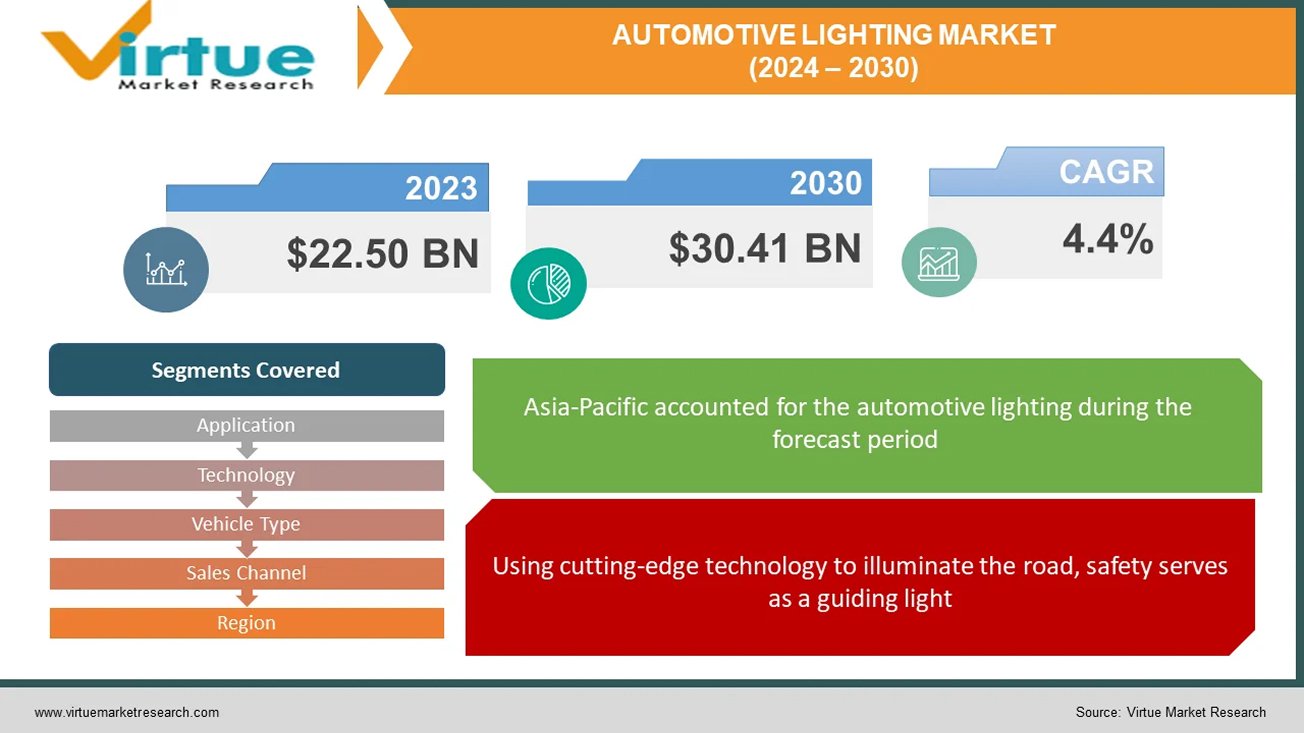
Global automotive lighting refers to all vehicle lighting systems, from headlamps that illuminate the road to taillights that communicate movements. They guarantee motorists and other road users alike safety, visibility, and style. While taillights frequently use LEDs for improved visibility, headlights are available in a variety of technologies, including LED and laser. Interior illumination, DRLs, and signal lights all have a role to play. This market, which was estimated to be worth $33.64 billion in 2022, is anticipated to rise to $67.39 billion by 2030 because of laws, luxury tastes, safety concerns, and technological developments like OLED taillights and adaptive headlights. Anticipate a future dominated by intelligent, connected, personalized, and sustainable lighting systems that enhance the safety, efficiency, and aesthetic appeal of automobiles.
Key Market Insights:
Car lighting works its magic to provide safety, visibility, and style. Headlights cut through the night, taillights express intent, and interiors shine with comfort. The billion-dollar global business is expected to rise due to consumer demand for high-end experiences, safer roads, and cutting-edge technology. Imagine dynamic messages being painted by taillights, headlights that adjust to the road, and interiors that customize their atmosphere. Driven by technological advancements like linked systems and laser beams, this future is calling. Anticipate even more visually attractive, environmentally friendly, and intelligent lighting to illuminate the way ahead, making cars safer, more efficient, and unquestionably cooler.
Global Automotive Lighting Market Drivers:
Using cutting-edge technology to illuminate the road, safety serves as a guiding light.
In the market for automobile lighting, safety is the driving force behind demand from the public and laws. While automated high beams smoothly react to traffic, adaptive headlights modify their beams so as not to blind other people. With visually striking displays, dynamic taillights convey intentions for braking and turning. Beyond these developments, integrated pedestrian identification and lane departure alerts will soon make roads safer and brighter for everyone.
Beyond Performance-Based Luxuries Redefined by Light.
Luxurious automobile lighting creates a distinct visual identity that goes beyond simple illumination. Personalized interior lighting customizes the driving experience by setting the mood with a range of colours and intensities, while intricate designs and distinctive DRLs modify exteriors. As you approach your automobile at night, welcoming lights lead the way, resulting in an interior that is perfectly lit. Not only is this symphony of light aesthetically pleasing, but it also stands as a tribute to luxury. Upcoming developments like gesture-controlled lighting and holographic displays promise to further enhance the experience.
Fuel Efficiency Takes the Lead: Illuminating Sustainability
The worldwide automotive lighting market is undergoing a significant transition towards energy-efficient solutions, as environmental concerns gain prominence. LED technology is leading the way, providing a ray of hope for the environment and drivers alike. LED lights beam brighter and use a lot less energy than conventional halogen lamps. There are some tangible advantages to this. For drivers, this translates to increased fuel economy, which lowers petrol prices and lessens reliance on fossil fuels. Greater air quality and a reduction in the transport sector's contribution to climate change are the results of reduced overall emissions.
To Learn more about this report,
Global Automotive Lighting Market Restraints and Challenges:
Although the global automotive lighting business is booming, there are still unknowns. Difficulties impede growth even as innovation propels it with eye catching features like laser beams and adaptable headlights. These technologies are luxury items due to their high cost and difficult integration, which puts producers' abilities to the test. The worldwide patchwork created by unclear legislation limits the potential of innovation. Durability issues persist, particularly when complex systems are subjected to challenging conditions. Ultimately, a lot of drivers still don't fully understand how these improvements can help them. Together, we can overcome these obstacles. The keys to reducing costs are improved production, more seamless integration, and unified regulations. Their full potential can be realized by educating customers about the safety, efficiency, and aesthetic value of these lighting wonders. By working together, we can pave the way for an even brighter and safer future for vehicle lighting.
Global Automotive Lighting Market Opportunities:
It is made possible by advanced LED technology, which gives drivers the ability to customize their illumination for the highest level of comfort and flair. Consumers that care about the environment want greener products, and vehicle lighting complies. While solar- and self-powered lighting technologies offer a future powered by clean energy, energy-efficient LEDs lower pollution. The advent of connected lighting systems heralds a new age. Envision automobiles interacting with infrastructure and one another to minimize accidents and enhance traffic efficiency. Integrated headlights with pedestrian recognition provide unmatched safety, while dramatic taillights with eye-catching displays alert onlookers to your intentions. The possibilities are endless in the future. Gesture-controlled interior illumination, holographic displays projected onto the road, and even light fixtures with self-healing capabilities.
AUTOMOTIVE LIGHTING MARKET REPORT COVERAGE:
To Learn more about this report,
Global Automotive Lighting Market Segmentation: By Application
Exterior Lighting
Interior Lighting
Due to laws requiring safety features like headlights, taillights, and brake lights, exterior lighting presently holds the most market share in the vehicle lighting industry. The dominance of this market is partly attributed to advancements in safety-focused technologies such as adaptive headlights and daytime running lights. The market value of external lighting is increased by the quick adoption of technology like LED bulbs and laser lights, which improve performance and aesthetics. Conversely, the interior lighting market is expected to increase at the fastest rate in the upcoming years. Innovations like ambient lighting and technology breakthroughs like LED and OLED displays, driven by consumer demand for comfort and personalisation, open new possibilities. The spread of sophisticated interior lighting systems is further driven by the growing emphasis on safety and the expansion of the luxury car market.
Global Automotive Lighting Market Segmentation: By Technology
Halogen
LED (Light-Emitting Diode)
Xenon
Emerging Technologies
The worldwide vehicle lighting market is currently dominated by halogen because of its more affordable price, advanced technology, and useful illumination. With its dependable supply chain and affordable option for manufacturers and cost-conscious customers, halogen holds the biggest market share. The fastest-growing market right now is LEDs, which are predicted to shortly overtake halogen. The rapid expansion of LEDs is driven by their higher efficiency, longer lifespan, flexibility in design, and technological breakthroughs including enhanced brightness. Because LEDs use less energy and produce fewer emissions and better fuel economy, they are becoming more and more popular in the changing automotive lighting market.
Global Automotive Lighting Market Segmentation: By Vehicle Type
Passenger Cars
Commercial Vehicles
Passenger automobiles rule the worldwide automotive lighting market. The sheer number of passenger cars produced which surpasses that of business vehicles and fuels the need for lighting systems is the primary cause of this popularity. The growing demand for personal automobiles in developing nations is a result of rising disposable income, which in turn drives the rise of the passenger car market. The importance that consumers place on safety and aesthetics elements helps to drive market expansion. But in the upcoming years, the market for electric and hybrid cars is expected to develop at the quickest rate. The exponential rise of the worldwide electric car market, which is still expanding and shows no signs of slowing down, is what is driving this surge. Specialised lighting solutions are required since electric and hybrid vehicles have different lighting requirements because of their specific functionality and design aesthetics.
Global Automotive Lighting Market Segmentation: By Sales Channel
OEM (Original Equipment Manufacturers)
Aftermarket
Most lighting systems sold nowadays are sold by OEMs (Original Equipment Manufacturers), primarily because manufacturers pre-install lighting systems in new cars. But in the next years, the aftermarket is expected to develop at the quickest rate. This spike in demand for replacement parts, especially lighting systems, can be linked to several variables, one of them being the average age of cars. The industry is expanding because of consumers' growing desire to personalise their cars with aftermarket lighting upgrades such LED upgrades and decorative lighting. The availability and affordability of technologies like adaptive headlights and laser lights in the aftermarket, together with other advancements in lighting technology, are driving demand even more. Moreover, the growing market for electric cars (EVs).
To Learn more about this report,
Global Automotive Lighting Market Segmentation: By Region
North America
Asia-Pacific
Europe
South America
Middle East and Africa
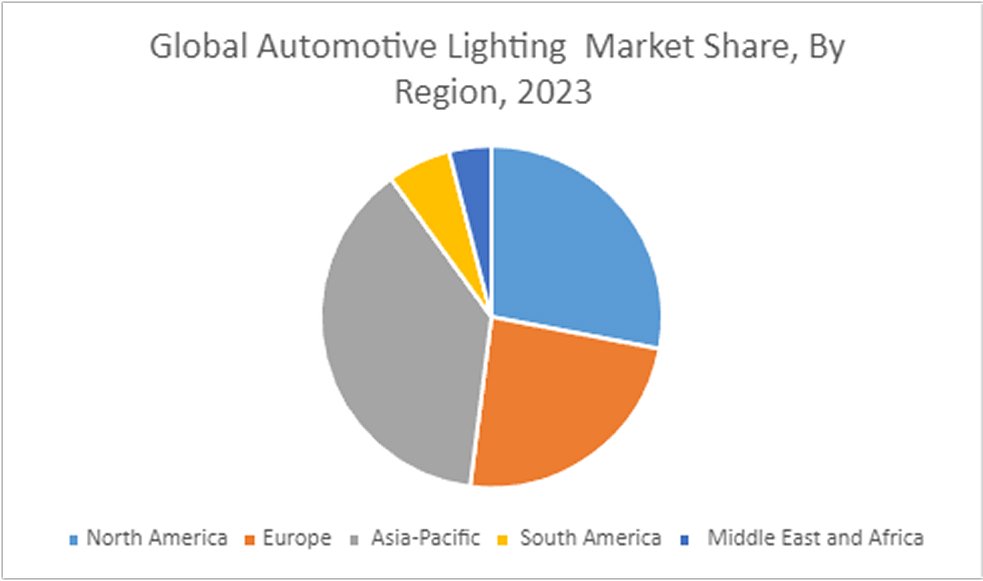
Throughout the forecast period, Asia Pacific is anticipated to be the automotive lighting market with the highest profitability. Over the past few years, Asia Pacific countries like China and India have seen notable increases in automotive manufacturing and sales, primarily in the medium-to premium luxury car segment. Asia Pacific is predicted to see an increase in the manufacturing of passenger cars, with India experiencing the strongest growth rate. Depending on the state of the national economy, the area offers a suitable selection of both high-end and cheap cars. For instance, there is a substantial demand for halogen, Xenon/HID, and LED since China and India produce more economy and mid-range automobiles. On the other hand, luxury car adoption rates are greater in South Korea and Japan, where LED lighting is the norm.
COVID-19 Impact Analysis on the Global Automotive Lighting Market:
A brief shadow was thrown by COVID-19 over the worldwide automotive lighting market. Production was stopped by lockdowns and supply chain disruptions, while luxury lighting upgrades were shelved by consumers on a tight budget. Resources became scarce, and R&D stagnated. Still, the market is recovering thanks to resurgent demand and rearranged priorities. While energy-efficient LEDs are being pushed towards adoption by sustainability, safety concerns are driving interest in features like pedestrian detection and adaptive headlights. The digital push of the epidemic creates opportunities for intelligent, networked lighting systems that may interact with infrastructure and other cars. Ultimately, the industry is positioned to shine brighter, focused on safety, sustainability, and a connected future, even though the pandemic dimmed its brilliance.
Recent Trends and Developments in the Global Automotive Lighting Market:
A development collaboration between OSRAM Continental and REHAU aims to incorporate lighting into external components, providing automobile manufacturers with innovative lighting options that improve functionality and design flexibility. For rear combination lamps, Hella unveiled a revolutionary lighting innovation called Hella FlatLight technology. A Memorandum of Understanding (MoU) was signed by Samvardhana Motherson Automotive Systems Group BV (SMRPBV), a division of Motherson Group, and Marelli Automotive Lighting to investigate a technology collaboration focused on intelligently lighted external body components. Valeo debuted their revolutionary 360° lighting system at the Shanghai Auto Show. This technology surrounds the car with a band of light, projecting instantaneous, clear signs that other drivers can see from a distance. Pedestrians, cyclists, and scooter riders are especially susceptible to these signals
Key Players:
AMS Osram
Cree
Hella
Hyundai Mobis
Koito
Luminus Devices
Magneti Marelli
Osram Licht AG
Stanley Electric
Valeo
Chapter 1. SMART TRAFFIC MANAGEMENT MARKET– Scope & Methodology
1.1. Market Segmentation
1.2. Scope, Assumptions & Limitations
1.3. Research Methodology
1.4. Primary Sources`
1.5. Secondary Sources Chapter 2. SMART TRAFFIC MANAGEMENT MARKET– Executive Summary
2.1. Market Size & Forecast – (2025 – 2030) ($M/$Bn)
2.2. Key Trends & Insights
2.2.1. Demand Side
2.2.2. Supply Side
2.3. Attractive Investment Propositions
2.4. COVID-19 Impact Analysis Chapter 3. SMART TRAFFIC MANAGEMENT MARKET– Competition Scenario
3.1. Market Share Analysis & Company Benchmarking
3.2. Competitive Strategy & Development Scenario
3.3. Competitive Pricing Analysis
3.4. Supplier-Distributor Analysis Chapter 4. SMART TRAFFIC MANAGEMENT MARKET- Entry Scenario
4.1. Regulatory Scenario
4.2. Case Studies – Key Start-ups
4.3. Customer Analysis
4.4. PESTLE Analysis
4.5. Porters Five Force Model
4.5.1. Bargaining Power of Suppliers
4.5.2. Bargaining Powers of Customers
4.5.3. Threat of New Entrants
4.5.4. Rivalry among Existing Players
4.5.5. Threat of Substitutes Chapter 5. SMART TRAFFIC MANAGEMENT MARKET- Landscape
5.1. Value Chain Analysis – Key Stakeholders Impact Analysis
5.2. Market Drivers
5.3. Market Restraints/Challenges
5.4. Market Opportunities
Chapter 6. SMART TRAFFIC MANAGEMENT MARKET– By Solution
6.1 Introduction/Key Findings
6.2 Traffic Monitoring System
6.3 Traffic Signal Control System
6.4 Incident Management & Control System
6.5 Journey Time Measurement System
6.6 Y-O-Y Growth trend Analysis By Solution
6.7 Absolute $ Opportunity Analysis By Solution , 2025-2030
Chapter 8. SMART TRAFFIC MANAGEMENT MARKET– By Deployment Mode
8.1 Introduction/Key Findings
8.2 Cloud-based
8.3 On-premises
8.4 Y-O-Y Growth trend Analysis Deployment Mode
8.5 Absolute $ Opportunity Analysis Deployment Mode , 2025-2030 Chapter 9. SMART TRAFFIC MANAGEMENT Market– By End-Use Industry
9.1 Introduction/Key Findings
9.2 Government & Defense
9.3 Transport & Logistics
9.4 Commercial
9.5 Y-O-Y Growth trend Analysis End-Use Industry
9.6 Absolute $ Opportunity Analysis End-Use Industry , 2025-2030
Chapter 10. SMART TRAFFIC MANAGEMENT MARKET, By Geography – Market Size, Forecast, Trends & Insights
10.1. North America
10.1.1. By Country
10.1.1.1. U.S.A.
10.1.1.2. Canada
10.1.1.3. Mexico
10.1.2. By Solution
10.1.3. By Deployment Mode
10.1.4. By Component
10.1.5. End-Use Industry
10.1.6. Countries & Segments - Market Attractiveness Analysis
10.2. Europe
10.2.1. By Country
10.2.1.1. U.K.
10.2.1.2. Germany
10.2.1.3. France
10.2.1.4. Italy
10.2.1.5. Spain
10.2.1.6. Rest of Europe
10.2.2. By Solution
10.2.3. By Deployment Mode
10.2.4. By Component
10.2.5. End-Use Industry
10.2.6. Countries & Segments - Market Attractiveness Analysis
10.3. Asia Pacific
10.3.1. By Country
10.3.1.2. China
10.3.1.2. Japan
10.3.1.3. South Korea
10.3.1.4. India
10.3.1.5. Australia & New Zealand
10.3.1.6. Rest of Asia-Pacific
10.3.2. By Solution
10.3.3. By End-Use Industry
10.3.4. By Component
10.3.5. Deployment Mode
10.3.6. Countries & Segments - Market Attractiveness Analysis
10.4. South America
10.4.1. By Country
10.4.1.1. Brazil
10.4.1.2. Argentina
10.4.1.3. Colombia
10.4.1.4. Chile
10.4.1.5. Rest of South America
10.4.2. By End-Use Industry
10.4.3. By Component
10.4.4. By Solution
10.4.5. Deployment Mode
10.4.6. Countries & Segments - Market Attractiveness Analysis
10.5. Middle East & Africa
10.5.1. By Country
10.5.1.4. United Arab Emirates (UAE)
10.5.1.2. Saudi Arabia
10.5.1.3. Qatar
10.5.1.4. Israel
10.5.1.5. South Africa
10.5.1.6. Nigeria
10.5.1.7. Kenya
10.5.1.10. Egypt
10.5.1.10. Rest of MEA
10.5.2. By Deployment Mode
10.5.3. By End-Use Industry
10.5.4. By Component
10.5.5. Solution
10.5.6. Countries & Segments - Market Attractiveness Analysis Chapter 11. SMART TRAFFIC MANAGEMENT MARKET– Company Profiles – (Overview, Service End-Use Industry Product Solution Portfolio, Financials, Strategies & Developments)
11.1 Siemens AG
11.2 Cisco Systems Inc.
11.3 IBM Corporation
11.4 Kapsch TrafficCom AG
11.5 Cubic Corporation
11.6 Iteris Inc.
11.7 Q-Free ASA
11.8 Hitachi Ltd.
11.9 TomTom International BV
11.10 Huawei Technologies Co. Ltd.
Fill out the form below and our team will get back to you shortly
FAQ's
Rising urbanization, government smart-city initiatives, IoT/AI integration, and real-time traffic-data demand will all help to drive the adoption of this market at a 15.2 % CAGR through 2030
The traffic monitoring systems dominate the market. Having a 21.4 % share in 2024, traffic monitoring systems, which are based on data gathering, enable all downstream analysis and control actions to dominate this market
The Asia-Pacific region is said to be the fastest-growing region. Rapid urbanization of APAC, national smart-city roadmaps, and strong 5G rollout are driving investments expected to have a CAGR > 15 % with market value exceeding USD 6.46 billion by 2030.
Lockdowns highlighted the necessity of adaptive-signal systems to control irregular traffic flows and assist emergency services, hence driving a 30 % recovery in post-2020 acquisitions, even if they halted new installations
High initial capital expenditures (USD 50K–200K per site), data privacy and cybersecurity regulations, and difficult connections with legacy infrastructure remain the major constraints faced by this market
More related reports
Get expert-driven market research reports from a leading research partner to help you navigate the future of the global industry.
Report Code: VMR-16657 | Published Date: July 2025 | Format: Excel and PDF
The Electromagnetic Metamaterials Market was valued at USD 693 million in 2024 and is projected to reach a market size of USD 2.69 billion by the end of 2030. Over the forecast period of 2025-2030, the market is projecte...
Report Code: VMR-14872 | Published Date: July 2024 | Format: Excel and PDF
The global NFV SD-WAN management market was USD 1.8 billion in 2023; it is projected to witness a compound annual growth rate of 32.3% during 2024-2030. It is expected to reach USD 12.8 billion by 2030. The market is dri...
Report Code: VMR-11425 | Published Date: July 2024 | Format: Excel and PDF
Global Trusted Platform Module Market was valued at USD 1.9 billion in 2023 and is projected to reach a market size of USD 4.1 billion by the end of 2030. Over the cast period of 2024 – 2030, the figure for requests is p...
Report Code: VMR-10729 | Published Date: March 2024 | Format: Excel and PDF
The global electric skateboard market was valued at USD 334.24 million and is projected to reach a market size of USD 578.05 million by the end of 2030. Over the forecast period of 2024–2030, the market is projected to g...
Report Code: VMR-18922 | Published Date: December 2025 | Format: Excel and PDF
The Photomask & Mask Blanks Market was valued at USD 6.51 billion in 2025 and is projected to reach a market size of USD 7.58 billion by the end of 2030. Over the forecast period of 2026-2030, the market is projected to...
“We received a complex piece of work for our niche market from Virtue Market research in short period of time. I appreciate the quality and content of the final files we received. Thanks for the support”
Medical Devices Company based in Europe
“We received a complex piece of work for our niche market from Virtue Market research in short period of time. I appreciate the quality and content of the final files we received. Thanks for the support”
Medical Devices Company based in Europe
“We received a complex piece of work for our niche market from Virtue Market research in short period of time. I appreciate the quality and content of the final files we received. Thanks for the support”
Medical Devices Company based in Europe
“We received a complex piece of work for our niche market from Virtue Market research in short period of time. I appreciate the quality and content of the final files we received. Thanks for the support”
Medical Devices Company based in Europe
“We received a complex piece of work for our niche market from Virtue Market research in short period of time. I appreciate the quality and content of the final files we received. Thanks for the support”
Medical Devices Company based in Europe
“We received a complex piece of work for our niche market from Virtue Market research in short period of time. I appreciate the quality and content of the final files we received. Thanks for the support”