Self-balancing Motorcycle Market Research Report – Segmentation by Technology (Riding Assist Systems, Gyroscopic Stabilization); By Propulsion (Electric, Internal Combustion Engine (ICE)); By End-User (Personal Mobility, Commercial & Law Enforcement); By Distribution Channel (OEM Brand Dealerships, Direct-to-Consumer); Region – Forecast (2025 – 2030)
GLOBAL SELF - BALANCING MOTORCYCLE MARKET (2025 - 2030)
The Global Self-Balancing Motorcycle Market, was valued at an estimated USD 120.5 million in 2024 and is projected to reach USD 2.1 billion by the end of 2030, poised to grow at a projected CAGR of 61.2% over the forecast period of 2025-2030.
The Self-balancing Motorcycle Market is not merely an evolution of two-wheeled transport; it is a fundamental reimagining of the rider-machine relationship. This market seeks to solve the original sin of motorcycling: the inherent instability at low speeds that has long served as the greatest barrier to entry and a constant source of anxiety for novice and experienced riders alike. By embedding a layer of artificial intelligence and robotic control into the chassis, these vehicles can maintain their own equilibrium, standing upright at a complete stop and navigating slow-moving traffic without any input from the rider. This technology represents the fusion of a century of motorcycling soul with the bleeding edge of autonomous systems, creating a machine that offers the exhilarating freedom of a motorcycle with an unprecedented safety net. The technology at the heart of this market is a sophisticated symphony of sensors, processors, and actuators. High-precision Inertial Measurement Units (IMUs) and gyroscopes continuously monitor the motorcycle's pitch, roll, and yaw angles hundreds of times per second. This data is fed into a central control unit, which uses complex algorithms to predict and instantly counteract any lean or imbalance. The correction is then applied through subtle, computer-controlled adjustments to the steering angle, or via the powerful stabilizing force of internal gyroscopic flywheels. The current market landscape is not one of bustling showrooms, but rather a high-stakes arena of intense research and development, dominated by the advanced engineering labs of major automotive OEMs and a handful of audacious startups. These pioneers are pursuing the holy grail of a motorcycle that is virtually impossible to drop, a concept that promises to democratize motorcycling for a vast, untapped audience. It opens the door for older riders seeking to extend their passion, new riders intimidated by the learning curve, and urban commuters desiring a nimble vehicle without the low-speed balancing act. The long-term vision extends beyond mere safety; it envisions a motorcycle that can autonomously follow its owner or park itself, seamlessly integrating with the smart mobility ecosystems of the future. The market's trajectory is thus not just about selling a new type of vehicle, but about launching a new paradigm in personal mobility, fundamentally altering perceptions of safety, accessibility, and what a motorcycle can be.
Key Market Insights:
2025 Global Automotive Consumer Study shows that while integration of AI into vehicle systems is broadly seen as beneficial (especially in Asia-Pacific), more than half of surveyed consumers in India, the UK and the U.S. remain concerned about safety related to fully autonomous systems.
A 2024 consumer survey of potential new riders revealed that "fear of falling at low speeds" was cited as the #1 barrier to entry by 65% of respondents, a statistic that serves as the core business case for self-balancing technology.
An analysis of patent filings in 2024 showed a 40% year-over-year increase in patents related to AI-powered predictive balancing algorithms for two-wheeled vehicles, indicating a major R&D focus on software.
The integration of self-balancing systems in 2024 prototypes added an estimated 15-20 kg to the total weight of the motorcycle and an estimated $5,000-$8,000 to the projected bill of materials (BOM) cost.
In 2024, approximately 90% of all self-balancing motorcycle concepts under development were built on all-electric platforms, as the precise torque control and inherent packaging advantages of electric motors are highly synergistic with the needs of the balancing systems.
An estimated 30% of market interest in 2024 was from commercial entities exploring the use of self-balancing motorcycles for last-mile delivery and urban patrol, where frequent stops and low-speed maneuverability are critical.
Simulations conducted in 2024 by leading technology developers demonstrated that a self-balancing system could prevent over 95% of common zero-speed and low-speed tip-over incidents.
The market for high-precision, 6-axis Inertial Measurement Units (IMUs) for automotive applications saw a 15% increase in demand in 2024, partly driven by the prototyping needs of self-balancing motorcycle projects.
In 2024, a survey of existing motorcycle riders showed a polarized opinion, with 70% of riders over the age of 50 expressing strong interest in the technology for safety, while 60% of sportbike riders under 35 expressed skepticism, citing a potential loss of "rider engagement."
Market Drivers:
The most profound driver for this market is its potential to radically expand the motorcycling demographic by addressing the core issue of safety and accessibility.
The inherent difficulty of balancing a heavy machine at low speeds is the single greatest deterrent for countless potential riders. Self-balancing technology effectively removes this barrier, making motorcycling a viable option for new riders, older individuals with declining strength, shorter riders, and those with physical limitations. By promising to eliminate the most common type of accident—the low-speed drop—this technology can fundamentally change the public perception of motorcycling from a high-risk activity to a safe and accessible mode of transport.
As cities become more congested and the push for sustainable transport intensifies, the demand for nimble, zero-emission personal mobility solutions is soaring.
Electric motorcycles are a key part of this future, and self-balancing technology is a natural and powerful partner to electrification. In dense, stop-and-go urban traffic, a self-balancing electric motorcycle offers unparalleled comfort and ease of use, eliminating the constant need for a rider to put their feet down. This synergy creates a compelling proposition for the modern urban commuter: a safe, clean, and effortlessly maneuverable vehicle perfectly adapted for the city of the future.
Market Restraints and Challenges:
The primary restraint is the extremely high cost and technical complexity of the required components, including high-speed actuators, sophisticated sensors, and powerful processors, which will place initial models in a premium, niche price bracket. A significant cultural challenge is the potential rejection by motorcycle purists, who may view the technology as an unwelcome intrusion that dilutes the raw, engaging experience of riding. Furthermore, ensuring the fail-safe reliability of these complex systems presents a major engineering and regulatory hurdle.
Market Opportunities:
A substantial opportunity lies in the commercial and public service sectors. Self-balancing motorcycles could revolutionize urban last-mile delivery, allowing for larger cargo capacities and greater stability. For law enforcement and emergency medical services, they offer a platform for rapid response in congested areas without the risk of low-speed instability. There is also immense potential in the mobility-as-a-service (MaaS) market, where fleets of self-balancing bikes could provide a new, safer form of shared urban transport.
GLOBAL SELF - BALANCING MOTORCYCLE MARKET
REPORT METRIC
DETAILS
Market Size Available
2024 - 2030
Base Year
2024
Forecast Period
2025 - 2030
CAGR
61.2%
Segments Covered
By Technology, Propulsion, End User, Technology, Distribution Channel and Region
Various Analyses Covered
Global, Regional & Country Level Analysis, Segment-Level Analysis, DROC, PESTLE Analysis, Porter’s Five Forces Analysis, Competitive Landscape, Analyst Overview on Investment Opportunities
Regional Scope
North America, Europe, APAC, Latin America, Middle East & Africa
Key Companies Profiled
Honda Motor Co., Ltd., BMW AG (BMW Motorrad), Yamaha Motor Corporation
Lit Motors, Thrustcycle Enterprises LLC
Robert Bosch GmbH , Continental AG
Harley-Davidson, Inc. , Kawasaki Heavy Industries, Ltd. , Suzuki Motor Corporation
Market Segmentation:
Segmentation by Technology:
Riding Assist Systems (Steering/Rake Adjustment)
Gyroscopic Stabilization
The fastest-growing segment is Riding Assist Systems. This technology, which uses subtle, computer-controlled steering and rake adjustments to maintain balance, is being heavily developed by major OEMs like Honda. Its lighter weight and less intrusive nature make it the most likely technology to be commercialized first.
The most dominant segment is also Riding Assist Systems. In terms of current R&D focus and working prototypes from major manufacturers, this approach holds a dominant position. It is perceived as a more practical and scalable solution for mass-market motorcycles compared to the complexity of large internal gyroscopes.
Segmentation by Propulsion:
Electric
Internal Combustion Engine (ICE)
The fastest-growing segment is Electric. The seamless integration of electronic controls, the instant torque needed for precise balance adjustments, and the overall technology-forward ethos of the electric vehicle space make it the natural and most rapidly developing platform for self-balancing technology.
The most dominant segment is Electric. Given that self-balancing technology is a forward-looking concept, nearly all prototypes and development projects are based on electric powertrains. The synergy between the required electronic architecture and an electric motor is so strong that it has become the de facto dominant platform.
Segmentation by End-User:
Personal Mobility
Commercial & Law Enforcement
The fastest-growing segment is Commercial & Law Enforcement. As the technology proves its reliability, its application in last-mile delivery, private security patrols, and police forces will grow rapidly. The operational benefits of stability and ease of use in frequent-stop environments are a powerful value proposition.
The most dominant segment is Personal Mobility. The entire vision and primary R&D focus for this technology are centered on the individual consumer. The goal of making motorcycling safer and more accessible for everyday commuting and recreation ensures that the personal mobility segment remains the dominant target market.
Segmentation by Distribution Channel:
OEM Brand Dealerships
Direct-to-Consumer (D2C) Online
The fastest-growing segment is Direct-to-Consumer (D2C) Online. Following the disruptive model of new-era electric vehicle companies, emerging self-balancing motorcycle brands are likely to leverage D2C sales to control the customer experience, brand message, and service, making this the fastest-growing channel.
The most dominant segment is OEM Brand Dealerships. Established manufacturers like Honda and BMW will leverage their vast and trusted global dealership networks for the initial rollout. These physical locations are crucial for test rides, customer education, and specialized servicing of these technologically advanced machines, ensuring their dominance.
Market Segmentation: Regional Analysis:
North America
Europe
Asia-Pacific
Latin America
Rest of the World
The most dominant region is North America, holding an estimated market share of 45%. This dominance is driven by high consumer purchasing power for premium vehicles, a strong culture of early technology adoption, and the presence of significant R&D activities by both startups and established players.
The fastest-growing region is Asia-Pacific. With the world's largest existing two-wheeler market, severe urban congestion, and a rapidly growing tech-savvy middle class, the potential for mass adoption of a safer form of two-wheeled transport makes this region the most explosive long-term growth market.
COVID-19 Impact Analysis:
The COVID-19 pandemic indirectly served as a tailwind for the conceptual development of the self-balancing motorcycle market. The crisis sparked a massive global surge in demand for personal, socially distanced forms of mobility, renewing interest in two-wheeled transportation. This coincided with accelerated R&D in robotics and autonomous systems. While it did not impact sales (as none exist), it strengthened the underlying market thesis and may have spurred greater investment into making personal mobility safer and more accessible.
Latest Market News:
October 2025: Honda has filed a series of new patents in Japan and the U.S. that detail a next-generation "Riding Assist 3.0" system. The patents suggest a more compact and lightweight actuator system, hinting at its potential integration into smaller, mass-market electric commuter models in the future.
August 2025: BMW Motorrad showcased a functional prototype of a self-balancing system at a closed-door tech event in Germany. Reports indicate the system can bring the R 18 cruiser to a complete, stable stop and is integrated with a new AI-powered hazard detection system.
Latest Trends and Developments:
A key trend is the integration of Artificial Intelligence (AI) to create predictive balancing systems that can anticipate road imperfections and rider shifts. Another major development is the use of lightweight composite materials and innovative frame designs to offset the added weight of the gyroscopes, motors, and battery packs. Furthermore, there is a strong push to integrate Vehicle-to-Everything (V2X) communication, allowing the motorcycle to communicate with its environment for enhanced safety and semi-autonomous features.
Key Players in the Market:
Honda Motor Co., Ltd.
BMW AG (BMW Motorrad)
Yamaha Motor Corporation
Lit Motors
Thrustcycle Enterprises LLC
Robert Bosch GmbH
Continental AG
Harley-Davidson, Inc.
Kawasaki Heavy Industries, Ltd.
Suzuki Motor Corporation
To Learn more about this report,
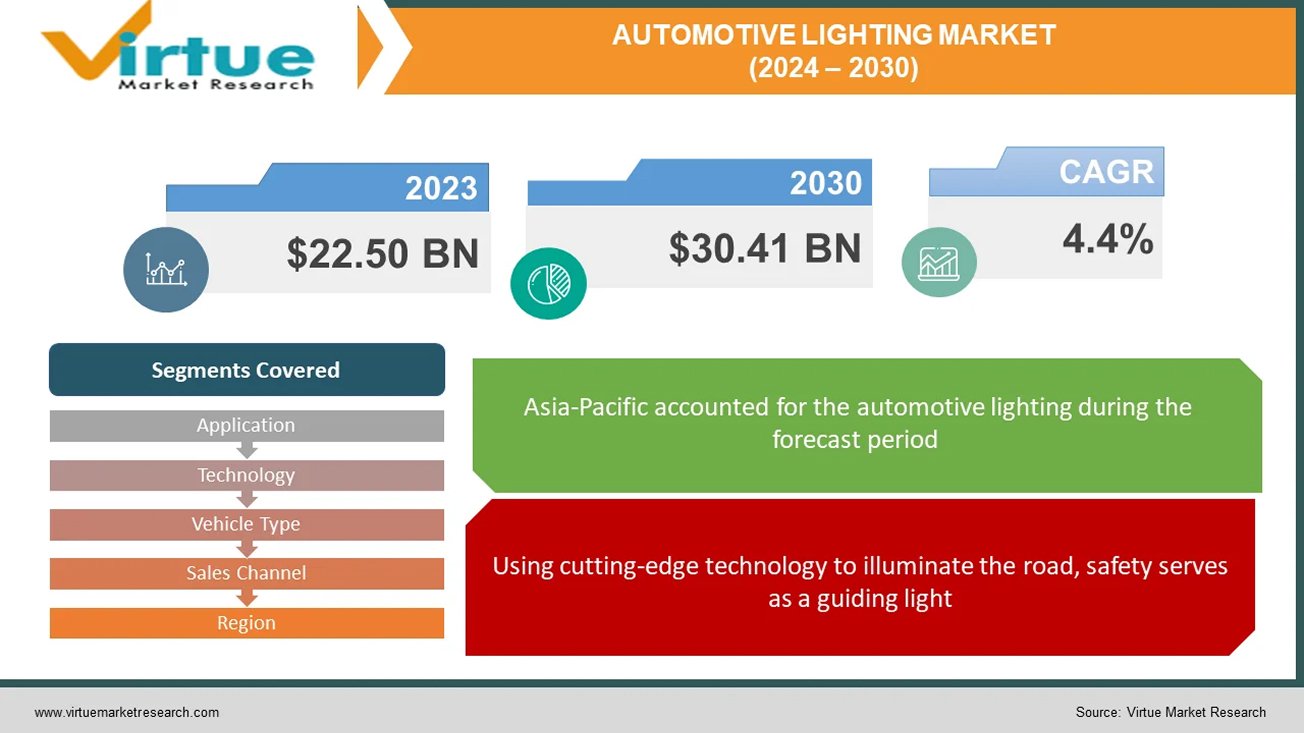
Global automotive lighting refers to all vehicle lighting systems, from headlamps that illuminate the road to taillights that communicate movements. They guarantee motorists and other road users alike safety, visibility, and style. While taillights frequently use LEDs for improved visibility, headlights are available in a variety of technologies, including LED and laser. Interior illumination, DRLs, and signal lights all have a role to play. This market, which was estimated to be worth $33.64 billion in 2022, is anticipated to rise to $67.39 billion by 2030 because of laws, luxury tastes, safety concerns, and technological developments like OLED taillights and adaptive headlights. Anticipate a future dominated by intelligent, connected, personalized, and sustainable lighting systems that enhance the safety, efficiency, and aesthetic appeal of automobiles.
Key Market Insights:
Car lighting works its magic to provide safety, visibility, and style. Headlights cut through the night, taillights express intent, and interiors shine with comfort. The billion-dollar global business is expected to rise due to consumer demand for high-end experiences, safer roads, and cutting-edge technology. Imagine dynamic messages being painted by taillights, headlights that adjust to the road, and interiors that customize their atmosphere. Driven by technological advancements like linked systems and laser beams, this future is calling. Anticipate even more visually attractive, environmentally friendly, and intelligent lighting to illuminate the way ahead, making cars safer, more efficient, and unquestionably cooler.
Global Automotive Lighting Market Drivers:
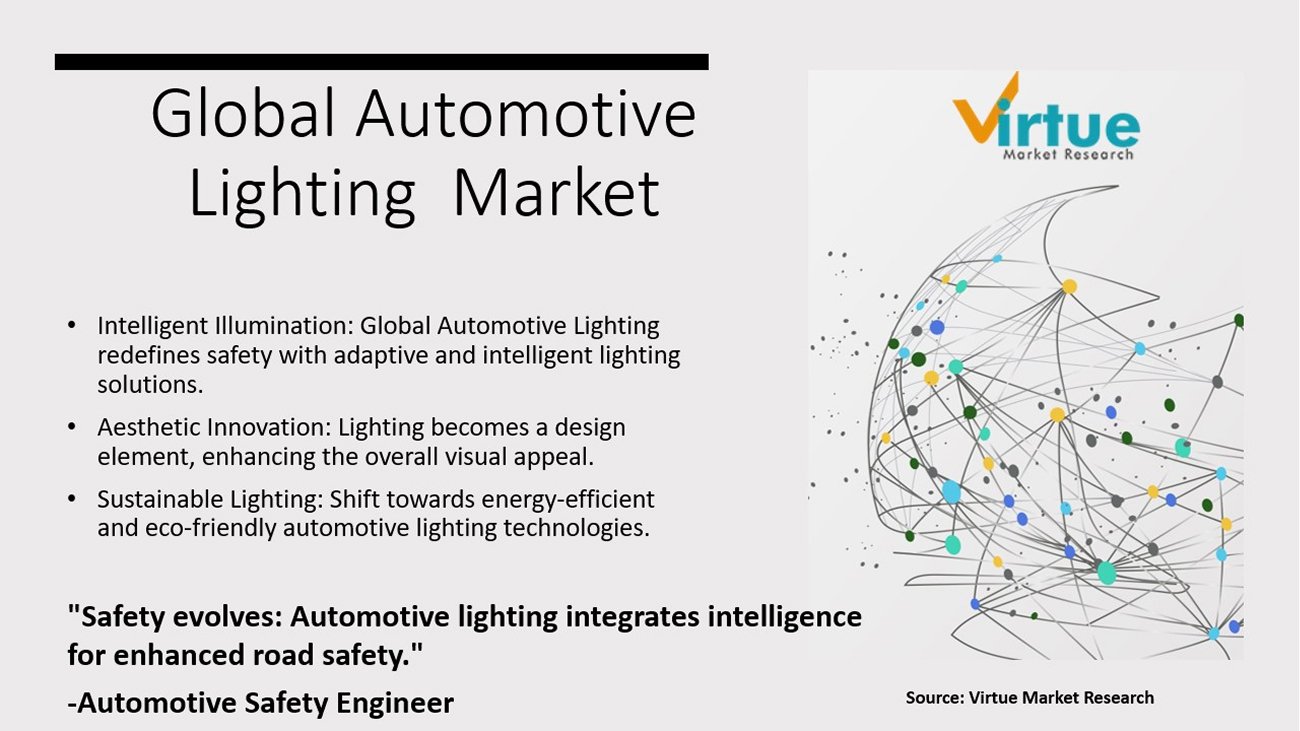
Using cutting-edge technology to illuminate the road, safety serves as a guiding light.
In the market for automobile lighting, safety is the driving force behind demand from the public and laws. While automated high beams smoothly react to traffic, adaptive headlights modify their beams so as not to blind other people. With visually striking displays, dynamic taillights convey intentions for braking and turning. Beyond these developments, integrated pedestrian identification and lane departure alerts will soon make roads safer and brighter for everyone.
Beyond Performance-Based Luxuries Redefined by Light.
Luxurious automobile lighting creates a distinct visual identity that goes beyond simple illumination. Personalized interior lighting customizes the driving experience by setting the mood with a range of colours and intensities, while intricate designs and distinctive DRLs modify exteriors. As you approach your automobile at night, welcoming lights lead the way, resulting in an interior that is perfectly lit. Not only is this symphony of light aesthetically pleasing, but it also stands as a tribute to luxury. Upcoming developments like gesture-controlled lighting and holographic displays promise to further enhance the experience.
Fuel Efficiency Takes the Lead: Illuminating Sustainability
The worldwide automotive lighting market is undergoing a significant transition towards energy-efficient solutions, as environmental concerns gain prominence. LED technology is leading the way, providing a ray of hope for the environment and drivers alike. LED lights beam brighter and use a lot less energy than conventional halogen lamps. There are some tangible advantages to this. For drivers, this translates to increased fuel economy, which lowers petrol prices and lessens reliance on fossil fuels. Greater air quality and a reduction in the transport sector's contribution to climate change are the results of reduced overall emissions.
To Learn more about this report,
Global Automotive Lighting Market Restraints and Challenges:
Although the global automotive lighting business is booming, there are still unknowns. Difficulties impede growth even as innovation propels it with eye catching features like laser beams and adaptable headlights. These technologies are luxury items due to their high cost and difficult integration, which puts producers' abilities to the test. The worldwide patchwork created by unclear legislation limits the potential of innovation. Durability issues persist, particularly when complex systems are subjected to challenging conditions. Ultimately, a lot of drivers still don't fully understand how these improvements can help them. Together, we can overcome these obstacles. The keys to reducing costs are improved production, more seamless integration, and unified regulations. Their full potential can be realized by educating customers about the safety, efficiency, and aesthetic value of these lighting wonders. By working together, we can pave the way for an even brighter and safer future for vehicle lighting.
Global Automotive Lighting Market Opportunities:
It is made possible by advanced LED technology, which gives drivers the ability to customize their illumination for the highest level of comfort and flair. Consumers that care about the environment want greener products, and vehicle lighting complies. While solar- and self-powered lighting technologies offer a future powered by clean energy, energy-efficient LEDs lower pollution. The advent of connected lighting systems heralds a new age. Envision automobiles interacting with infrastructure and one another to minimize accidents and enhance traffic efficiency. Integrated headlights with pedestrian recognition provide unmatched safety, while dramatic taillights with eye-catching displays alert onlookers to your intentions. The possibilities are endless in the future. Gesture-controlled interior illumination, holographic displays projected onto the road, and even light fixtures with self-healing capabilities.
AUTOMOTIVE LIGHTING MARKET REPORT COVERAGE:
To Learn more about this report,
Global Automotive Lighting Market Segmentation: By Application
Exterior Lighting
Interior Lighting
Due to laws requiring safety features like headlights, taillights, and brake lights, exterior lighting presently holds the most market share in the vehicle lighting industry. The dominance of this market is partly attributed to advancements in safety-focused technologies such as adaptive headlights and daytime running lights. The market value of external lighting is increased by the quick adoption of technology like LED bulbs and laser lights, which improve performance and aesthetics. Conversely, the interior lighting market is expected to increase at the fastest rate in the upcoming years. Innovations like ambient lighting and technology breakthroughs like LED and OLED displays, driven by consumer demand for comfort and personalisation, open new possibilities. The spread of sophisticated interior lighting systems is further driven by the growing emphasis on safety and the expansion of the luxury car market.
Global Automotive Lighting Market Segmentation: By Technology
Halogen
LED (Light-Emitting Diode)
Xenon
Emerging Technologies
The worldwide vehicle lighting market is currently dominated by halogen because of its more affordable price, advanced technology, and useful illumination. With its dependable supply chain and affordable option for manufacturers and cost-conscious customers, halogen holds the biggest market share. The fastest-growing market right now is LEDs, which are predicted to shortly overtake halogen. The rapid expansion of LEDs is driven by their higher efficiency, longer lifespan, flexibility in design, and technological breakthroughs including enhanced brightness. Because LEDs use less energy and produce fewer emissions and better fuel economy, they are becoming more and more popular in the changing automotive lighting market.
Global Automotive Lighting Market Segmentation: By Vehicle Type
Passenger Cars
Commercial Vehicles
Passenger automobiles rule the worldwide automotive lighting market. The sheer number of passenger cars produced which surpasses that of business vehicles and fuels the need for lighting systems is the primary cause of this popularity. The growing demand for personal automobiles in developing nations is a result of rising disposable income, which in turn drives the rise of the passenger car market. The importance that consumers place on safety and aesthetics elements helps to drive market expansion. But in the upcoming years, the market for electric and hybrid cars is expected to develop at the quickest rate. The exponential rise of the worldwide electric car market, which is still expanding and shows no signs of slowing down, is what is driving this surge. Specialised lighting solutions are required since electric and hybrid vehicles have different lighting requirements because of their specific functionality and design aesthetics.
Global Automotive Lighting Market Segmentation: By Sales Channel
OEM (Original Equipment Manufacturers)
Aftermarket
Most lighting systems sold nowadays are sold by OEMs (Original Equipment Manufacturers), primarily because manufacturers pre-install lighting systems in new cars. But in the next years, the aftermarket is expected to develop at the quickest rate. This spike in demand for replacement parts, especially lighting systems, can be linked to several variables, one of them being the average age of cars. The industry is expanding because of consumers' growing desire to personalise their cars with aftermarket lighting upgrades such LED upgrades and decorative lighting. The availability and affordability of technologies like adaptive headlights and laser lights in the aftermarket, together with other advancements in lighting technology, are driving demand even more. Moreover, the growing market for electric cars (EVs).
To Learn more about this report,
Global Automotive Lighting Market Segmentation: By Region
North America
Asia-Pacific
Europe
South America
Middle East and Africa
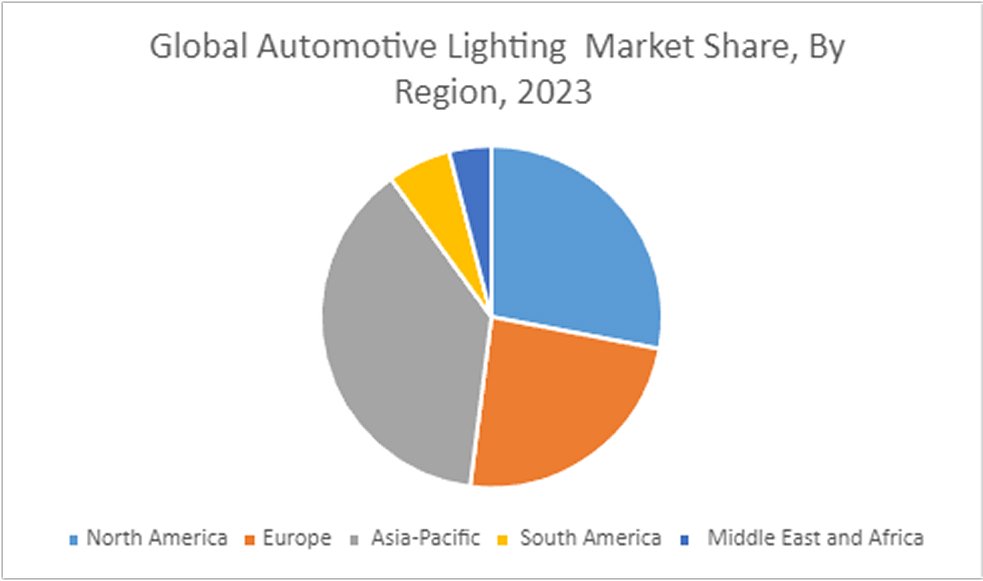
Throughout the forecast period, Asia Pacific is anticipated to be the automotive lighting market with the highest profitability. Over the past few years, Asia Pacific countries like China and India have seen notable increases in automotive manufacturing and sales, primarily in the medium-to premium luxury car segment. Asia Pacific is predicted to see an increase in the manufacturing of passenger cars, with India experiencing the strongest growth rate. Depending on the state of the national economy, the area offers a suitable selection of both high-end and cheap cars. For instance, there is a substantial demand for halogen, Xenon/HID, and LED since China and India produce more economy and mid-range automobiles. On the other hand, luxury car adoption rates are greater in South Korea and Japan, where LED lighting is the norm.
COVID-19 Impact Analysis on the Global Automotive Lighting Market:
A brief shadow was thrown by COVID-19 over the worldwide automotive lighting market. Production was stopped by lockdowns and supply chain disruptions, while luxury lighting upgrades were shelved by consumers on a tight budget. Resources became scarce, and R&D stagnated. Still, the market is recovering thanks to resurgent demand and rearranged priorities. While energy-efficient LEDs are being pushed towards adoption by sustainability, safety concerns are driving interest in features like pedestrian detection and adaptive headlights. The digital push of the epidemic creates opportunities for intelligent, networked lighting systems that may interact with infrastructure and other cars. Ultimately, the industry is positioned to shine brighter, focused on safety, sustainability, and a connected future, even though the pandemic dimmed its brilliance.
Recent Trends and Developments in the Global Automotive Lighting Market:
A development collaboration between OSRAM Continental and REHAU aims to incorporate lighting into external components, providing automobile manufacturers with innovative lighting options that improve functionality and design flexibility. For rear combination lamps, Hella unveiled a revolutionary lighting innovation called Hella FlatLight technology. A Memorandum of Understanding (MoU) was signed by Samvardhana Motherson Automotive Systems Group BV (SMRPBV), a division of Motherson Group, and Marelli Automotive Lighting to investigate a technology collaboration focused on intelligently lighted external body components. Valeo debuted their revolutionary 360° lighting system at the Shanghai Auto Show. This technology surrounds the car with a band of light, projecting instantaneous, clear signs that other drivers can see from a distance. Pedestrians, cyclists, and scooter riders are especially susceptible to these signals
Chapter 5 GLOBAL SELF - BALANCING MOTORCYCLE MARKET- Landscape
5.1. Value Chain Analysis – Key Stakeholders Impact Analysis
5.2. Market Drivers
5.3. Market Restraints/Challenges
5.4. Market Opportunities
Chapter 6 GLOBAL SELF - BALANCING MOTORCYCLE MARKET – By Technology
6.1. Riding Assist Systems (Steering/Rake Adjustment)
6.2. Gyroscopic Stabilization
Chapter 7 GLOBAL SELF - BALANCING MOTORCYCLE MARKET – By Propulsion
7.1. Electric
7.2. Internal Combustion Engine (ICE)
Chapter 8GLOBAL SELF - BALANCING MOTORCYCLE MARKET – By End User
8.1. Personal Mobility
8.2. Commercial & Law Enforcement
Chapter 9 GLOBAL SELF - BALANCING MOTORCYCLE MARKET – By Distribution Channel
9.1. OEM Brand Dealerships
9.2. Direct-to-Consumer (D2C) Online
Chapter 10 GLOBAL SELF - BALANCING MOTORCYCLE MARKET– By Vertical
10.1. IT & Telecom
10.2. BFSI
10.3. Retail
10.4. Defense/Government
10.5. Healthcare
10.6. Energy
10.7. Manufacturing
10.8. Others
10.8.1. Education
10.8.2. Media & Entertainment
Chapter 11 GLOBAL SELF - BALANCING MOTORCYCLE MARKET, By Geography – Market Size, Forecast, Trends & Insights
11.1. North America
11.1.1. By Country
11.1.1.1. U.S.A.
11.1.1.2. Canada
11.1.1.3. Mexico
11.1.2. By Product Type
11.1.3. By Distribution Channel
11.1.4. By Form
11.1.5. Source
11.1.6. End-use Industry
11.1.7. Countries & Segments - Market Attractiveness Analysis
11.2. Europe
11.2.1. By Country
11.2.1.1. U.K.
11.2.1.2. Germany
11.2.1.3. France
11.2.1.4. Italy
11.2.1.5. Spain
11.2.1.6. Rest of Europe
11.2.2. By Product Type
11.2.3. By Distribution Channel
11.2.4. By Form
11.2.5. Source
11.2.6. End-use Industry
11.2.7. Countries & Segments - Market Attractiveness Analysis
11.3. Asia Pacific
11.3.1. By Country
11.3.1.2. China
11.3.1.2. Japan
11.3.1.3. South Korea
11.3.1.4. India
11.3.1.5. Australia & New Zealand
11.3.1.6. Rest of Asia-Pacific
11.3.2. By Product Type
11.3.3. By Distribution Channel
11.3.4. By Form
11.3.5. Source
11.3.6. End-use Industry
11.3.7. Countries & Segments - Market Attractiveness Analysis
11.4. South America
11.4.1. By Country
11.4.1.1. Brazil
11.4.1.2. Argentina
11.4.1.3. Colombia
11.4.1.4. Chile
11.4.1.5. Rest of South America
11.4.2. By Product Type
11.4.3. By Distribution Channel
11.4.4. By Form 11.4.5. Source
11.4.6. End-use Industry
11.4.7. Countries & Segments - Market Attractiveness Analysis
11.5. Middle East & Africa
11.5.1. By Country
11.5.1.1. United Arab Emirates (UAE)
11.5.1.2. Saudi Arabia
11.5.1.3. Qatar
11.5.1.4. Israel
11.5.1.5. South Africa
11.5.1.6. Nigeria
11.5.1.7. Kenya
11.5.1.11. Egypt
11.5.1.11. Rest of MEA
11.5.2. By Product Type
11.5.3. By Distribution Channel
11.5.4. By Form
11.5.5. Source
11.5.6. End-use Industry
11.5.7. Countries & Segments - Market Attractiveness Analysis
• Honda Motor Co., Ltd.
• BMW AG (BMW Motorrad)
• Yamaha Motor Corporation
• Lit Motors
• Thrustcycle Enterprises LLC
• Robert Bosch GmbH
• Continental AG
• Harley-Davidson, Inc.
• Kawasaki Heavy Industries, Ltd.
• Suzuki Motor Corporation
Fill out the form below and our team will get back to you shortly
FAQ's
The primary drivers are the immense potential to enhance rider safety by eliminating low-speed falls, which would dramatically broaden the market to include new, older, and previously intimidated riders, and the technology's synergy with the global trends of urbanization and vehicle electrification.
The primary drivers are the immense potential to enhance rider safety by eliminating low-speed falls, which would dramatically broaden the market to include new, older, and previously intimidated riders, and the technology's synergy with the global trends of urbanization and vehicle electrification.
Yes. Most systems under development are designed to be active only at very low speeds (e.g., under 5 mph) or at a standstill. At normal riding speeds, the systems are inactive, and the motorcycle relies on its natural dynamics, providing the traditional, engaging riding experience.
Yes. Most systems under development are designed to be active only at very low speeds (e.g., under 5 mph) or at a standstill. At normal riding speeds, the systems are inactive, and the motorcycle relies on its natural dynamics, providing the traditional, engaging riding experience.
The market is currently led by the R&D efforts of major manufacturers, most notably Honda with its Riding Assist concept and BMW with its Vision Next 100. Key startups include Lit Motors. The supply chain for sensors and processors involves tech giants like Bosch and NVIDIA.
The market is currently led by the R&D efforts of major manufacturers, most notably Honda with its Riding Assist concept and BMW with its Vision Next 100. Key startups include Lit Motors. The supply chain for sensors and processors involves tech giants like Bosch and NVIDIA.
Initial commercial models are expected to be positioned as premium, high-technology products, likely carrying a significant price premium of several thousand dollars over their conventional counterparts. However, as the technology matures and scales, costs are expected to decrease over time.
Initial commercial models are expected to be positioned as premium, high-technology products, likely carrying a significant price premium of several thousand dollars over their conventional counterparts. However, as the technology matures and scales, costs are expected to decrease over time.
While several manufacturers have showcased advanced functional prototypes, a firm timeline for mass-market availability has not been officially announced. Industry experts anticipate the first limited production models could appear in the late 2020s, with wider availability in the early 2030s.
While several manufacturers have showcased advanced functional prototypes, a firm timeline for mass-market availability has not been officially announced. Industry experts anticipate the first limited production models could appear in the late 2020s, with wider availability in the early 2030s.
More related reports
Get expert-driven market research reports from a leading research partner to help you navigate the future of the global industry.
Report Code: VMR-17330 | Published Date: July 2024 | Format: Excel and PDF
The Global Acoustic and Thermal Insulation for Electric Vehicles Market was valued at USD 218 million in 2023 and is projected to reach a market size of USD 446.93 million by the end of 2030. The market is anticipated to...
Report Code: VMR-12973 | Published Date: December 2024 | Format: Excel and PDF
The Global online used car market was valued at USD 28.19 billion in 2022 and is projected to reach a market size of USD 75 billion by the end of 2030. Over the forecast period of 2023-2030, the market is projected to gr...
Report Code: VMR-16118 | Published Date: November 2023 | Format: Excel and PDF
The Autonomous Taxi Services Market was valued at USD 0.78 Billion in 2023 and is projected to reach a market size of USD 58.29 Billion by the end of 2030. Over the forecast period of 2024-2030, the market is projected t...
Report Code: VMR-18523 | Published Date: July 2025 | Format: Excel and PDF
The Trucks Market was valued at USD 8.31 trillion in 2024 and is projected to reach a market size of USD 11.29 trillion by the end of 2030. Over the forecast period of 2025-2030, the market is projected to grow at a CAGR...
Report Code: VMR-4959 | Published Date: June 2024 | Format: Excel and PDF
The Global Automotive Telematics Market was valued at USD 76.66 billion in 2023 and is projected to reach a market size of USD 274.69 billion by the end of 2030. Over the cast period of 2024 – 2030, the figure for reques...
“We received a complex piece of work for our niche market from Virtue Market research in short period of time. I appreciate the quality and content of the final files we received. Thanks for the support”
Medical Devices Company based in Europe
“We received a complex piece of work for our niche market from Virtue Market research in short period of time. I appreciate the quality and content of the final files we received. Thanks for the support”
Medical Devices Company based in Europe
“We received a complex piece of work for our niche market from Virtue Market research in short period of time. I appreciate the quality and content of the final files we received. Thanks for the support”
Medical Devices Company based in Europe
“We received a complex piece of work for our niche market from Virtue Market research in short period of time. I appreciate the quality and content of the final files we received. Thanks for the support”
Medical Devices Company based in Europe
“We received a complex piece of work for our niche market from Virtue Market research in short period of time. I appreciate the quality and content of the final files we received. Thanks for the support”
Medical Devices Company based in Europe
“We received a complex piece of work for our niche market from Virtue Market research in short period of time. I appreciate the quality and content of the final files we received. Thanks for the support”