Poland Cards and Payments Market Research Report – Segmentation by Payment Instrument (Cards, Mobile wallets, Bank transfers, Cash); and Region; - Size, Share, Growth Analysis | Forecast (2024– 2030)
Poland Cards and Payments Market Size (2024-2030)
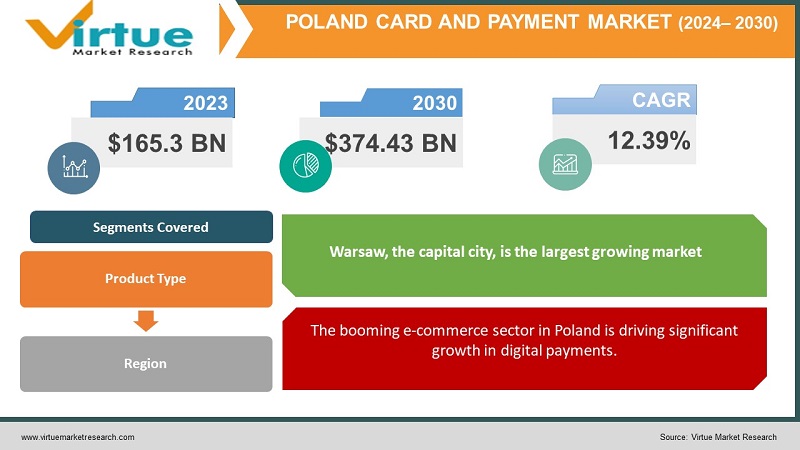
The Poland cards and payments market was valued at USD 165.3 billion in 2023 and is projected to reach a market size of USD 374.43 billion by the end of 2030. Over the forecast period of 2024–2030, the market is projected to grow at a CAGR of 12.39%.
A convergence of variables, including government initiatives, technology improvements, and cultural preferences, is causing a seismic upheaval in Poland's payment landscape. A tech-savvy populace ready to embrace the efficiency and ease of cashless transactions is at the center of this shift. Poland, in contrast to many of its European peers, has a payments ecosystem where debit cards dominate, accounting for an astounding 79 percent of the market. This dominance can be linked to societal norms that favor debit cards over other payment options because of their lower related fees. The swift adoption of cashless transactions is accelerated by programs such as "Cashless Poland," which are designed to encourage electronic payments and decrease dependence on physical currency.
Key Market Insights:
The payment landscape in Poland is changing dramatically, primarily due to a rise in digital adoption and a slow move away from cash. In Poland, debit cards are the clear leaders, making up about 80% of all payment cards in use, in contrast to many of their Western counterparts. This inclination is a result of historical precedent and cultural influences, but it also reflects the security and ease that come with contemporary debit options. More than 80% of card transactions in Poland are contactless, making it one of the countries in Europe with the greatest penetration rates of contactless payments. Poland is leading the way in the cashless revolution due to its quick adoption, which is being pushed by government initiatives and customer preferences for simplicity and speed. Although global powerhouses such as Visa and Mastercard have considerable influence, a domestic competitor, BLIK, has become a prominent participant. With the help of this cutting-edge mobile payment solution, customers may approve transactions straight from their banking apps, providing a safe and easy experience. BLIK is incredibly popular for online shopping, especially on big shopping days like Black Friday.
Poland Cards and Payments Market Drivers:
The booming e-commerce sector in Poland is driving significant growth in digital payments.
Convenience, choice, and accessibility are driving a dynamic shift in the Polish e-commerce market away from brick-and-mortar supremacy and toward an online realm. Digital payments are at the core of this shift, bringing in a new era of seamless transactions and improved customer experiences. The desire for quick and safe payment options has increased dramatically as online shopping has become more common, which has led to the explosive growth of digital payments in Poland. Credit cards, debit cards, and creative alternative payment gateways are just a few of the payment methods that are integrated to provide customers with a wide range of options for quick and safe payments. With the ability to start transactions straight from bank accounts, online banking has emerged as the mainstay of digital payments. Easy fund transfers, payments, and financial management are now possible with Polish banks' expanding Internet banking services—all from the convenience of your home or mobile device. The easy shopping experience is produced by this seamless integration with e-commerce platforms, which also expedites the payment procedure. These days, e-wallets are essential tools for digital transactions since they provide a safe and easy way to store payment information and make online purchases. Widely used services like PayPal, Google Pay, and Apple Pay offer a seamless payment experience along with improved security due to state-of-the-art authentication and encryption techniques.
The cards and payments market in Poland is being driven by efforts to promote financial inclusion and accessibility.
The development of Poland's card and payments market is mostly determined by factors such as financial inclusion and accessibility, which demonstrate a strong commitment to providing basic banking services and digital payment solutions to all societal sectors. In an attempt to close the gap between underprivileged people and mainstream financial services, this coordinated drive towards inclusion encompasses a blend of technical innovation, regulatory measures, and cooperative endeavors between financial institutions and fintech startups. The fundamental principle of this venture is the unwavering dedication to providing banking services to underserved groups, such as those living in low-income neighborhoods and rural locations. Due to financial difficulties, a lack of physical bank branches, and geographic restrictions, these communities have historically had considerable obstacles when trying to use standard banking services. However, the emergence of mobile payments and digital banking has signaled a revolutionary change that has reduced obstacles and increased the accessibility of financial services for formerly underserved populations.
Poland Cards and Payments Market Restraints and Challenges:
One of the significant challenges facing the cards and payments market in Poland is the limited digital infrastructure, particularly in rural and remote areas.
The cards and payments industry faces a major obstacle from Poland's sparsely distributed digital infrastructure, which prevents the country's rural and isolated areas from widely adopting electronic payment and digital banking services. Even with the fast technological improvements that urban areas have undergone, many rural populations continue to have unequal access to digital resources and internet connectivity. One of the main issues in rural areas, where access to high-speed broadband networks may be limited or nonexistent, is inadequate internet connectivity. Individuals and organizations are unable to access digital payment platforms, execute electronic transactions, or participate in online banking due to the unreliability of the Internet infrastructure. Residents' access to the advantages of digital financial services may be restricted as a result, forcing them to depend on conventional banking services and cash transactions. In addition, there are frequently few physical bank branches and ATM networks in rural areas, which makes it more difficult for locals to obtain financial services.
Economic uncertainty looms as a formidable obstacle confronting the cards and payments market in Poland.
When economic downturns cast their shadow, consumer confidence often takes a nosedive. Tightened belts and cautious spending have become the norm, with essential purchases prioritized and discretionary expenses falling by the wayside. This translates to fewer transactions, potentially stagnating growth and hindering the adoption of new payment solutions. Adding fuel to the fire, inflation erodes purchasing power, leaving less disposable income for non-essentials. Food, fuel, and housing devour a larger portion of budgets, leaving less room for other goods and services. This translates to softer demand for merchants, impacting transaction volumes and revenue streams. Geopolitical tensions and global economic uncertainties act as storm clouds, casting long shadows over consumer sentiment and investor confidence. Trade disputes, conflicts, and currency fluctuations introduce volatility, prompting businesses to adopt a more conservative approach to expansion and investment. This can stifle innovation and slow down market growth in the payments sector.
Poland Cards and Payments Market Opportunities:
Poland's card and payments market pulsates with potential, fueled by a tech-savvy population, government initiatives, and a booming e-commerce scene. The surging e-commerce sector demands seamless and secure online payments. Open banking solutions and instant payment systems can simplify transactions, while "Buy Now, Pay Later" (BNPL) options cater to millennials seeking flexible payment options. Fingerprint and facial recognition technologies are gaining traction, offering enhanced security and a touch-free experience. Banks and fintech players can capitalize on this trend by integrating biometrics into payment cards and wearables. While e-wallets like Apple Pay and Google Pay are popular, niche solutions like Blik hold immense potential. Further integrating Blik with e-commerce platforms and expanding its functionalities can unlock wider adoption. As the gig economy flourishes, micropayment solutions offering instant and seamless transactions for small-value payments will be crucial. Innovative solutions catering to freelancers and microbusinesses can tap into this burgeoning segment. With rising competition, offering cashback and loyalty programs can incentivize card usage and attract new customers. Banks and fintech companies can partner with retailers to create unique and value-added programs. Collaborations between banks, fintech startups, and established players can foster innovation, share resources, and expand reach, benefiting the entire ecosystem.
POLAND CARDS AND PAYMENTS MARKET REPORT COVERAGE:
REPORT METRIC
DETAILS
Market Size Available
2023 - 2030
Base Year
2023
Forecast Period
2024 - 2030
CAGR
11.6%
Segments Covered
By Product, Type, Consumption, Distribution Channel and Region
Various Analyses Covered
Regional & Country Level Analysis, Segment-Level Analysis, DROC, PESTLE Analysis, Porter’s Five Forces Analysis, Competitive Landscape, Analyst Overview on Investment Opportunities
Regional Scope
Poland
Key Companies Profiled
PKO Bank Polski, Santander Bank Polska, Pekao S.A., Millenium Bank, mBank, ING Bank Śląski, Alior Bank, Credit Agricole Bank
Poland Cards and Payments Market Segmentation
Poland Cards and Payments Market Segmentation: By Product Type
Cards
Mobile wallets
Bank transfers
Cash
Cards are both the largest and fastest-growing segment, with a share of around 80%. Cash has traditionally been the preferred payment method, and debit cards offer a familiar and convenient alternative with lower fees compared to credit cards. Cashless Poland" initiatives aim to promote debit card usage through incentives and infrastructure development. Poland boasts one of the highest contactless payment penetration rates in Europe, making debit cards even more convenient for everyday transactions. Mobile wallets have been gaining traction, particularly among younger generations. Apple Pay, Google Pay, and BLIK (a local bank-backed system) account for roughly 5% of transactions. BLIK enjoys wider e-commerce integration and boasts impressive user numbers. Bank transfers are still commonly used for online payments and bills, accounting for around 3–5% of transactions. However, their share is expected to decline as digital wallets gain popularity. Cash, although declining, still holds a 2-3% share, primarily among older demographics and in smaller towns. Mobile wallets are undoubtedly the fastest-growing segment. This is driven by increased smartphone penetration, convenience and speed, enhanced security, and integration with e-commerce platforms.
Market Segmentation: Regional Analysis
Warsaw, the capital city, is the largest growing market, accounting for approximately 30% of the total market share. Warsaw boasts the largest population in Poland, translating to a higher concentration of potential users and merchants. The city serves as a major financial and business hub, attracting diverse industries and fostering higher disposable income. Warsaw benefits from a well-developed payment infrastructure, facilitating wider adoption of digital payment methods. The city attracts a tech-savvy population that readily embraces new payment technologies. Kraków, the second-largest city, is the fastest-growing area. It holds a significant share of around 20%, driven by its cultural significance, tourism industry, and growing tech sector. The city attracts a significant number of tourists, contributing to increased cashless transactions. Kraków is becoming a hub for innovative startups, including fintech companies, fueling digital payment adoption. Like Warsaw, government initiatives like "Cashless Krakow" are actively promoting digital payments. In Łódź and Wrocław, steady growth is being seen due to their developing economies and increasing digital adoption. Smaller towns and rural areas collectively have cash still holding a stronger presence due to demographic factors and slower infrastructure development.
COVID-19 Impact Analysis on the Poland Card and Payments Market.
Hygiene concerns fueled the rapid adoption of contactless payments, pushing Poland even further towards its "Cashless Poland" vision. Contactless transactions skyrocketed, exceeding 80%, solidifying their dominance. Lockdowns and social distancing drove a surge in online shopping, forcing businesses to adopt secure digital payment methods. This propelled mobile wallets like BLIK and international players like Apple Pay and Google Pay to prominence. Initiatives like "Polska Bezgotówkowa" (Cashless Poland) offered incentives for both consumers and merchants, further accelerating the shift towards digital transactions. Concerns about online fraud led to increased development and adoption of advanced security measures like biometrics and tokenization. Growing demand for seamless online transactions fueled the adoption of open banking solutions, enabling secure data sharing between banks and third-party providers for innovative payment experiences. Despite the progress, disparities in internet access and digital literacy remain, particularly in rural areas. Bridging this gap is crucial for inclusive financial participation.
Latest Trends/ Developments:
Poland's card and payment landscape is pulsating with change, driven by a tech-savvy population and a government actively pushing for a cashless society. Fingerprint and facial recognition technologies are increasingly embedded in cards and mobile wallets, offering both convenience and security. Banks are leading the charge, with institutions like Bank Pocztowy launching biometric Mastercard debit cards. This trend enhances the user experience and addresses growing security concerns. Open banking regulations are unlocking innovation, allowing third-party providers to access financial data with user consent. This fosters competition and personalized financial solutions. For example, the "Instant Payments" system allows near-instant money transfers between different banks, revolutionizing online transactions. Poland's booming e-commerce sector demands an agile payments ecosystem. Secure online gateways like Przelewy24 and Dotpay are expanding, integrating various payment methods like BLIK and BLIK Code, a QR code solution, for a seamless online shopping experience. While the zloty remains king, cryptocurrencies like Bitcoin and stablecoins are gaining traction. Though not yet mainstream, crypto-friendly businesses are emerging, and the government is exploring regulatory frameworks for this nascent space. With increased digital transactions, data privacy and security concerns are paramount. The government is implementing stricter regulations like PSD2, demanding strong authentication and data protection measures. Consumers are also becoming more aware of their rights and opting for secure payment methods. The National Bank of Poland (NBP) plays a crucial role in shaping the market. Initiatives like "Cashless Poland" promote digital payments, while regulations like open banking encourage competition and innovation. These developments create a dynamic environment for growth and consumer choice. Embracing emerging trends like biometrics, open banking, and alternative currencies will be crucial for players to stay ahead of the curve.
Key Players:
PKO Bank Polski
Santander Bank Polska
Pekao S.A.
Millenium Bank
mBank
ING Bank Śląski
Alior Bank
Credit Agricole Bank
To Learn more about this report,
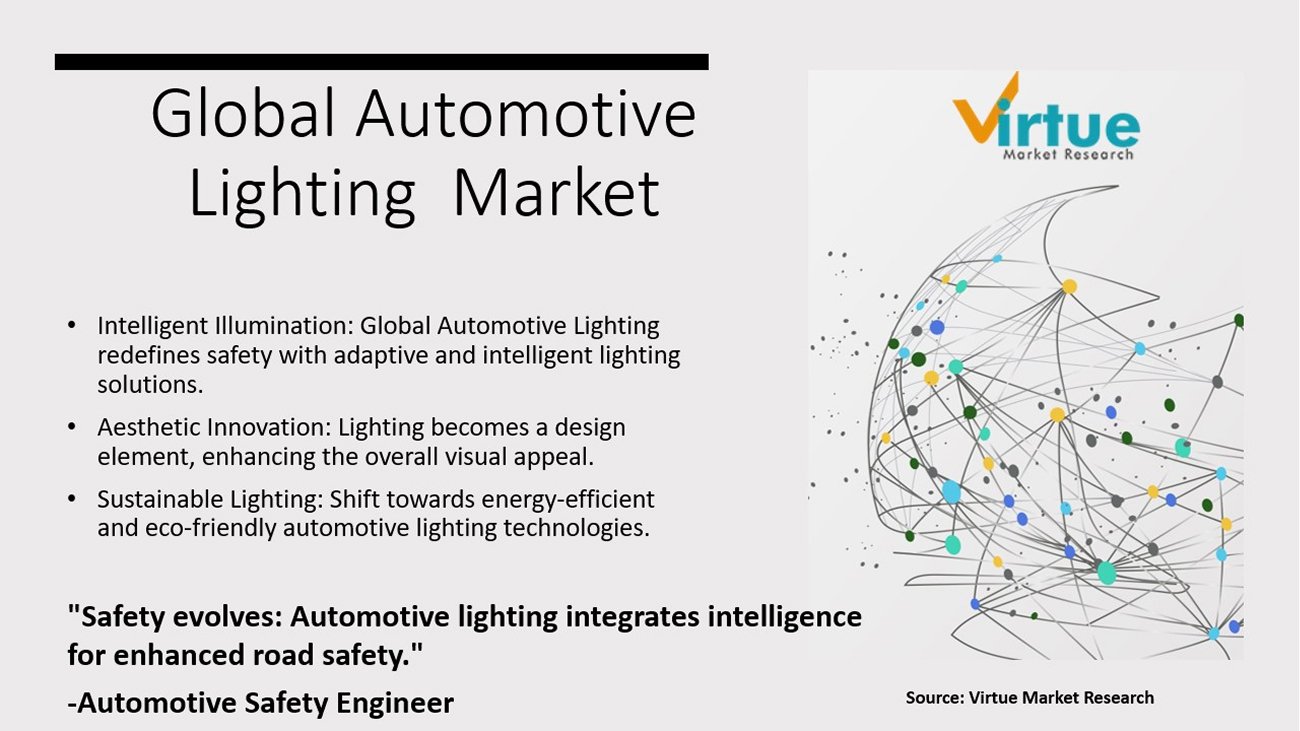
Global automotive lighting refers to all vehicle lighting systems, from headlamps that illuminate the road to taillights that communicate movements. They guarantee motorists and other road users alike safety, visibility, and style. While taillights frequently use LEDs for improved visibility, headlights are available in a variety of technologies, including LED and laser. Interior illumination, DRLs, and signal lights all have a role to play. This market, which was estimated to be worth $33.64 billion in 2022, is anticipated to rise to $67.39 billion by 2030 because of laws, luxury tastes, safety concerns, and technological developments like OLED taillights and adaptive headlights. Anticipate a future dominated by intelligent, connected, personalized, and sustainable lighting systems that enhance the safety, efficiency, and aesthetic appeal of automobiles.
Key Market Insights:
Car lighting works its magic to provide safety, visibility, and style. Headlights cut through the night, taillights express intent, and interiors shine with comfort. The billion-dollar global business is expected to rise due to consumer demand for high-end experiences, safer roads, and cutting-edge technology. Imagine dynamic messages being painted by taillights, headlights that adjust to the road, and interiors that customize their atmosphere. Driven by technological advancements like linked systems and laser beams, this future is calling. Anticipate even more visually attractive, environmentally friendly, and intelligent lighting to illuminate the way ahead, making cars safer, more efficient, and unquestionably cooler.
Global Automotive Lighting Market Drivers:
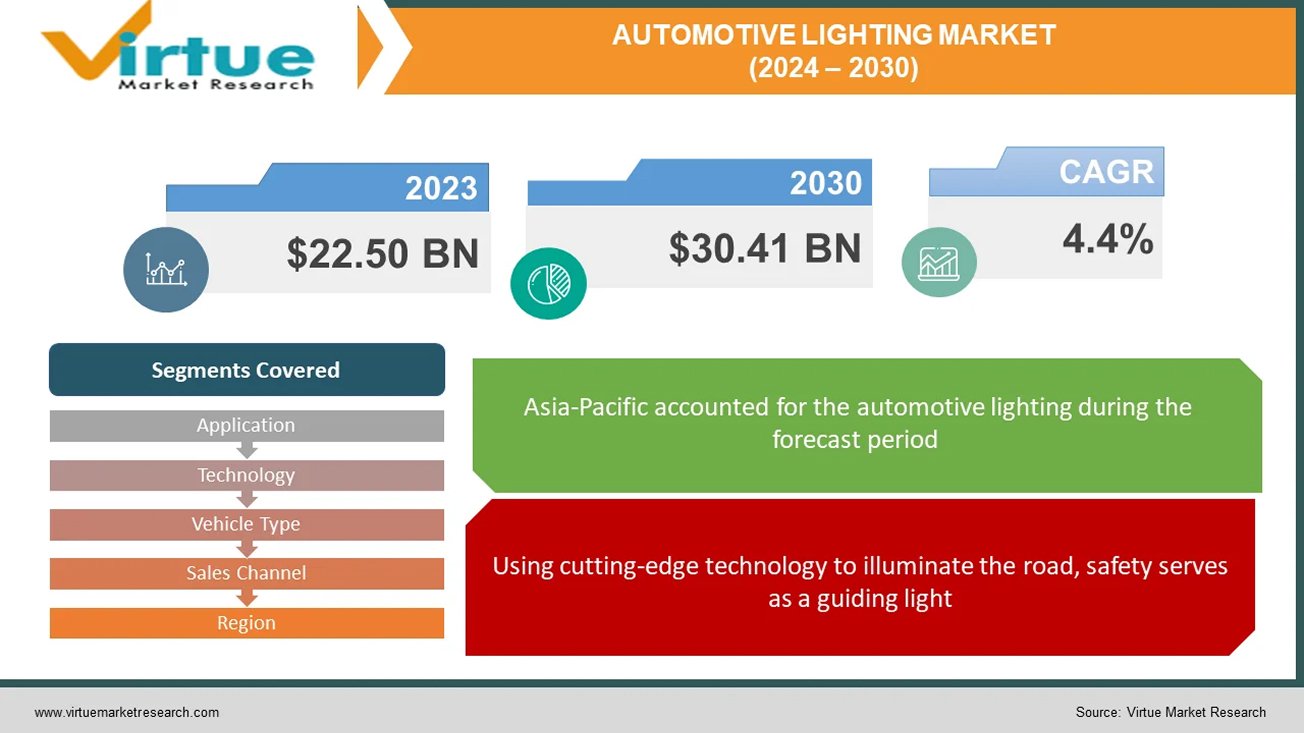
Using cutting-edge technology to illuminate the road, safety serves as a guiding light.
In the market for automobile lighting, safety is the driving force behind demand from the public and laws. While automated high beams smoothly react to traffic, adaptive headlights modify their beams so as not to blind other people. With visually striking displays, dynamic taillights convey intentions for braking and turning. Beyond these developments, integrated pedestrian identification and lane departure alerts will soon make roads safer and brighter for everyone.
Beyond Performance-Based Luxuries Redefined by Light.
Luxurious automobile lighting creates a distinct visual identity that goes beyond simple illumination. Personalized interior lighting customizes the driving experience by setting the mood with a range of colours and intensities, while intricate designs and distinctive DRLs modify exteriors. As you approach your automobile at night, welcoming lights lead the way, resulting in an interior that is perfectly lit. Not only is this symphony of light aesthetically pleasing, but it also stands as a tribute to luxury. Upcoming developments like gesture-controlled lighting and holographic displays promise to further enhance the experience.
Fuel Efficiency Takes the Lead: Illuminating Sustainability
The worldwide automotive lighting market is undergoing a significant transition towards energy-efficient solutions, as environmental concerns gain prominence. LED technology is leading the way, providing a ray of hope for the environment and drivers alike. LED lights beam brighter and use a lot less energy than conventional halogen lamps. There are some tangible advantages to this. For drivers, this translates to increased fuel economy, which lowers petrol prices and lessens reliance on fossil fuels. Greater air quality and a reduction in the transport sector's contribution to climate change are the results of reduced overall emissions.
To Learn more about this report,
Global Automotive Lighting Market Restraints and Challenges:
Although the global automotive lighting business is booming, there are still unknowns. Difficulties impede growth even as innovation propels it with eye catching features like laser beams and adaptable headlights. These technologies are luxury items due to their high cost and difficult integration, which puts producers' abilities to the test. The worldwide patchwork created by unclear legislation limits the potential of innovation. Durability issues persist, particularly when complex systems are subjected to challenging conditions. Ultimately, a lot of drivers still don't fully understand how these improvements can help them. Together, we can overcome these obstacles. The keys to reducing costs are improved production, more seamless integration, and unified regulations. Their full potential can be realized by educating customers about the safety, efficiency, and aesthetic value of these lighting wonders. By working together, we can pave the way for an even brighter and safer future for vehicle lighting.
Global Automotive Lighting Market Opportunities:
It is made possible by advanced LED technology, which gives drivers the ability to customize their illumination for the highest level of comfort and flair. Consumers that care about the environment want greener products, and vehicle lighting complies. While solar- and self-powered lighting technologies offer a future powered by clean energy, energy-efficient LEDs lower pollution. The advent of connected lighting systems heralds a new age. Envision automobiles interacting with infrastructure and one another to minimize accidents and enhance traffic efficiency. Integrated headlights with pedestrian recognition provide unmatched safety, while dramatic taillights with eye-catching displays alert onlookers to your intentions. The possibilities are endless in the future. Gesture-controlled interior illumination, holographic displays projected onto the road, and even light fixtures with self-healing capabilities.
AUTOMOTIVE LIGHTING MARKET REPORT COVERAGE:
To Learn more about this report,
Global Automotive Lighting Market Segmentation: By Application
Exterior Lighting
Interior Lighting
Due to laws requiring safety features like headlights, taillights, and brake lights, exterior lighting presently holds the most market share in the vehicle lighting industry. The dominance of this market is partly attributed to advancements in safety-focused technologies such as adaptive headlights and daytime running lights. The market value of external lighting is increased by the quick adoption of technology like LED bulbs and laser lights, which improve performance and aesthetics. Conversely, the interior lighting market is expected to increase at the fastest rate in the upcoming years. Innovations like ambient lighting and technology breakthroughs like LED and OLED displays, driven by consumer demand for comfort and personalisation, open new possibilities. The spread of sophisticated interior lighting systems is further driven by the growing emphasis on safety and the expansion of the luxury car market.
Global Automotive Lighting Market Segmentation: By Technology
Halogen
LED (Light-Emitting Diode)
Xenon
Emerging Technologies
The worldwide vehicle lighting market is currently dominated by halogen because of its more affordable price, advanced technology, and useful illumination. With its dependable supply chain and affordable option for manufacturers and cost-conscious customers, halogen holds the biggest market share. The fastest-growing market right now is LEDs, which are predicted to shortly overtake halogen. The rapid expansion of LEDs is driven by their higher efficiency, longer lifespan, flexibility in design, and technological breakthroughs including enhanced brightness. Because LEDs use less energy and produce fewer emissions and better fuel economy, they are becoming more and more popular in the changing automotive lighting market.
Global Automotive Lighting Market Segmentation: By Vehicle Type
Passenger Cars
Commercial Vehicles
Passenger automobiles rule the worldwide automotive lighting market. The sheer number of passenger cars produced which surpasses that of business vehicles and fuels the need for lighting systems is the primary cause of this popularity. The growing demand for personal automobiles in developing nations is a result of rising disposable income, which in turn drives the rise of the passenger car market. The importance that consumers place on safety and aesthetics elements helps to drive market expansion. But in the upcoming years, the market for electric and hybrid cars is expected to develop at the quickest rate. The exponential rise of the worldwide electric car market, which is still expanding and shows no signs of slowing down, is what is driving this surge. Specialised lighting solutions are required since electric and hybrid vehicles have different lighting requirements because of their specific functionality and design aesthetics.
Global Automotive Lighting Market Segmentation: By Sales Channel
OEM (Original Equipment Manufacturers)
Aftermarket
Most lighting systems sold nowadays are sold by OEMs (Original Equipment Manufacturers), primarily because manufacturers pre-install lighting systems in new cars. But in the next years, the aftermarket is expected to develop at the quickest rate. This spike in demand for replacement parts, especially lighting systems, can be linked to several variables, one of them being the average age of cars. The industry is expanding because of consumers' growing desire to personalise their cars with aftermarket lighting upgrades such LED upgrades and decorative lighting. The availability and affordability of technologies like adaptive headlights and laser lights in the aftermarket, together with other advancements in lighting technology, are driving demand even more. Moreover, the growing market for electric cars (EVs).
To Learn more about this report,
Global Automotive Lighting Market Segmentation: By Region
North America
Asia-Pacific
Europe
South America
Middle East and Africa
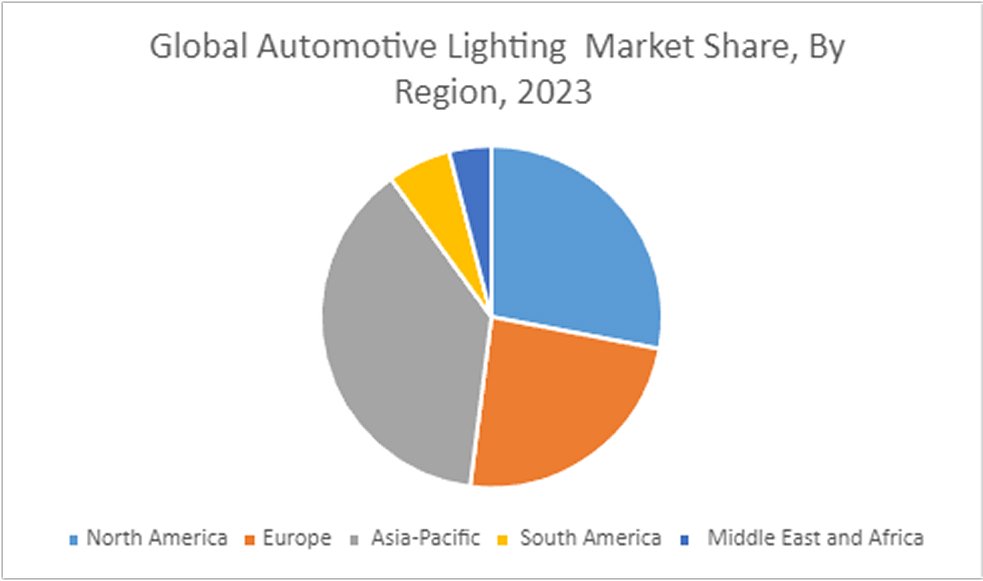
Throughout the forecast period, Asia Pacific is anticipated to be the automotive lighting market with the highest profitability. Over the past few years, Asia Pacific countries like China and India have seen notable increases in automotive manufacturing and sales, primarily in the medium-to premium luxury car segment. Asia Pacific is predicted to see an increase in the manufacturing of passenger cars, with India experiencing the strongest growth rate. Depending on the state of the national economy, the area offers a suitable selection of both high-end and cheap cars. For instance, there is a substantial demand for halogen, Xenon/HID, and LED since China and India produce more economy and mid-range automobiles. On the other hand, luxury car adoption rates are greater in South Korea and Japan, where LED lighting is the norm.
COVID-19 Impact Analysis on the Global Automotive Lighting Market:
A brief shadow was thrown by COVID-19 over the worldwide automotive lighting market. Production was stopped by lockdowns and supply chain disruptions, while luxury lighting upgrades were shelved by consumers on a tight budget. Resources became scarce, and R&D stagnated. Still, the market is recovering thanks to resurgent demand and rearranged priorities. While energy-efficient LEDs are being pushed towards adoption by sustainability, safety concerns are driving interest in features like pedestrian detection and adaptive headlights. The digital push of the epidemic creates opportunities for intelligent, networked lighting systems that may interact with infrastructure and other cars. Ultimately, the industry is positioned to shine brighter, focused on safety, sustainability, and a connected future, even though the pandemic dimmed its brilliance.
Recent Trends and Developments in the Global Automotive Lighting Market:
A development collaboration between OSRAM Continental and REHAU aims to incorporate lighting into external components, providing automobile manufacturers with innovative lighting options that improve functionality and design flexibility. For rear combination lamps, Hella unveiled a revolutionary lighting innovation called Hella FlatLight technology. A Memorandum of Understanding (MoU) was signed by Samvardhana Motherson Automotive Systems Group BV (SMRPBV), a division of Motherson Group, and Marelli Automotive Lighting to investigate a technology collaboration focused on intelligently lighted external body components. Valeo debuted their revolutionary 360° lighting system at the Shanghai Auto Show. This technology surrounds the car with a band of light, projecting instantaneous, clear signs that other drivers can see from a distance. Pedestrians, cyclists, and scooter riders are especially susceptible to these signals
Key Players:
AMS Osram
Cree
Hella
Hyundai Mobis
Koito
Luminus Devices
Magneti Marelli
Osram Licht AG
Stanley Electric
Valeo
Chapter 1. Poland Card and Payments Market– Scope & Methodology
1.1. Market Segmentation
1.2. Scope, Assumptions & Limitations
1.3. Research Methodology
1.4. Primary Sources
1.5. Secondary Sources
Chapter 2. Poland Card and Payments Market – Executive Summary
Fill out the form below and our team will get back to you shortly
FAQ's
The e-commerce sector and efforts to promote financial inclusion as well as accessibility are the main drivers in this market
Limited digital infrastructure and economic uncertainty are the main concerns being faced by the market
PKO Bank Polski, Santander Bank Polska, Pekao S.A., Millenium Bank, mBank, ING Bank Śląski, Alior Bank, and Credit Agricole Bank are the prominent players.
Warsaw currently holds the largest market share, estimated at around 30%.
Kraków exhibits the fastest growth, driven by its increasing population, expanding economy, and government programs aimed at bridging the digital divide and fostering technological innovation.
More related reports
Get expert-driven market research reports from a leading research partner to help you navigate the future of the global industry.
Report Code: VMR-203 | Published Date: July 2025 | Format: Excel and PDF
The 3D Scanning Market was valued at USD 2.28 billion in 2024 and is projected to reach a market size of USD 5.37 billion by the end of 2030. Over the forecast period of 2025-2030, the market is projected to grow at a CA...
Report Code: VMR-14818 | Published Date: July 2024 | Format: Excel and PDF
The Global Passwordless Authentication Market is expected to grow from USD 22.70 billion in 2025 to approximately USD 49.13 billion by 2030, at a 16.7% CAGR from 2026-2030.
Report Code: VMR-435 | Published Date: March 2024 | Format: Excel and PDF
The Equity Management Software Market was valued at USD 591.85 million in 2023. Over the forecast period of 2024-2030, it is projected to reach USD 1508.47 million by 2030, growing at a CAGR of 14.3%.
Report Code: VMR-15816 | Published Date: March 2024 | Format: Excel and PDF
The global intellectual property (IP) services market was valued at USD 2.8 billion and is projected to reach a market size of USD 6.38 billion by the end of 2030. Over the forecast period of 2024–2030, the market is pro...
“We received a complex piece of work for our niche market from Virtue Market research in short period of time. I appreciate the quality and content of the final files we received. Thanks for the support”
Medical Devices Company based in Europe
“We received a complex piece of work for our niche market from Virtue Market research in short period of time. I appreciate the quality and content of the final files we received. Thanks for the support”
Medical Devices Company based in Europe
“We received a complex piece of work for our niche market from Virtue Market research in short period of time. I appreciate the quality and content of the final files we received. Thanks for the support”
Medical Devices Company based in Europe
“We received a complex piece of work for our niche market from Virtue Market research in short period of time. I appreciate the quality and content of the final files we received. Thanks for the support”
Medical Devices Company based in Europe
“We received a complex piece of work for our niche market from Virtue Market research in short period of time. I appreciate the quality and content of the final files we received. Thanks for the support”
Medical Devices Company based in Europe
“We received a complex piece of work for our niche market from Virtue Market research in short period of time. I appreciate the quality and content of the final files we received. Thanks for the support”