Middle East and Africa Smart Vending Machine Market Research Report – Segmentation by Product (Smart Snack & Beverage Machines, Cold Chain Medical Vending, Automated Retail Kiosks, Multifunctional Vending Systems), Application (Retail & Convenience, Healthcare & Pharmaceuticals, Airports & Transit Hubs, Corporate & Education Campuses, Hospitality) ; and Region - Size, Share, Growth Analysis | Forecast (2025– 2030)
Middle East and Africa Smart Vending Machine Market Size (2025-2030)
The Middle East and Africa Smart Vending Machine Market was valued at USD 0.68 billion in 2024 and will grow at a CAGR of 11.2% from 2025 to 2030. The market is expected to reach USD 1.29 billion by 2030.
Smart vending machines combine automated retail hardware with IoT connectivity, cashless payments, telemetry, and AI-enabled inventory and customer-engagement software. In MEA, adoption is driven by urbanization, rising tourism and business travel, increasing acceptance of cashless transactions, and demand for contactless retail solutions accelerated by the COVID-19 pandemic. Diverse use-cases—from chilled medical-product dispensers in hospitals to automated cafés in airports and smart kiosks in corporate campuses—are expanding the addressable market. Growth in hospitality, retail modernization, and last-mile retail solutions for under-served urban and remote locations are catalyzing deployments. Key enablers include investments in cashless infrastructure, mobile payments, 4G/5G coverage improvements, and partnerships between vending operators and FMCG, pharmaceutical, and logistics providers. Challenges include electricity reliability in some regions, climate-control requirements for cold-chain vending, import duties, and need for localized maintenance networks. Nevertheless, as MEA economies invest in smart city initiatives and contactless commerce, smart vending machines are positioned to capture incremental retail share by offering convenience, operational data, and new monetization models for operators and brands.
Key Market Insights
Cashless payments account for over 72% of transaction value on smart vending machines in urban MEA hubs.
Smart medical and cold-chain vending grew fastest in 2024, representing roughly 18% of new deployments due to hospital automation needs.
Airports, transit hubs, and hospitality venues contributed nearly 40% of commercial deployments in 2024.
UAE, Saudi Arabia, and South Africa together represent more than 50% of regional revenue in 2024.
Remote-monitoring and telemetry reduce stockouts by approximately 30% for operators using predictive restocking algorithms.
Multifunctional kiosks that combine retail, advertising, and digital-services generate 20–25% higher per-unit revenue than single-function machines.
Equipment financing and vendor-as-a-service offerings accelerated small-operator adoption by lowering upfront CAPEX in 2024.
Middle East and Africa Smart Vending Machine Market Drivers
Urbanization, tourism growth and convenience retail demand is driving the market growth
Rapid urbanization across the Middle East and Africa, coupled with strong tourism flows in select markets, has driven demand for convenient, always-on retail solutions that match fast-paced consumer lifestyles. Cities in the Gulf Cooperation Council (GCC) and large African metros are experiencing growing footfall in transit hubs, malls, corporate parks, and university campuses; these environments favor unattended retail points that reduce labor costs and provide 24/7 access to food, beverages, electronics, and travel essentials. The tourism and business-travel rebound following the pandemic substantially increased demand for contactless, quick-service retail in airports, hotels, and exhibition centers, where vending machines can meet immediate needs for travelers with limited time. For retailers and brands, smart vending offers a channel to test SKU assortment, price elasticity, and dynamic promotions with limited overhead. Moreover, increased smartphone penetration and cashless payment adoption across MEA enable frictionless transactions, loyalty integration, and digital promotions tied to vending. Smart vending deployments align with urban planning strategies focused on micro-retail and last-mile convenience, especially in districts where real estate costs for staffed retail are high. Operators benefit from telemetry and data analytics that optimize SKU mix and restocking routes, improving gross margins and customer satisfaction. These structural shifts toward urban convenience retail and tourism-driven demand underpin strong growth for smart vending across MEA through 2030.
Healthcare automation and cold-chain requirements for medical dispensing is driving the market growth
Healthcare digitization and the growing need for reliable cold-chain management have created a substantial niche for smart vending machines in hospitals, clinics, and pharmaceutical distribution points. Medical-grade vending machines that control temperature, log dispensing events, and integrate with hospital inventory systems provide secure access to vaccines, biologics, emergency medications, and PPE, reducing human errors and ensuring traceability. The COVID-19 pandemic accelerated investment in automated points-of-care distribution, highlighting the value of contactless dispensing and remote-monitoring for inventory control. In regions of MEA where pharmacy access is constrained by geography or hours, smart medical kiosks provide after-hours access to essential medications while enforcing prescription and authentication workflows. Additionally, clinical trials, mobile clinic programs, and vaccination campaigns utilize automated dispensers for secure drug handling and chain-of-custody documentation. Integration with electronic health records and authentication platforms (e.g., national ID or e-prescription systems) enhances compliance and security. For manufacturers, medical-grade vending expands total addressable market and supports higher ASPs due to specialized refrigeration and compliance features. Given ongoing public-health investments and expansion of hospital infrastructure across MEA, smart medical and cold-chain vending represent a durable driver of market growth through 2030.
Middle East and Africa Smart Vending Machine Market Challenges and Restraints
Infrastructure variability, climate and operational maintenance demands is restricting the market growth
Widespread deployment of smart vending machines across Middle East and Africa faces practical constraints related to infrastructure variability, harsh climatic conditions, and the need for reliable local service networks. Many vending solutions require stable power supplies, controlled-temperature environments, and consistent mobile connectivity for telemetry and cashless transactions—conditions that vary widely across MEA markets. High ambient temperatures in Gulf countries and extreme heat in some African regions increase cooling loads and energy consumption for chilled or frozen SKUs, elevating operating costs and technical failure rates. Conversely, regions with less robust mobile data coverage or intermittent electricity challenge remote monitoring and real-time payment authorization. The need for rapid on-site maintenance and spare-part availability requires operators to build local service capabilities or partner with third-party technicians, which adds overhead and complicates scalability. Import tariffs, customs delays, and regulatory differences (safety, food handling, electrical compliance) also increase capital and time-to-market for new deployments. These operational and infrastructure hurdles can deter small operators and slow rollout cadence, particularly beyond major metropolitan centers. Addressing these restraints demands investment in ruggedized hardware, hybrid-power solutions, regional service hubs, and partnerships with local distributors to ensure uptime and user trust.
Market Opportunities
The Middle East and Africa smart vending machine market offers multiple high-value opportunities as consumer behavior, technology, and infrastructure evolve. First, multifunctional vending systems that combine retail, digital services, and advertising present strong upside: machines can sell goods, dispense tickets or SIM cards, provide bill-pay kiosks, and display targeted digital advertising, driving diversified revenue streams for operators. In high-footfall commercial venues and transport hubs, ad-supported vending lowers operator breakeven and increases per-unit ROI. Second, cold-chain and medical vending for vaccines, biologics, and temperature-sensitive pharmaceuticals is a rapidly expanding niche; public health programs, private clinics, and pharmaceutical distributors can use automated dispensers to widen access while preserving product integrity. Third, last-mile retail in under-served urban neighborhoods and remote worksites (mining camps, oil & gas facilities) benefits from autonomous replenishment and telemetry—operators can deploy micro-retail hubs requiring limited infrastructure when paired with solar-battery hybrids and compact refrigeration units. Fourth, integration with mobile wallets, national digital ID systems, and loyalty platforms tailored to GCC payment ecosystems (including QR-based wallets) creates seamless buyer experiences and better consumer analytics. Fifth, financing models—equipment-as-a-service, revenue-sharing, and operator-managed franchises—reduce CAPEX barriers for retailers and accelerate network growth. Sixth, cross-border expansion companies can leverage local partners for installation and maintenance while offering centralized software management. Finally, data monetization—aggregated purchase insights, footfall analytics, and targeted promotions—provides incremental revenue to operators and brand partners. These opportunities favor ecosystems that blend robust hardware, adaptable power and cooling, localized maintenance, and flexible commercial models to scale across varied MEA markets through 2030.
MIDDLE EAST AND AFRICA SMART VENDING MACHINE MARKET REPORT COVERAGE:
REPORT METRIC
DETAILS
Market Size Available
2024 - 2030
Base Year
2024
Forecast Period
2025 - 2030
CAGR
11.2%
Segments Covered
By Product, application, and Region
Various Analyses Covered
Regional & Country Level Analysis, Segment-Level Analysis, DROC, PESTLE Analysis, Porter’s Five Forces Analysis, Competitive Landscape, Analyst Overview on Investment Opportunities
Regional Scope
United Arab Emirates (UAE), Saudi Arabia, South Africa, Kenya, Rest of MEA
Middle East and Africa Smart Vending Machine Market Segmentation:
Middle East and Africa Smart Vending Machine Market SegmentationBy Product
Smart Snack & Beverage Machines
Cold Chain & Medical Vending
Automated Retail Kiosks
Multifunctional Vending Systems
Smart snack and beverage machines are the dominant product segment across Middle East and Africa because they address ubiquitous daily consumer needs and are easiest to deploy at scale. These units require less stringent refrigeration for many SKUs, are lower cost per unit, and quickly deliver transactional revenue in airports, malls, educational campuses, and office parks. High-frequency purchases and broad demographic appeal drive regular usage and fast payback for operators. Their relative technical simplicity reduces maintenance burden and allows operators to pilot deployments and iterate offers. Additionally, snack and beverage machines benefit from cross-promotional partnerships with FMCG brands, enabling rapid stocking and supply agreements. For these reasons, snack and beverage vending remains the backbone of smart vending revenue and network growth across MEA.
Middle East and Africa Smart Vending Machine Market Segmentation By Application
Retail & Convenience
Healthcare & Pharmaceuticals
Airports, Transit Hubs & Hospitality
Corporate & Education Campuses
Public & Remote Access Points
Airports, transit hubs, and hospitality applications are the dominant use case for smart vending in MEA due to high foot traffic, captive audiences, and traveler willingness to pay for convenience. These venues demand 24/7 availability, rapid service, and a curated SKU mix—attributes that vending machines can deliver cost-effectively. Operators enjoy premium pricing in airports and hotels compared with street-level locations, while venue operators can monetize floor space with low-touch installations. Additionally, traveler demographics—business travelers, tourists, and transit passengers—tend to favor convenience purchases, supporting higher per-transaction revenues. The need for contactless retail and rapid replenishment in these environments further accelerates adoption of telemetry-enabled smart vending, cementing these applications as the highest-value deployment channels in MEA.
Middle East and Africa Smart Vending Machine Market Regional Segmentation
United Arab Emirates
Saudi Arabia
Qatar
Israel
South Africa
Nigeria
Kenya
Egypt
Rest of MEA
The United Arab Emirates (UAE) is the dominant regional market for smart vending machines in Middle East and Africa, driven by a confluence of factors that favor rapid adoption and high revenue per unit. The UAE’s advanced retail infrastructure, high tourist volumes especially in Dubai and Abu Dhabi world-class airports and hospitality sectors, and strong consumer purchasing power create an ideal environment for premium smart vending deployments. Government-backed smart-city initiatives and a pro-innovation regulatory environment facilitate testing of new payment methods, digital advertising, and unmanned retail concepts. Infrastructure reliability, widespread 4G/5G coverage, and high wallet penetration ease integration of cashless payments and telemetry. The country’s dense portfolio of international events, conferences, and exhibitions provides recurring high-footfall venues, while luxury retail environments favor multifunctional vending offering premium merchandise or convenience services. UAE-based operators also benefit from robust logistics networks and availability of international service-support providers for rapid maintenance. Although Saudi Arabia and South Africa represent large markets in volume and geographic breadth, the UAE’s combination of high per-capita consumption, favorable business climate, and tourism-driven demand yields higher revenue density per installation. As a result, many regional and global vendors choose UAE as the launch market for MEA pilots and proof-of-concept rollouts, reinforcing its leadership position through 2030.
COVID-19 Impact Analysis on the Middle East and Africa Smart Vending Machine Market
The COVID-19 pandemic had a mixed but ultimately accelerating impact on the smart vending machine market across Middle East and Africa. Initially, lockdowns, travel restrictions, and retail closures slowed new installations and disrupted supply chains for components and cooling equipment. Operators faced reduced footfall in malls and transit hubs, while public-health restrictions temporarily limited in-person retail. However, the pandemic rapidly shifted consumer and operator priorities toward contactless transactions and frictionless retail experiences, creating a strong business case for touchless vending and cashless payments. Hospitals and clinics sought automated dispensing solutions to reduce staff exposure and ensure continuous access to essentials, increasing demand for medical-grade and pharmacy vending. Foodservice operators exploring alternatives to staffed kiosks accelerated pilots of automated cafés and snack machines, especially in airports and hospital lobbies. Telemetry and remote-monitoring features proved invaluable during periods of restricted access, enabling centralized restocking decisions and minimizing truck rolls. E-commerce acceleration also pushed omnichannel strategies where vending machines served as micro-fulfillment points for click-and-collect or last-mile delivery. Conversely, some regions experienced infrastructure challenges—reduced logistics and slower customs clearance for imported machines—delaying rollouts. The pandemic highlighted the importance of resilient service networks and localized parts availability, resulting in new operator strategies to decentralize maintenance capabilities. In the medium term, COVID-19’s emphasis on hygiene, reduced interpersonal contact, and reliable access to essentials strengthened the strategic rationale for smart vending across MEA, catalyzing investment and shifting pilots into scaled rollouts between 2022 and 2024 and setting the stage for expanded adoption through 2030.
Latest Trends/Developments
Several trends and technological developments are reshaping the MEA smart vending landscape. First, cashless and mobile-wallet integration has become standard; vendors now accept regional wallets, QR payments, and contactless NFC, enabling promotions and loyalty integration with minimal friction. Second, multifunctional vending units that combine retail sales with advertising screens, ticketing, and digital services (e.g., SIM-card activation, bill-pay) are increasing revenue per location. Digital advertising on machine displays provides a secondary revenue stream that subsidizes unit costs in premium venues. Third, AI-driven inventory optimization and predictive restocking reduce logistics costs and stockouts; machine-learning models analyze purchase patterns by hour, day, and event schedules to optimize assortments. Fourth, medical and cold-chain vending innovations—integrated temperature logs, tamper-proof access controls, and authenticated prescription workflows—are expanding use in hospitals and remote clinics. Fifth, ruggedized, solar-assisted power options and hybrid battery systems enable deployments in off-grid or unreliable-grid areas, expanding reach into remote worksites and rural communities. Sixth, modular hardware that allows quick SKU reconfiguration and remote firmware updates reduces downtime and obsolescence risk. Seventh, partnerships between FMCG brands and vending operators enable programmatic promotions and trial campaigns with real-time SKU swaps. Eighth, equipment-as-a-service financing models and revenue-share agreements lower entry barriers for retailers and small operators. Finally, sustainability efforts—energy-efficient refrigeration, recyclable packaging, and carbon-offset programs—are increasingly used in proposals to municipalities and large corporate clients. Together, these trends underscore a market moving from proof-of-concept pilots to scalable, data-rich networks that combine retail convenience, medical access, and digital services tailored to MEA’s varied environments.
Key Players
Crane Co. (Vending Solutions)
Azkoyen Group
Selecta Group (vending & coffee services)
SandenVendo (Sanden Holdings)
N&W Global Vending (evoca group)
VendoPark (regional operator)
Vendon (software & telemetry provider)
Nayax (cashless payments & management)
USI (United Solutions International – cold chain vending)
Robomatica / Local kiosks and integrators
Market News
On October 19, 2025, InfraX (a subsidiary of Digital DEWA) and MEA-Comm (a UAE-based system integrator) signed an MoU to accelerate Industrial IoT and Smart City transformation across the UAE. This collaboration includes jointly assessing AI-powered platforms and edge-enabled architectures to enable automation and smarter decision-making for complex industrial environments, which is highly relevant to advanced smart vending/industrial vending applications.
On September 15, 2025, a global market report highlighted the continuing trend of technological development in the vending machine industry, noting the acceleration in adoption of AI-powered solutions, patented innovations, and intelligent designs for unattended retail, especially in emerging markets like the Middle East & Africa (MEA).
To Learn more about this report,
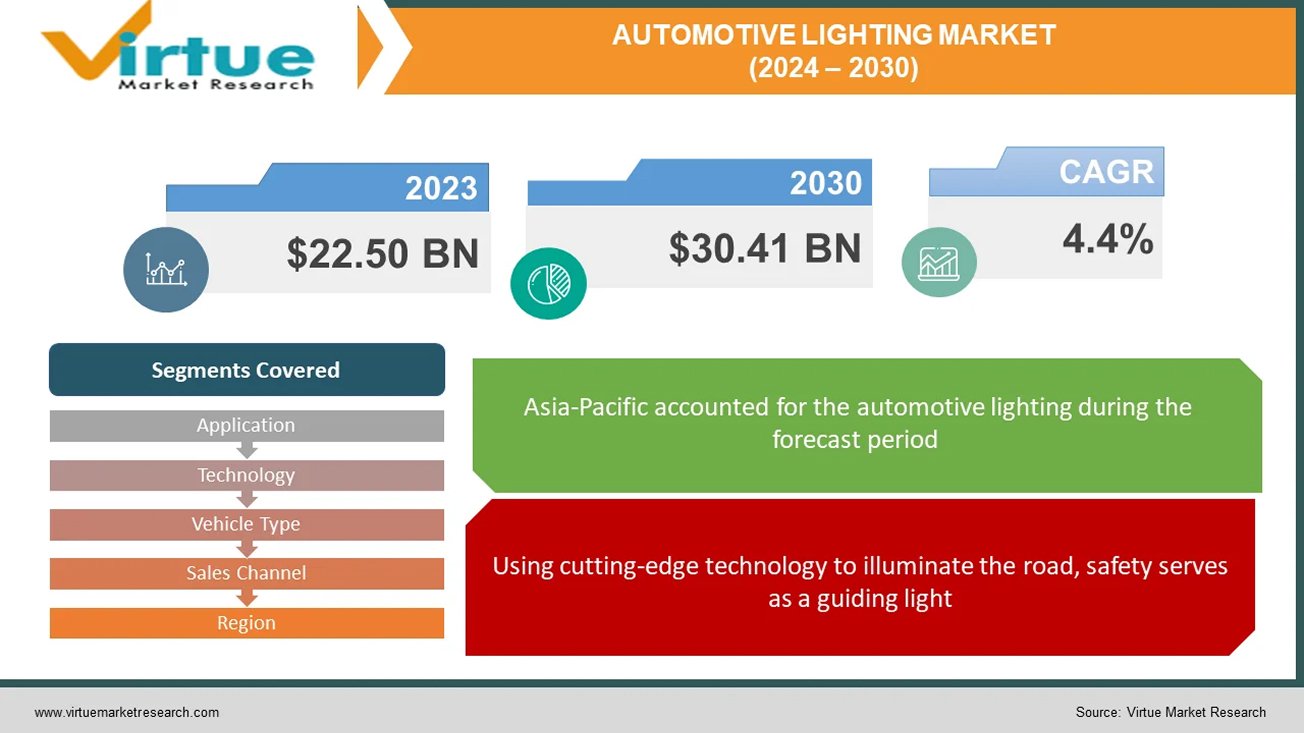
Global automotive lighting refers to all vehicle lighting systems, from headlamps that illuminate the road to taillights that communicate movements. They guarantee motorists and other road users alike safety, visibility, and style. While taillights frequently use LEDs for improved visibility, headlights are available in a variety of technologies, including LED and laser. Interior illumination, DRLs, and signal lights all have a role to play. This market, which was estimated to be worth $33.64 billion in 2022, is anticipated to rise to $67.39 billion by 2030 because of laws, luxury tastes, safety concerns, and technological developments like OLED taillights and adaptive headlights. Anticipate a future dominated by intelligent, connected, personalized, and sustainable lighting systems that enhance the safety, efficiency, and aesthetic appeal of automobiles.
Key Market Insights:
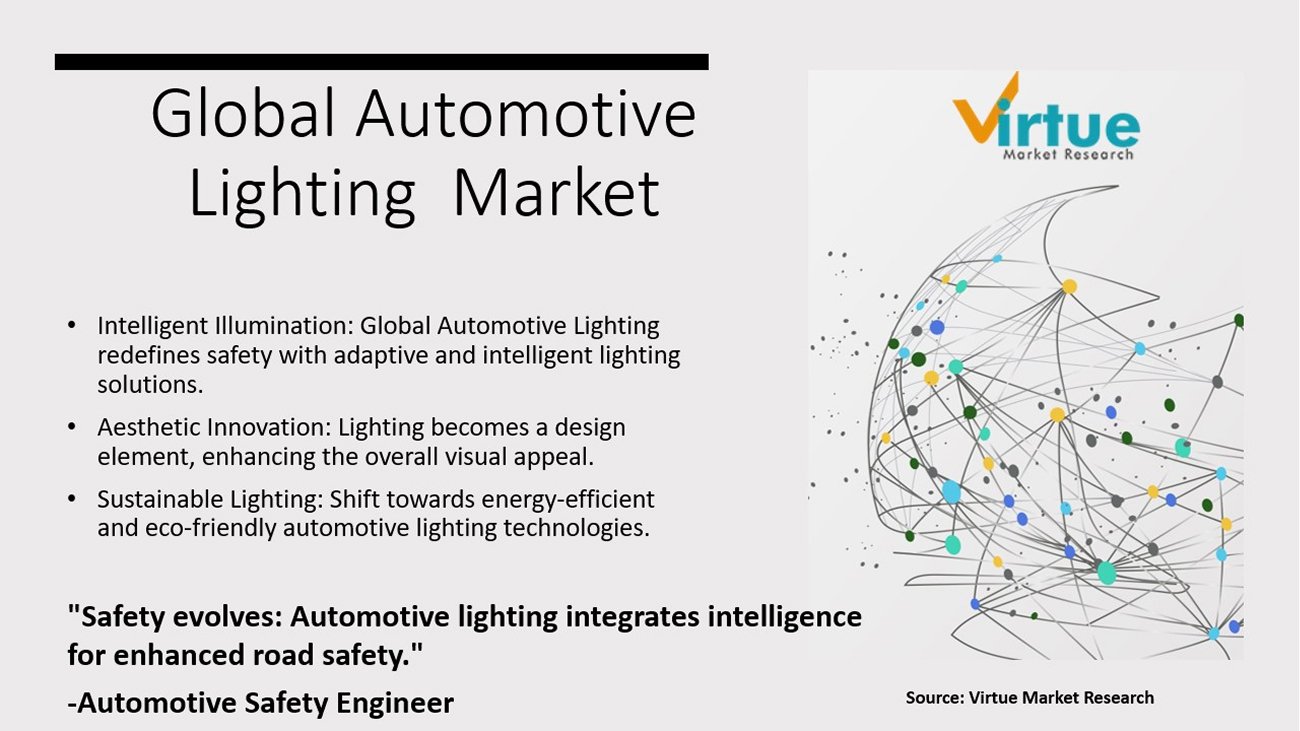
Car lighting works its magic to provide safety, visibility, and style. Headlights cut through the night, taillights express intent, and interiors shine with comfort. The billion-dollar global business is expected to rise due to consumer demand for high-end experiences, safer roads, and cutting-edge technology. Imagine dynamic messages being painted by taillights, headlights that adjust to the road, and interiors that customize their atmosphere. Driven by technological advancements like linked systems and laser beams, this future is calling. Anticipate even more visually attractive, environmentally friendly, and intelligent lighting to illuminate the way ahead, making cars safer, more efficient, and unquestionably cooler.
Global Automotive Lighting Market Drivers:
Using cutting-edge technology to illuminate the road, safety serves as a guiding light.
In the market for automobile lighting, safety is the driving force behind demand from the public and laws. While automated high beams smoothly react to traffic, adaptive headlights modify their beams so as not to blind other people. With visually striking displays, dynamic taillights convey intentions for braking and turning. Beyond these developments, integrated pedestrian identification and lane departure alerts will soon make roads safer and brighter for everyone.
Beyond Performance-Based Luxuries Redefined by Light.
Luxurious automobile lighting creates a distinct visual identity that goes beyond simple illumination. Personalized interior lighting customizes the driving experience by setting the mood with a range of colours and intensities, while intricate designs and distinctive DRLs modify exteriors. As you approach your automobile at night, welcoming lights lead the way, resulting in an interior that is perfectly lit. Not only is this symphony of light aesthetically pleasing, but it also stands as a tribute to luxury. Upcoming developments like gesture-controlled lighting and holographic displays promise to further enhance the experience.
Fuel Efficiency Takes the Lead: Illuminating Sustainability
The worldwide automotive lighting market is undergoing a significant transition towards energy-efficient solutions, as environmental concerns gain prominence. LED technology is leading the way, providing a ray of hope for the environment and drivers alike. LED lights beam brighter and use a lot less energy than conventional halogen lamps. There are some tangible advantages to this. For drivers, this translates to increased fuel economy, which lowers petrol prices and lessens reliance on fossil fuels. Greater air quality and a reduction in the transport sector's contribution to climate change are the results of reduced overall emissions.
To Learn more about this report,
Global Automotive Lighting Market Restraints and Challenges:
Although the global automotive lighting business is booming, there are still unknowns. Difficulties impede growth even as innovation propels it with eye catching features like laser beams and adaptable headlights. These technologies are luxury items due to their high cost and difficult integration, which puts producers' abilities to the test. The worldwide patchwork created by unclear legislation limits the potential of innovation. Durability issues persist, particularly when complex systems are subjected to challenging conditions. Ultimately, a lot of drivers still don't fully understand how these improvements can help them. Together, we can overcome these obstacles. The keys to reducing costs are improved production, more seamless integration, and unified regulations. Their full potential can be realized by educating customers about the safety, efficiency, and aesthetic value of these lighting wonders. By working together, we can pave the way for an even brighter and safer future for vehicle lighting.
Global Automotive Lighting Market Opportunities:
It is made possible by advanced LED technology, which gives drivers the ability to customize their illumination for the highest level of comfort and flair. Consumers that care about the environment want greener products, and vehicle lighting complies. While solar- and self-powered lighting technologies offer a future powered by clean energy, energy-efficient LEDs lower pollution. The advent of connected lighting systems heralds a new age. Envision automobiles interacting with infrastructure and one another to minimize accidents and enhance traffic efficiency. Integrated headlights with pedestrian recognition provide unmatched safety, while dramatic taillights with eye-catching displays alert onlookers to your intentions. The possibilities are endless in the future. Gesture-controlled interior illumination, holographic displays projected onto the road, and even light fixtures with self-healing capabilities.
AUTOMOTIVE LIGHTING MARKET REPORT COVERAGE:
To Learn more about this report,
Global Automotive Lighting Market Segmentation: By Application
Exterior Lighting
Interior Lighting
Due to laws requiring safety features like headlights, taillights, and brake lights, exterior lighting presently holds the most market share in the vehicle lighting industry. The dominance of this market is partly attributed to advancements in safety-focused technologies such as adaptive headlights and daytime running lights. The market value of external lighting is increased by the quick adoption of technology like LED bulbs and laser lights, which improve performance and aesthetics. Conversely, the interior lighting market is expected to increase at the fastest rate in the upcoming years. Innovations like ambient lighting and technology breakthroughs like LED and OLED displays, driven by consumer demand for comfort and personalisation, open new possibilities. The spread of sophisticated interior lighting systems is further driven by the growing emphasis on safety and the expansion of the luxury car market.
Global Automotive Lighting Market Segmentation: By Technology
Halogen
LED (Light-Emitting Diode)
Xenon
Emerging Technologies
The worldwide vehicle lighting market is currently dominated by halogen because of its more affordable price, advanced technology, and useful illumination. With its dependable supply chain and affordable option for manufacturers and cost-conscious customers, halogen holds the biggest market share. The fastest-growing market right now is LEDs, which are predicted to shortly overtake halogen. The rapid expansion of LEDs is driven by their higher efficiency, longer lifespan, flexibility in design, and technological breakthroughs including enhanced brightness. Because LEDs use less energy and produce fewer emissions and better fuel economy, they are becoming more and more popular in the changing automotive lighting market.
Global Automotive Lighting Market Segmentation: By Vehicle Type
Passenger Cars
Commercial Vehicles
Passenger automobiles rule the worldwide automotive lighting market. The sheer number of passenger cars produced which surpasses that of business vehicles and fuels the need for lighting systems is the primary cause of this popularity. The growing demand for personal automobiles in developing nations is a result of rising disposable income, which in turn drives the rise of the passenger car market. The importance that consumers place on safety and aesthetics elements helps to drive market expansion. But in the upcoming years, the market for electric and hybrid cars is expected to develop at the quickest rate. The exponential rise of the worldwide electric car market, which is still expanding and shows no signs of slowing down, is what is driving this surge. Specialised lighting solutions are required since electric and hybrid vehicles have different lighting requirements because of their specific functionality and design aesthetics.
Global Automotive Lighting Market Segmentation: By Sales Channel
OEM (Original Equipment Manufacturers)
Aftermarket
Most lighting systems sold nowadays are sold by OEMs (Original Equipment Manufacturers), primarily because manufacturers pre-install lighting systems in new cars. But in the next years, the aftermarket is expected to develop at the quickest rate. This spike in demand for replacement parts, especially lighting systems, can be linked to several variables, one of them being the average age of cars. The industry is expanding because of consumers' growing desire to personalise their cars with aftermarket lighting upgrades such LED upgrades and decorative lighting. The availability and affordability of technologies like adaptive headlights and laser lights in the aftermarket, together with other advancements in lighting technology, are driving demand even more. Moreover, the growing market for electric cars (EVs).
To Learn more about this report,
Global Automotive Lighting Market Segmentation: By Region
North America
Asia-Pacific
Europe
South America
Middle East and Africa
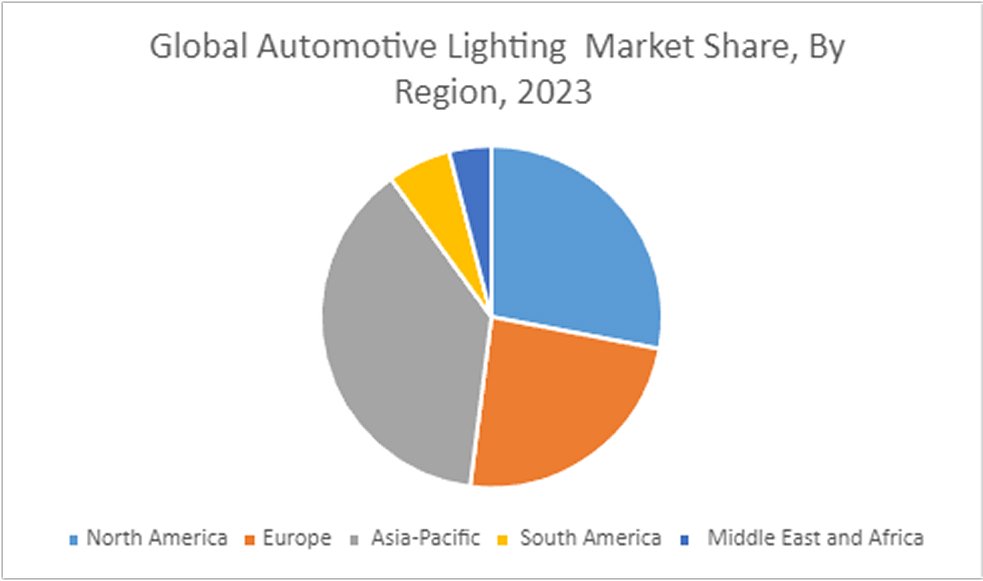
Throughout the forecast period, Asia Pacific is anticipated to be the automotive lighting market with the highest profitability. Over the past few years, Asia Pacific countries like China and India have seen notable increases in automotive manufacturing and sales, primarily in the medium-to premium luxury car segment. Asia Pacific is predicted to see an increase in the manufacturing of passenger cars, with India experiencing the strongest growth rate. Depending on the state of the national economy, the area offers a suitable selection of both high-end and cheap cars. For instance, there is a substantial demand for halogen, Xenon/HID, and LED since China and India produce more economy and mid-range automobiles. On the other hand, luxury car adoption rates are greater in South Korea and Japan, where LED lighting is the norm.
COVID-19 Impact Analysis on the Global Automotive Lighting Market:
A brief shadow was thrown by COVID-19 over the worldwide automotive lighting market. Production was stopped by lockdowns and supply chain disruptions, while luxury lighting upgrades were shelved by consumers on a tight budget. Resources became scarce, and R&D stagnated. Still, the market is recovering thanks to resurgent demand and rearranged priorities. While energy-efficient LEDs are being pushed towards adoption by sustainability, safety concerns are driving interest in features like pedestrian detection and adaptive headlights. The digital push of the epidemic creates opportunities for intelligent, networked lighting systems that may interact with infrastructure and other cars. Ultimately, the industry is positioned to shine brighter, focused on safety, sustainability, and a connected future, even though the pandemic dimmed its brilliance.
Recent Trends and Developments in the Global Automotive Lighting Market:
A development collaboration between OSRAM Continental and REHAU aims to incorporate lighting into external components, providing automobile manufacturers with innovative lighting options that improve functionality and design flexibility. For rear combination lamps, Hella unveiled a revolutionary lighting innovation called Hella FlatLight technology. A Memorandum of Understanding (MoU) was signed by Samvardhana Motherson Automotive Systems Group BV (SMRPBV), a division of Motherson Group, and Marelli Automotive Lighting to investigate a technology collaboration focused on intelligently lighted external body components. Valeo debuted their revolutionary 360° lighting system at the Shanghai Auto Show. This technology surrounds the car with a band of light, projecting instantaneous, clear signs that other drivers can see from a distance. Pedestrians, cyclists, and scooter riders are especially susceptible to these signals
Key Players:
AMS Osram
Cree
Hella
Hyundai Mobis
Koito
Luminus Devices
Magneti Marelli
Osram Licht AG
Stanley Electric
Valeo
Chapter 1. Middle East and Africa Smart Vending Machine Market – SCOPE & METHODOLOGY
1.1. Market Segmentation
1.2. Scope, Assumptions & Limitations
1.3. Research Methodology
1.4. Primary Sources.
1.5. Secondary Sources Chapter 2. MIDDLE EAST AND AFRICA SMART VENDING MACHINE MARKET – EXECUTIVE SUMMARY
2.1. Market Size & Forecast – (2025 – 2030) ($M/$Bn)
2.2. Key Trends & Insights
2.2.1. Demand Side
2.2.2. Supply Side
2.3. Attractive Investment Propositions
2.4. COVID-19 Impact Analysis Chapter 3. MIDDLE EAST AND AFRICA SMART VENDING MACHINE MARKET – COMPETITION SCENARIO
3.1. Market Share Analysis & Company Benchmarking
3.2. Competitive Strategy & Development Scenario
3.3. Competitive Pricing Analysis
3.4. Supplier-Distributor Analysis Chapter 4. MIDDLE EAST AND AFRICA SMART VENDING MACHINE MARKET - ENTRY SCENARIO
4.1. Regulatory Scenario
4.2. Case Studies – Key Start-ups
4.3. Customer Analysis
4.4. PESTLE Analysis
4.5. Porters Five Force Model
4.5.1. Bargaining Middle East and Africa Smart Vending Machine of Suppliers
4.5.2. Bargaining Risk Analytics s of Customers
4.5.3. Threat of New Entrants
4.5.4. Rivalry among Existing Players
4.5.5. Threat of Substitutes Players
4.5.6. Threat of Substitutes Chapter 5. MIDDLE EAST AND AFRICA SMART VENDING MACHINE MARKET - LANDSCAPE
5.1. Value Chain Analysis – Key Stakeholders Impact Analysis
5.2. Market Drivers
5.3. Market Restraints/Challenges
5.4. Market Opportunities Chapter 6. MIDDLE EAST AND AFRICA SMART VENDING MACHINE MARKET – By Product
6.1 Introduction/Key Findings
6.2 Smart Snack & Beverage Machines
6.3 Cold Chain & Medical Vending
6.4 Automated Retail Kiosks
6.5 Multifunctional Vending Systems
6.6 Y-O-Y Growth trend Analysis By Product
6.7 Absolute $ Opportunity Analysis By Product , 2025-2030
Chapter 7. MIDDLE EAST AND AFRICA SMART VENDING MACHINE MARKET – By Application
7.1 Introduction/Key Findings
7.2 Retail & Convenience
7.3 Healthcare & Pharmaceuticals
7.4 Airports, Transit Hubs & Hospitality
7.5 Corporate & Education Campuses
7.6 Public & Remote Access Points
7.7 Y-O-Y Growth trend Analysis By Application
7.8 Absolute $ Opportunity Analysis By Application , 2025-2030
Chapter 8. MIDDLE EAST AND AFRICA SMART VENDING MACHINE MARKET - By Geography – Market Size, Forecast, Trends & Insights
8.1. Middle East & Africa
8.1.1. By Country
8.1.1.1. United Arab Emirates (UAE)
8.1.1.2. Saudi Arabia
8.1.1.3. Qatar
8.1.1.4. Israel
8.1.1.5. South Africa
8.1.1.6. Nigeria
8.1.1.7. Kenya
8.1.1.8. Egypt
8.1.1.8. Rest of MEA
8.1.2. By Product
8.1.3. By Application
8.1.4. Countries & Segments - Market Attractiveness Analysis
Chapter 9. MIDDLE EAST AND AFRICA SMART VENDING MACHINE MARKET – Company Profiles – (Overview, Product Portfolio, Financials, Strategies & Developments)
9.1 Crane Co. (Vending Solutions)
9.2 Azkoyen Group
9.3 Selecta Group (vending & coffee services)
9.4 SandenVendo (Sanden Holdings)
9.5 N&W Global Vending (evoca group)
9.6 VendoPark (regional operator)
9.7 Vendon (software & telemetry provider)
9.8 Nayax (cashless payments & management)
9.9 USI (United Solutions International – cold chain vending)
9.10 Robomatica / Local kiosks and integrators
Report Code: VMR-203 | Published Date: July 2025 | Format: Excel and PDF
The 3D Scanning Market was valued at USD 2.28 billion in 2024 and is projected to reach a market size of USD 5.37 billion by the end of 2030. Over the forecast period of 2025-2030, the market is projected to grow at a CA...
Report Code: VMR-14818 | Published Date: July 2024 | Format: Excel and PDF
The Global Passwordless Authentication Market is expected to grow from USD 22.70 billion in 2025 to approximately USD 49.13 billion by 2030, at a 16.7% CAGR from 2026-2030.
Report Code: VMR-435 | Published Date: March 2024 | Format: Excel and PDF
The Equity Management Software Market was valued at USD 591.85 million in 2023. Over the forecast period of 2024-2030, it is projected to reach USD 1508.47 million by 2030, growing at a CAGR of 14.3%.
Report Code: VMR-15816 | Published Date: March 2024 | Format: Excel and PDF
The global intellectual property (IP) services market was valued at USD 2.8 billion and is projected to reach a market size of USD 6.38 billion by the end of 2030. Over the forecast period of 2024–2030, the market is pro...
“We received a complex piece of work for our niche market from Virtue Market research in short period of time. I appreciate the quality and content of the final files we received. Thanks for the support”
Medical Devices Company based in Europe
“We received a complex piece of work for our niche market from Virtue Market research in short period of time. I appreciate the quality and content of the final files we received. Thanks for the support”
Medical Devices Company based in Europe
“We received a complex piece of work for our niche market from Virtue Market research in short period of time. I appreciate the quality and content of the final files we received. Thanks for the support”
Medical Devices Company based in Europe
“We received a complex piece of work for our niche market from Virtue Market research in short period of time. I appreciate the quality and content of the final files we received. Thanks for the support”
Medical Devices Company based in Europe
“We received a complex piece of work for our niche market from Virtue Market research in short period of time. I appreciate the quality and content of the final files we received. Thanks for the support”
Medical Devices Company based in Europe
“We received a complex piece of work for our niche market from Virtue Market research in short period of time. I appreciate the quality and content of the final files we received. Thanks for the support”