The Managed Detection & Response (MDR) Services Market was valued at USD 4.19 billion in 2025 and is projected to reach a market size of USD 11.30 billion by the end of 2030. Over the forecast period of 2026-2030, the market is projected to grow at a CAGR of 21.95%.
The Managed Detection & Response (MDR) Services Market encompasses a segment of cybersecurity offering a set of services through a managed service model, including threat monitoring on a 24/7 basis, advanced threat detection, rapid incident response, and expert-led remediation. This industry has risen when entities started realizing the inadequacy of traditional security tools against sophisticated, stealthy, and persistent scenarios of cyber threats. MDR services combine technologies such as endpoint detection, network analytics, behavioral monitoring, and threat intelligence with the human expertise of security analysts and threat hunters, thus allowing a proactive approach to the defense rather than a reactive approach to the recovery. The market is influenced by the increasing complexity of attack vectors that involve ransomware, fileless malware, and identity-based attacks, all of which require continuous monitoring and rapid response capabilities. Enterprises from various sectors are resorting to MDR as a solution to the shortage of skills in their internal security teams and, at the same time, to gain better visibility of their hybrid and cloud-based environments. In terms of strategy, MDR services are considered a more affordable option to building and running an in-house security operations center, providing scalability, shorter detection times, and less time for attackers to dwell in the environment. The MDR Services Market is still changing and growing in response to the rapid digitization and the tighter regulations, and it is increasingly becoming a vital element in the development of resilient, intelligence-driven cybersecurity frameworks for modern organizations.
Key Market Insights:
Talent shortage is accelerating MDR adoption. The global cybersecurity workforce gap is on the order of 4.8 million unfilled roles, while total active cyber professionals are roughly 5.5 million. This shortfall is a major driver for organisations to outsource detection & response capabilities to managed providers.
Generative AI is both a new defensive capability and a perceived risk. Uptake is rapid. Roughly 52% of surveyed business/tech leaders expect generative AI to cause “catastrophic” cyber incidents within 12 months, while a large share (69% in the survey) plan to deploy generative AI tools for cyber-defence within the next year, creating demand for MDR providers that embed AI-assisted detection and response.
MDR materially shortens attacker dwell time and response metrics. Industry telemetry shows median attacker dwell time improving to 10 days (from 16 days year-on-year), and multiple operational studies/surveys report that managed detection solutions commonly cut mean-time-to-detect / mean-time-to-respond by around 40–60%, with typical MDR response turnarounds measured in hours (often 3 hours) versus much longer in-house averages. These operational gains are a key ROI argument for MDR.
Asia-Pacific is the fastest-growing geography for security investment (and MDR uptake). Regional analyses show Asia-Pacific security spending has been rising rapidly (reported 12.8% CAGR since 2022 in one large survey) and APAC is widely cited as the fastest-growing region for managed security/MDR adoption, making it a priority expansion market.
The product/service evolution: MXDR / XDR, telemetry fusion, automation & AI. The market is moving beyond endpoint-only MDR toward extended MDR (MXDR/XDR) that fuses endpoint, cloud, identity, and network telemetry with automation and AI-assisted threat hunting. Large industry studies also call out huge growth in vended security spending and massive telemetry volumes (e.g., trillions of signals analysed), which together are changing provider economics and capabilities. Deloitte
Market Drivers:
The Rising Sophistication of Cyber Threats Is Accelerating the Adoption of Managed Detection and Response (MDR) Services.
In the digital age today, organizations of all types are co-existing with an increasingly aggressive cybersecurity environment where the threats change very quickly, not only by their scale, but also by their sophistication and impact. Cyber villains nowadays resort to features like zero-day exploits, advanced persistent threats (APTs), ransomware-as-a-service, fileless malware, and social engineering tactics that can easily evade traditional security defenses like antivirus software and static firewalls. As the number of attacks grows to the extent that enterprises are confronted with hundreds of intrusion attempts each year and are experiencing high-severity incidents virtually daily, the realization has dawned on everyone that traditional, perimeter-based defenses are no longer adequate. Companies are coming to terms with the fact that merely detecting threats is not enough and that will have to be replaced by real-time, continuous monitoring and rapid response to minimize dwell time and operational damage. This change in how risk is perceived is one of the major reasons behind the growing popularity of Managed Detection and Response (MDR) services, which give you 24/7 threat visibility, proactive threat hunting, and expert-led incident response empowered by artificial intelligence and behavior-based analytics. By lessening alert fatigue, enhancing the accuracy of detections, and allowing quicker containment of sophisticated attacks, MDR services overcome the technical as well as the operational constraints of internal security teams. Accordingly, the move towards MDR from a mere security upgrade to a strategic move by enterprises aiming to secure their vital assets, ensure regulatory compliance, and keep the trust of their stakeholders in the time of constant cyber risks has been irrevocably changed.
Global Shortage of Skilled Cybersecurity Professionals Is Driving Enterprises Toward MDR Service Providers.
While escalating cyber threats are a major reason for organizations stepping up their security, an equally important internal challenge is slowly making the task of these security teams more and more difficult: the global shortage of skilled cybersecurity professionals. Besides security teams internally being stretched due to the proliferation of technologies that require digital transformation – expanding cloud adoption, remote work models, growing data volumes, and an increasing number of connected devices – and often lacking the advanced expertise needed to effectively detect, analyze, and respond to sophisticated attacks, the problem of scarcity of highly skilled individuals only gets more complicated. The shortage of skills is most visibly evident in areas where the work is of high-skill and relies heavily on human operator skills, such as threat-intelligence analysis, proactive threat hunting, and rapid incident response - areas where automation is not enough and human judgment is indispensable. Even organizations that aim to grow their security operations by hiring more people are faced with strong competition from others for talent, so it is very challenging to have and maintain a fully staffed security operations center. Therefore, most corporations have been outsourcing to Managed Detection and Response (MDR) service providers who come with experienced analysts, 24/7 monitoring, and high-level security capabilities, all of which would take the organizations years to develop internally if they decided not to outsource. Using the services of an MDR provider, companies can get over the hurdle of a lack of experts, enjoy the benefits of economies of scale and be equipped with advanced security tools, while their in-house teams can stay focused on strategic initiatives and business innovation; hence, it comes as no surprise that leveraging MDR is increasingly seen as a practical and effective way to respond to persistent talent shortages and rising cyber risk.
Market Restraints and Challenges:
Several major factors and issues hamper the Managed Detection & Response (MDR) services market from being widely adopted and scaled in corporations. One is the critical shortage of competent cybersecurity personnel that continues to be a major challenge. MDR providers depend greatly on skilled threat analysts and incident responders to offer 24/7 monitoring and quick remediation. Therefore, this lack of human capital drives up the providers' operational costs, confines the extent of their service offerings, and brings about the challenge of maintaining the right mix of automation and human skills. Additionally, integration challenges with legacy IT environments represent another big limitation. In such cases, the use of disconnected security tools and the old infrastructure prevents easy data correlation and obtaining real-time threat visibility. These difficulties usually make the time required for the rollout longer, impair the quality of the response mechanisms, and lead to organizations being reluctant to the idea of unified and agile security operations. As a result, these issues hinder the overall market penetration.
Market Opportunities:
The Managed Detection & Response (MDR) Services Market will be able to tap into significant growth opportunities as enterprise security needs continue to evolve and global digital expansion unfolds. For instance, the growing demand from small and midsized organizations and the developing economies, which nowadays face limitations in terms of their own cybersecurity experts/scarce in-house cybersecurity expertise, and the frequency of cyberattacks is getting higher, hence further speeding the change to outsourced, subscription-based MDR solutions, is one major opportunity. Thus, providers that deliver scalable, affordable, and cloud-native offerings will be able to break through these less-served segments. Moreover, there is another strong opportunity in the combination of the latest technology and the adaptation to the needs of the chosen industries, as the organisations' constant pursuit of MDR platforms augmented with AI, automation, and extended detection capabilities, will be at the core of the demand they generate eventually. Industries such as healthcare, financial services, and critical infrastructure are turning to MDR solutions that marry real-time threat intelligence with regulatory compliance support, thus allowing vendors to set apart their products and be laden with a base of satisfied clients, who will provide them with long-term, high-value business.
Endpoint-centric MDR services hold the majority of the MDR market share at present since entities are mainly concerned with protecting laptops, desktops, mobile devices, and IoT devices from cyberattacks that are becoming more and more sophisticated. Through these services, a company is able to closely track the activities, detect any impending threat, and swiftly respond to it, only at an endpoint, thereby safeguarding the functioning of the essential business operations. The segment's popularity is attributable to the global shift towards work from home, Bring Your Own Device (BYOD) policies, and the rise of endpoint-heavy networks, which have caused enterprises to look at endpoint security as their highest priority, regardless of their sector.
Cloud-Native MDR Services are the fastest-growing subsegment by a wide margin, as this trend mirrors the rapid pace at which enterprise workloads are being moved to cloud environments. The demand for multi-cloud and hybrid cloud architectures is leading to an explosion in the necessity of specialized MDR solutions that can continuously secure dynamic cloud infrastructures. By utilizing threat intelligence, automation, and AI-powered analytics at an advanced level, cloud native MDR can rapidly ascertain and counteract cloud-specific threats. The increasing use of cloud, combined with the need for scalability and the growing complexity of cyber-attacks on cloud workloads, are the main drivers of this segment's growth.
Managed Detection & Response (MDR) Services Market Segmentation By Application
• Banking, Financial Services & Insurance (BFSI)
• IT & Telecommunications
• Government & Defense
• Healthcare
• Manufacturing
• Retail
• Energy & Utilities
• Other Industries
Banking, Financial Services & Insurance (BFSI) accounts extensively for the MDR services market share as the sector is in dire need of strong cybersecurity measures. Financial institutions deal with a large amount of highly sensitive information, such as personal, transactional, and investment data, which renders them attractive targets for highly skilled cybercriminals. MDR services help BFSI companies to protect their resources, comply with the law, and keep their customers' confidence through continuous monitoring, threat intelligence, and rapid incident response. The increased use of digital banking, mobile payments, and fintech solutions further supports the need for sophisticated threat detection and response capabilities, thus making BFSI the largest application segment in this market.
Healthcare is becoming the most rapidly expanding sector application of MDR services. These days, hospitals, clinics, and research facilities in medicine are increasingly dependent on digital records, telemedicine, and medical devices connected to the internet, which means an increased risk of attack from cyber threats. Moreover, the increase in ransomware attacks on healthcare institutions and the very strict patient data protection compliance requirements are the main reasons why healthcare organizations are embracing MDR solutions at breakneck speed. As healthcare digitization is taking place at a global level faster and faster, the need for cybersecurity services that are proactive, managed, or both will skyrocket, thus making it the fastest-growing segment of the market by application.
• North America
• Europe
• Asia Pacific
• Latin America
• Middle East & Africa
North America leads the market for MDR services as a result of the widespread use of highly advanced cybersecurity solutions by both enterprises and government organizations. This area reaps benefits from a very developed IT infrastructure, tightly regulated laws, and the increasing knowledge about highly skilled cyber attackers. Companies in North America are turning to MDR vendors to help safeguard their data, meet compliance standards, and generally strengthen security. The heavy consumption here makes North America the top regional market for MDR services worldwide.
Asia Pacific is the fastest-growing regional market segment of the global Managed Detection and Response (MDR) services, with the growth being driven by rapid digital transformation, cloud technology adoption, and the growing number of small and medium-sized enterprises (SMEs) in the developing economies. The increasing number of cyberattacks and the lack of sufficient in-house cybersecurity skills in countries like India, China, and Southeast Asia have led enterprises to seek external help in threat detection and response. Besides that, the heightened emphasis on governmental programs in cybersecurity and the development of smart infrastructure are the key factors propagating MDR uptake in the region, thereby making it the most vibrant and fastest-growing market worldwide.
COVID-19 Impact Analysis:
The COVID-19 pandemic not only changed the security priorities of enterprises but also acted as a major rescheduling factor for the Managed Detection & Response (MDR) services market. When organizations transitioned to remote and hybrid work models, the traditional perimeter-based security was weakened, hence the attack surfaces were extended across the endpoints, cloud workloads, and home networks. In response to such changes, phishing, ransomware, credential theft, and supply-chain attacks saw a spurt in cases, and enterprises gladly acknowledged the need for continuous, expert-led threat monitoring. As the price and complexity of building in-house security operation centers are high, MDR services have been rapidly gaining popularity, offering real-time detection, advanced analytics, and rapid incident response. Small and mid-sized enterprises, in particular, have been trying to balance their limited cybersecurity staff with compliance requirements, and that is why they have chosen MDR solutions. Alongside cloud adoption and usage of SaaS, MDR vendors have also been accelerated during the pandemic, which has increased the demand for MDR vendors who can provide the security of distributed and dynamic environments. At the same time, budgeting uncertainties have been an encouragement for companies to opt for subscription-based MDR, which offers predictable costs and measurable risk reduction. To sum up, the COVID-19 pandemic has switched MDR from a helper security option to the core resilience strategy, thereby positioning managed threat detection and response as an indispensable service to maintain business continuity, operational trust, and cyber readiness in an increasingly digital and threat-intensive global landscape.
Latest Market News:
In March 2024, Dell Technologies and CrowdStrike expanded their strategic partnership to deliver comprehensive MDR services powered by the CrowdStrike Falcon® XDR platform, aiming to supercharge threat detection and response capabilities for combined enterprise clients worldwide.
In June 2024, Darktrace unveiled a new Managed Detection & Response (MDR) service blending AI-driven threat containment with 24/7 expert support, poised to bolster security operations across diverse enterprise environments as AI threats rise.
In April 2025, Rapid7 officially launched Managed Detection & Response (MDR) for Enterprise, a fully managed, customizable MDR service targeting complex distributed IT environments with tailored detection engineering and continuous 24×7 global SOC coverage.
In January 2025, Sophos announced enhancements to its MDR service, reporting support for more than 26,000 customers worldwide, a growth of 37% in 2024, highlighting strong adoption of expert-led detection and response across global customers.
Latest Trends and Developments:
The Managed Detection & Response (MDR) services market is rapidly changing as AI and machine learning are integrated for automated threat detection, triage, and containment, which allows a near-real-time response and reduces false positives. Cloud-native and hybrid MDR offerings are gaining popularity as they can provide scalable security to multi-cloud and distributed environments while also satisfying regional compliance requirements. Also, the market is moving towards Extended Detection & Response (XDR) integration that allows a single view across endpoints, networks, clouds, and applications for quicker and more accurate threat detection and mitigation. The combination of proactive threat hunting and DNS-based incident response is strengthening the resilience front, allowing an organization to first identify and then neutralize an advanced persistent threat before it escalates. Vendors are responding with industry-specific solutions and developing strategic partnerships to enhance capabilities and meet regulatory requirements. MDR adoption is growing due to increased cyber threats, regulatory pressures, and skill shortages. As a result, MDR has become a strategic cybersecurity necessity rather than just an operational tool.
Key Players in the Market:
CrowdStrike
Secureworks
Palo Alto Networks
IBM
Rapid7
Arctic Wolf
FireEye
Cisco Systems
Sophos
AT&T Cybersecurity
To Learn more about this report,
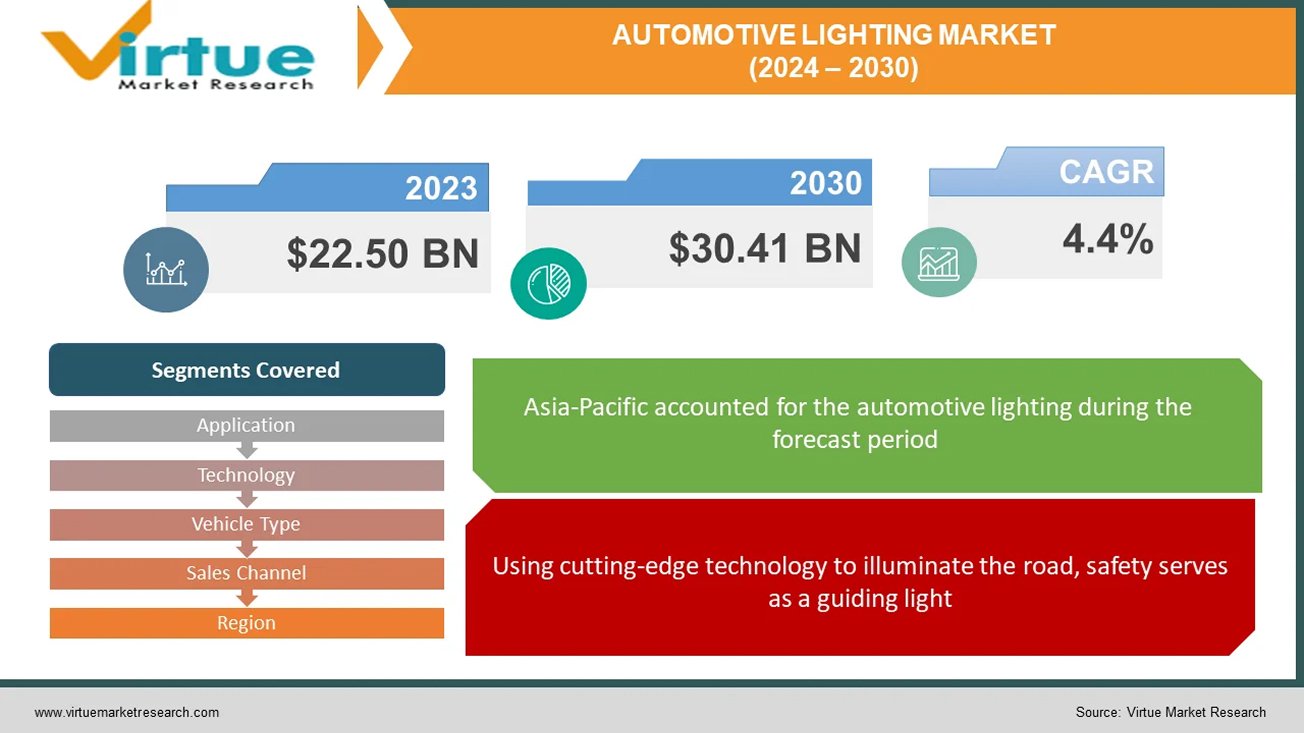
Global automotive lighting refers to all vehicle lighting systems, from headlamps that illuminate the road to taillights that communicate movements. They guarantee motorists and other road users alike safety, visibility, and style. While taillights frequently use LEDs for improved visibility, headlights are available in a variety of technologies, including LED and laser. Interior illumination, DRLs, and signal lights all have a role to play. This market, which was estimated to be worth $33.64 billion in 2022, is anticipated to rise to $67.39 billion by 2030 because of laws, luxury tastes, safety concerns, and technological developments like OLED taillights and adaptive headlights. Anticipate a future dominated by intelligent, connected, personalized, and sustainable lighting systems that enhance the safety, efficiency, and aesthetic appeal of automobiles.
Key Market Insights:
Car lighting works its magic to provide safety, visibility, and style. Headlights cut through the night, taillights express intent, and interiors shine with comfort. The billion-dollar global business is expected to rise due to consumer demand for high-end experiences, safer roads, and cutting-edge technology. Imagine dynamic messages being painted by taillights, headlights that adjust to the road, and interiors that customize their atmosphere. Driven by technological advancements like linked systems and laser beams, this future is calling. Anticipate even more visually attractive, environmentally friendly, and intelligent lighting to illuminate the way ahead, making cars safer, more efficient, and unquestionably cooler.
Global Automotive Lighting Market Drivers:
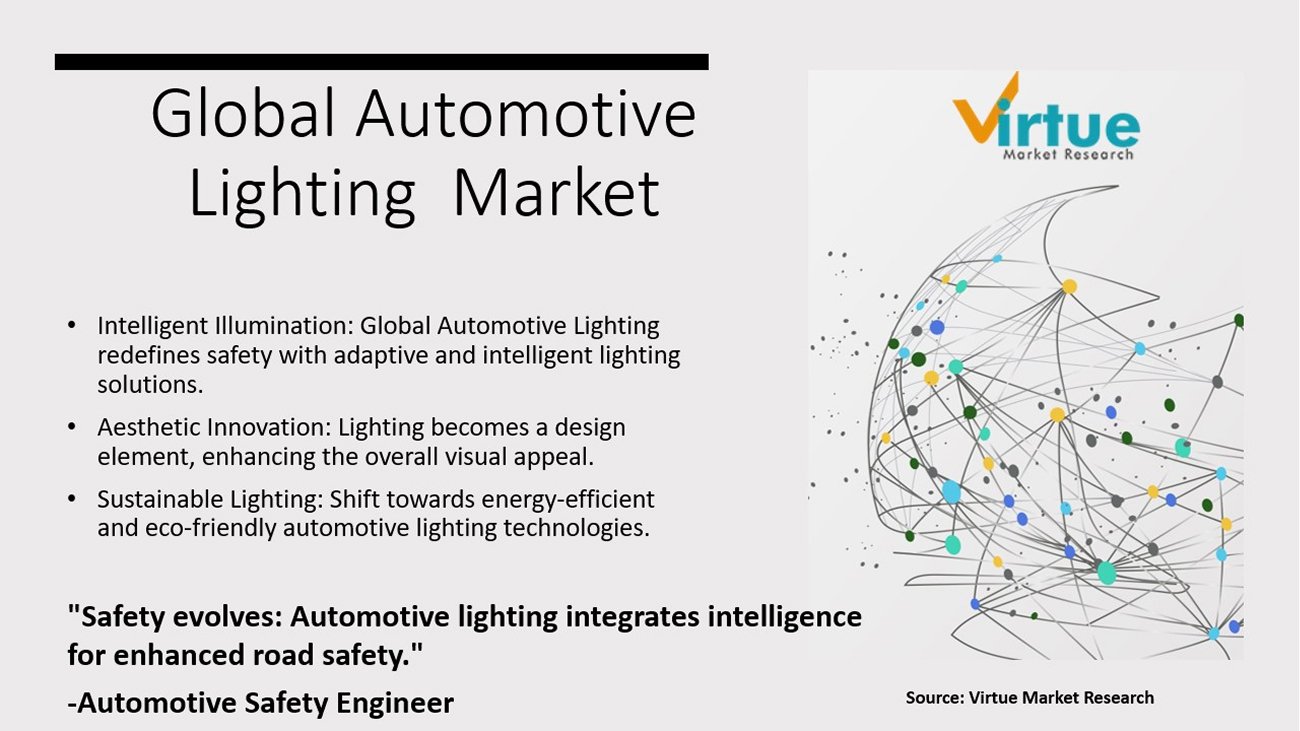
Using cutting-edge technology to illuminate the road, safety serves as a guiding light.
In the market for automobile lighting, safety is the driving force behind demand from the public and laws. While automated high beams smoothly react to traffic, adaptive headlights modify their beams so as not to blind other people. With visually striking displays, dynamic taillights convey intentions for braking and turning. Beyond these developments, integrated pedestrian identification and lane departure alerts will soon make roads safer and brighter for everyone.
Beyond Performance-Based Luxuries Redefined by Light.
Luxurious automobile lighting creates a distinct visual identity that goes beyond simple illumination. Personalized interior lighting customizes the driving experience by setting the mood with a range of colours and intensities, while intricate designs and distinctive DRLs modify exteriors. As you approach your automobile at night, welcoming lights lead the way, resulting in an interior that is perfectly lit. Not only is this symphony of light aesthetically pleasing, but it also stands as a tribute to luxury. Upcoming developments like gesture-controlled lighting and holographic displays promise to further enhance the experience.
Fuel Efficiency Takes the Lead: Illuminating Sustainability
The worldwide automotive lighting market is undergoing a significant transition towards energy-efficient solutions, as environmental concerns gain prominence. LED technology is leading the way, providing a ray of hope for the environment and drivers alike. LED lights beam brighter and use a lot less energy than conventional halogen lamps. There are some tangible advantages to this. For drivers, this translates to increased fuel economy, which lowers petrol prices and lessens reliance on fossil fuels. Greater air quality and a reduction in the transport sector's contribution to climate change are the results of reduced overall emissions.
To Learn more about this report,
Global Automotive Lighting Market Restraints and Challenges:
Although the global automotive lighting business is booming, there are still unknowns. Difficulties impede growth even as innovation propels it with eye catching features like laser beams and adaptable headlights. These technologies are luxury items due to their high cost and difficult integration, which puts producers' abilities to the test. The worldwide patchwork created by unclear legislation limits the potential of innovation. Durability issues persist, particularly when complex systems are subjected to challenging conditions. Ultimately, a lot of drivers still don't fully understand how these improvements can help them. Together, we can overcome these obstacles. The keys to reducing costs are improved production, more seamless integration, and unified regulations. Their full potential can be realized by educating customers about the safety, efficiency, and aesthetic value of these lighting wonders. By working together, we can pave the way for an even brighter and safer future for vehicle lighting.
Global Automotive Lighting Market Opportunities:
It is made possible by advanced LED technology, which gives drivers the ability to customize their illumination for the highest level of comfort and flair. Consumers that care about the environment want greener products, and vehicle lighting complies. While solar- and self-powered lighting technologies offer a future powered by clean energy, energy-efficient LEDs lower pollution. The advent of connected lighting systems heralds a new age. Envision automobiles interacting with infrastructure and one another to minimize accidents and enhance traffic efficiency. Integrated headlights with pedestrian recognition provide unmatched safety, while dramatic taillights with eye-catching displays alert onlookers to your intentions. The possibilities are endless in the future. Gesture-controlled interior illumination, holographic displays projected onto the road, and even light fixtures with self-healing capabilities.
AUTOMOTIVE LIGHTING MARKET REPORT COVERAGE:
To Learn more about this report,
Global Automotive Lighting Market Segmentation: By Application
Exterior Lighting
Interior Lighting
Due to laws requiring safety features like headlights, taillights, and brake lights, exterior lighting presently holds the most market share in the vehicle lighting industry. The dominance of this market is partly attributed to advancements in safety-focused technologies such as adaptive headlights and daytime running lights. The market value of external lighting is increased by the quick adoption of technology like LED bulbs and laser lights, which improve performance and aesthetics. Conversely, the interior lighting market is expected to increase at the fastest rate in the upcoming years. Innovations like ambient lighting and technology breakthroughs like LED and OLED displays, driven by consumer demand for comfort and personalisation, open new possibilities. The spread of sophisticated interior lighting systems is further driven by the growing emphasis on safety and the expansion of the luxury car market.
Global Automotive Lighting Market Segmentation: By Technology
Halogen
LED (Light-Emitting Diode)
Xenon
Emerging Technologies
The worldwide vehicle lighting market is currently dominated by halogen because of its more affordable price, advanced technology, and useful illumination. With its dependable supply chain and affordable option for manufacturers and cost-conscious customers, halogen holds the biggest market share. The fastest-growing market right now is LEDs, which are predicted to shortly overtake halogen. The rapid expansion of LEDs is driven by their higher efficiency, longer lifespan, flexibility in design, and technological breakthroughs including enhanced brightness. Because LEDs use less energy and produce fewer emissions and better fuel economy, they are becoming more and more popular in the changing automotive lighting market.
Global Automotive Lighting Market Segmentation: By Vehicle Type
Passenger Cars
Commercial Vehicles
Passenger automobiles rule the worldwide automotive lighting market. The sheer number of passenger cars produced which surpasses that of business vehicles and fuels the need for lighting systems is the primary cause of this popularity. The growing demand for personal automobiles in developing nations is a result of rising disposable income, which in turn drives the rise of the passenger car market. The importance that consumers place on safety and aesthetics elements helps to drive market expansion. But in the upcoming years, the market for electric and hybrid cars is expected to develop at the quickest rate. The exponential rise of the worldwide electric car market, which is still expanding and shows no signs of slowing down, is what is driving this surge. Specialised lighting solutions are required since electric and hybrid vehicles have different lighting requirements because of their specific functionality and design aesthetics.
Global Automotive Lighting Market Segmentation: By Sales Channel
OEM (Original Equipment Manufacturers)
Aftermarket
Most lighting systems sold nowadays are sold by OEMs (Original Equipment Manufacturers), primarily because manufacturers pre-install lighting systems in new cars. But in the next years, the aftermarket is expected to develop at the quickest rate. This spike in demand for replacement parts, especially lighting systems, can be linked to several variables, one of them being the average age of cars. The industry is expanding because of consumers' growing desire to personalise their cars with aftermarket lighting upgrades such LED upgrades and decorative lighting. The availability and affordability of technologies like adaptive headlights and laser lights in the aftermarket, together with other advancements in lighting technology, are driving demand even more. Moreover, the growing market for electric cars (EVs).
To Learn more about this report,
Global Automotive Lighting Market Segmentation: By Region
North America
Asia-Pacific
Europe
South America
Middle East and Africa
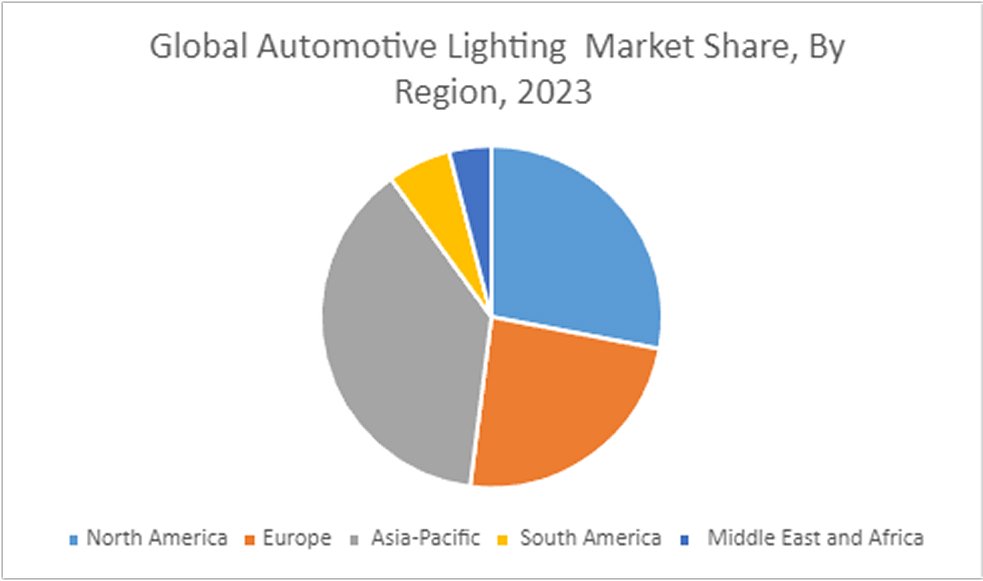
Throughout the forecast period, Asia Pacific is anticipated to be the automotive lighting market with the highest profitability. Over the past few years, Asia Pacific countries like China and India have seen notable increases in automotive manufacturing and sales, primarily in the medium-to premium luxury car segment. Asia Pacific is predicted to see an increase in the manufacturing of passenger cars, with India experiencing the strongest growth rate. Depending on the state of the national economy, the area offers a suitable selection of both high-end and cheap cars. For instance, there is a substantial demand for halogen, Xenon/HID, and LED since China and India produce more economy and mid-range automobiles. On the other hand, luxury car adoption rates are greater in South Korea and Japan, where LED lighting is the norm.
COVID-19 Impact Analysis on the Global Automotive Lighting Market:
A brief shadow was thrown by COVID-19 over the worldwide automotive lighting market. Production was stopped by lockdowns and supply chain disruptions, while luxury lighting upgrades were shelved by consumers on a tight budget. Resources became scarce, and R&D stagnated. Still, the market is recovering thanks to resurgent demand and rearranged priorities. While energy-efficient LEDs are being pushed towards adoption by sustainability, safety concerns are driving interest in features like pedestrian detection and adaptive headlights. The digital push of the epidemic creates opportunities for intelligent, networked lighting systems that may interact with infrastructure and other cars. Ultimately, the industry is positioned to shine brighter, focused on safety, sustainability, and a connected future, even though the pandemic dimmed its brilliance.
Recent Trends and Developments in the Global Automotive Lighting Market:
A development collaboration between OSRAM Continental and REHAU aims to incorporate lighting into external components, providing automobile manufacturers with innovative lighting options that improve functionality and design flexibility. For rear combination lamps, Hella unveiled a revolutionary lighting innovation called Hella FlatLight technology. A Memorandum of Understanding (MoU) was signed by Samvardhana Motherson Automotive Systems Group BV (SMRPBV), a division of Motherson Group, and Marelli Automotive Lighting to investigate a technology collaboration focused on intelligently lighted external body components. Valeo debuted their revolutionary 360° lighting system at the Shanghai Auto Show. This technology surrounds the car with a band of light, projecting instantaneous, clear signs that other drivers can see from a distance. Pedestrians, cyclists, and scooter riders are especially susceptible to these signals
Chapter 7. MANAGED DETECTION & RESPONSE (MDR) SERVICES MARKET – By Application
7.1 Introduction/Key Findings
7.2 Banking, Financial Services & Insurance (BFSI)
7.3 IT & Telecommunications
7.4 Government & Defense
7.5 Healthcare
7.6 Manufacturing
7.7 Retail
7.8 Energy & Utilities
7.9 Other Industries
7.10 Y-O-Y Growth trend Analysis By Application
7.11 Absolute $ Opportunity Analysis By Application , 2026-2030
Chapter 8. MANAGED DETECTION & RESPONSE (MDR) SERVICES MARKET - By Geography – Market Size, Forecast, Trends & Insights
8.1. North America
8.1.1. By Country
8.1.1.1. U.S.A.
8.1.1.2. Canada
8.1.1.3. Mexico
8.1.2. By Application
8.1.3. By Type
8.1.4. Countries & Segments - Market Attractiveness Analysis
8.2. Europe
8.2.1. By Country
8.2.1.1. U.K.
8.2.1.2. Germany
8.2.1.3. France
8.2.1.4. Italy
8.2.1.5. Spain
8.2.1.6. Rest of Europe
8.2.2. By Type
8.2.3. By Application
8.2.4. Countries & Segments - Market Attractiveness Analysis
8.3. Asia Pacific
8.3.1. By Country
8.3.1.1. China
8.3.1.2. Japan
8.3.1.3. South Korea
8.3.1.4. India
8.3.1.5. Australia & New Zealand
8.3.1.6. Rest of Asia-Pacific
8.3.2. By Type
8.3.3. By Application
8.3.4. Countries & Segments - Market Attractiveness Analysis
8.4. South America
8.4.1. By Country
8.4.1.1. Brazil
8.4.1.2. Argentina
8.4.1.3. Colombia
8.4.1.4. Chile
8.4.1.5. Rest of South America
8.4.2. By Type
8.4.3. By Application
8.4.4. Countries & Segments - Market Attractiveness Analysis
8.5. Middle East & Africa
8.5.1. By Country
8.5.1.1. United Arab Emirates (UAE)
8.5.1.2. Saudi Arabia
8.5.1.3. Qatar
8.5.1.4. Israel
8.5.1.5. South Africa
8.5.1.6. Nigeria
8.5.1.7. Kenya
8.5.1.8. Egypt
8.5.1.8. Rest of MEA
8.5.2. By Type
8.5.3. By Application
8.5.4. Countries & Segments - Market Attractiveness Analysis
Chapter 9. MANAGED DETECTION & RESPONSE (MDR) SERVICES MARKET – Company Profiles – (Overview, Type Portfolio, Financials, Strategies & Developments)
9.1 CrowdStrike
9.2 Secureworks
9.3 Palo Alto Networks
9.4 IBM
9.5 Rapid7
9.6 Arctic Wolf
9.7 FireEye
9.8 Cisco Systems
9.9 Sophos
9.10 AT&T Cybersecurity
Fill out the form below and our team will get back to you shortly
FAQ's
The MDR Services Market encompasses cybersecurity solutions offered via a managed service model. These services include 24/7 threat monitoring, advanced threat detection, rapid incident response, and expert-led remediation. MDR integrates technologies like endpoint detection, network analytics, behavioral monitoring, and threat intelligence with human expertise, helping organizations proactively defend against sophisticated cyber threats
Ans: The report segments the MDR market by type (Endpoint-Centric, Network-Centric, Application-Centric, Cloud-Native), by application (BFSI, IT & Telecommunications, Government & Defense, Healthcare, Manufacturing, Retail, Energy & Utilities, Other Industries), and by region (North America, Europe, Asia Pacific, Latin America, Middle East & Africa).
North America currently leads the MDR market due to advanced IT infrastructure and regulatory requirements. Asia-Pacific is the fastest-growing region, driven by digital transformation and cloud adoption. BFSI holds the largest share by application, while Healthcare is the fastest-growing sector due to increasing cyberattacks and strict data protection regulations.
Ans: Key drivers include rising cyber threat sophistication, talent shortages in cybersecurity, and increasing cloud and hybrid IT adoption. Challenges include a shortage of skilled cybersecurity professionals, integration difficulties with legacy IT systems, and operational costs associated with maintaining 24/7 managed security services.
The pandemic accelerated MDR adoption as enterprises shifted to remote and hybrid work, expanding attack surfaces. Traditional perimeter security became insufficient, and subscription-based MDR solutions gained popularity for providing continuous monitoring, rapid response, and predictable cybersecurity costs, especially for SMEs.
More related reports
Get expert-driven market research reports from a leading research partner to help you navigate the future of the global industry.
Report Code: VMR-203 | Published Date: July 2025 | Format: Excel and PDF
The 3D Scanning Market was valued at USD 2.28 billion in 2024 and is projected to reach a market size of USD 5.37 billion by the end of 2030. Over the forecast period of 2025-2030, the market is projected to grow at a CA...
Report Code: VMR-14818 | Published Date: July 2024 | Format: Excel and PDF
The Global Passwordless Authentication Market is expected to grow from USD 22.70 billion in 2025 to approximately USD 49.13 billion by 2030, at a 16.7% CAGR from 2026-2030.
Report Code: VMR-435 | Published Date: March 2024 | Format: Excel and PDF
The Equity Management Software Market was valued at USD 591.85 million in 2023. Over the forecast period of 2024-2030, it is projected to reach USD 1508.47 million by 2030, growing at a CAGR of 14.3%.
Report Code: VMR-15816 | Published Date: March 2024 | Format: Excel and PDF
The global intellectual property (IP) services market was valued at USD 2.8 billion and is projected to reach a market size of USD 6.38 billion by the end of 2030. Over the forecast period of 2024–2030, the market is pro...
“We received a complex piece of work for our niche market from Virtue Market research in short period of time. I appreciate the quality and content of the final files we received. Thanks for the support”
Medical Devices Company based in Europe
“We received a complex piece of work for our niche market from Virtue Market research in short period of time. I appreciate the quality and content of the final files we received. Thanks for the support”
Medical Devices Company based in Europe
“We received a complex piece of work for our niche market from Virtue Market research in short period of time. I appreciate the quality and content of the final files we received. Thanks for the support”
Medical Devices Company based in Europe
“We received a complex piece of work for our niche market from Virtue Market research in short period of time. I appreciate the quality and content of the final files we received. Thanks for the support”
Medical Devices Company based in Europe
“We received a complex piece of work for our niche market from Virtue Market research in short period of time. I appreciate the quality and content of the final files we received. Thanks for the support”
Medical Devices Company based in Europe
“We received a complex piece of work for our niche market from Virtue Market research in short period of time. I appreciate the quality and content of the final files we received. Thanks for the support”