Global K12 Online Education Market Research Report – Segmentation By grade level (High School (9–12), Elementary (K–5), Middle School (6–8)), By application (STEM & coding, Language & literacy, Test preparation & college readiness, Special needs & remedial learning, Others), By end user (Public schools / Districts, Private schools, Tutoring centers & Direct-to-consumer, Homeschool users); Region – Forecast (2026 – 2030)
GLOBAL K12 ONLINE EDUCATION MARKET (2026 - 2030)
The Global K12 Online Education Market was valued at USD 154.31 billion in 2025 and is projected to reach a market size of USD 401.90 Billion by the end of 2030. Over the forecast period of 2026-2030, the market is projected to grow at a CAGR of 21.1 %.
The global K12 online education market can be defined as the fast-changing digital learning ecosystem that can provide students between kindergarten and grade twelve with an organized model of academic programmes and individualized learning experiences using virtual platforms. This market in the past couple of years has shifted to being supplementary to a mainstream educational model due to increasing demands on flexibility, academic continuity and equal opportunities for obtaining learning outside of the formal classroom. The scenery is currently characterized by an active combination of interactive curriculum, immersive online material, and smart learning pathways that are supplemented by AI-powered analytics and adaptive tutoring. Online learning is becoming a common strategic practice in schools, families, and communities to increase academic achievement, serve a wide variety of learning requirements, and provide enhanced learning in the STEM, language acquisition, test preparation, and remedial support cultures. It has a market presence that stretches through government-run and privately run school systems, tutoring groups, direct-to-consumer, and increasingly large homeschooling families looking for an option to rigorous, customized learning. The students of high schools require college and career preparation programmes, whereas those studying in elementary and middle schools require the reenactment of basic knowledge and interactive modules. The world is becoming increasingly globalized, with digital infrastructure becoming smoother and educators moving to hybrid and entirely virtual classrooms that combine real-time learning with self-paced development. Portfolio vendors are adding collaborative tools, digital assessment and gamified learning designs to their portfolio to increase the level of engagement and quantifiable performance results. The current change does not only indicate the transition of technology but rather a larger change in the philosophy of education, that is, student flexibility, accessibility, and equity in learning should be placed at the heart of future academic achievement.
Key Market Insights:
Generative AI investment is growing rapidly. Hundreds of EdTech companies are projecting to increase GenAI spending by a third per year, and those with long-established AI plans are projecting an ROI per (claiming) 3-fold higher.
Pandemic disruptions set many K-12 students several months further back in core subjects (meaning on average about half a year in math and nearly four months in reading), fueling the continued demand for online remediation and blended-learning tools.
Increasing institutional interest in AI-enabled personalisation: adaptive learning, real-time feedback, automated assessment, etc., are being considered to be rolled out on a bigger scale.
Although 1/3+ of major EdTech providers continue to be based in North America, Asia (particularly India and China) is also proving a force, owing to high student enrolment, mobile usage, and favourable digital-education policy.
Extremely high smartphone penetration and diverse connectivity are driving product design towards mobile-first, low-bandwidth-compatible, and offline learning applications, particularly in emerging or underserved areas.
Investors and partners in the public sector are redirecting their attention: today, they prefer to invest in EdTech projects that show practical learning results, effective data and analytics, and valuable impact, and not only user growth.
Market Drivers:
Increased need for customized, versatile, and competence-based online learning is driving the market.
The increasing demand for flexible and student-focused learning environments where learners can work at their own pace is the first significant driving factor that defines the Global K-12 Online Education Market. Parents, educators and school systems around the world are realizing that the traditional classroom model, constructed based on rigid timetables and standardized approaches to teaching, is failing to effectively accommodate the different learning paces, learning styles and academic preparation levels. This is being bridged by online platforms that target younger learners up to high school students with adaptive learning tracks, real-time assessment, and interactive content that are not based on general meanings but individual ability. The modern generation of students is getting exposed to online ecosystems that promote inquisitiveness, imagination, and critical thinking.
Increasing focus on academic achievement, competitiveness on tests, and learning based on skills is driving the market.
The third strong force that has been shaping the development of the K-12 online learning industry is the mounting pressure on students to attain better academic grades and competitive results that open the gateway to future prospects. Parents, teachers, and schools all over the world are focusing on good performance in standardized tests, college admissions preparation, and mastery of specific subjects. Due to the increase in expectations and competition in the university admissions and scholarship opportunities, digital learning resources aimed at enhancing academic outcomes are fast gaining adoption. Online platforms have played a critical role in test preparation, skills development, and focused remediation to assist students to overcome learning gaps.
Market Restraints and Challenges:
The international K-12 online education sector is faced with a complex net of limitations and problems hindering adoption and scaling. Lack of balanced digital infrastructure means that there are various districts that have unreliable connectivity or computer devices that are of old age. Low investment over the long term is constrained by budgetary limitations and disjointed procurement cycles, and the alignment of the content is difficult because of the varying standards and laws on curriculum in different regions. The readiness of teachers is disproportionate: to redesign the lessons to be delivered virtually, instructors will require time, training, and incentives. The issue of student engagement, screen exhaustion, and a growing inequality disparity remain a concern in the absence of addressing the socio-economic inequalities. The additional friction is produced by the data privacy and cybersecurity risks, both to the administrators and vendors. In the meantime, there is a high level of competition which puts pressure on pricing that may compromise on quality and sustainability. Integration difficulties – linking new systems to old ones and evaluation tools generates technical debt and logistical pain.
Market Opportunities:
The global K-12 online education market offers a range of opportunities that are both lucrative to the innovators and educators as well as to the institutions. Individual learning environments can be used to pilot adaptive curricula at elementary, middle and high school experiences to enhance performance with reduced costs of delivery. STEM, code, and test prep are high-need niches, which are prepared to accept immersive and project-based content and gamified assessment. Recurring revenue and broader adoption are made possible by subscriptions, fermiums, and B2B relationships with public districts and private schools. The technical solutions of particular use, such as tools of multilingual literacy, assistive technologies in special-needs learning, and remedial programmes that can be incorporated into the classroom training, are currently in demand. Another growth opportunity is provided through teacher professional development and micro-credentialing programmes. Developing market economies and homeschooling communities open avenues on which localized content and price flexibility succeed.
GLOBAL K12 ONLINE EDUCATION MARKET
REPORT METRIC
DETAILS
Market Size Available
2024 - 2030
Base Year
2024
Forecast Period
2025 - 2030
CAGR
21.1%
Segments Covered
By Product, Type, Consumption, Distribution Channel and Region
Various Analyses Covered
Global, Regional & Country Level Analysis, Segment-Level Analysis, DROC, PESTLE Analysis, Porter’s Five Forces Analysis, Competitive Landscape, Analyst Overview on Investment Opportunities
Regional Scope
North America, Europe, APAC, Latin America, Middle East & Africa
Key Companies Profiled
BYJU'S, Khan Academy, K12 (Stride, Inc.)
Pearson, McGraw-Hill Education
IXL Learning, DreamBox Learning
Outschool, Age of Learning (ABCmouse)
VIPKid
Market Segmentation:
Segmentation by Grade level
High School (9–12)
Elementary (K–5)
Middle School (6–8)
The most prevalent portion of the Global K-12 Online Education Market is occupied by high school (9-12) due to the increasing demand for high-level academic programmes, digital courses with STEM orientation, college preparation education, and individualized learning programmes aimed at competitive testing. The category enjoys the advantages of good uptake of blended formats, virtual labs, AI-based assessment platforms, and structured digital curricula consistent with graduation requirements. High schools are investing more in certified online classes, dual credit programmes and test preparation courses, which help in improving academic results and preparing students who have the ambitions to enter the professional and higher education fields.
The fastest growing segment is elementary (K-5), which is boosted by the growing digital literacy programmes, adaptive learning platforms, gamification content, and early skills development programmes that aim at basic proficiency. The increase in household engagement in technology-enabled learning, demand for interactive multimedia education, and availability of cloud-based e-learning applications will increase the pace in this category. The digital solutions that have been created to support early reading, numeracy, and phonics reading, as well as cognitive skills development, allow the teachers and parents to develop learning environments that are well organized, converting early learning into an immersive and supportive learning environment.
Segmentation by Application
STEM & coding
Language & literacy
Test preparation & college readiness
Special needs & remedial learning
Others
STEM & coding represent the biggest portion in the application environment because there is a high level of institutional emphasis on science and technology skills needed by students and employees to become academically and professionally prepared. The increase in investment in mathematics platforms, science simulation platforms, robotics platforms, and computer programming platforms all facilitates wide implementation in school systems and in after-school learning activities. Owing to partnerships with educational publishers, technology vendors, and certification organisations, the market has guaranteed a well-organized progression of basic science concepts to advanced skills of computational thinking and implemented engineering.
The most rapidly expanding application type is special needs & remedial learning, which benefits largely from the rising number of personalized accessibility devices, adaptive learning environments, and assistive technologies to support various learning requirements. Quickening the introduction of government frameworks of inclusion, teacher training and the development of specifically designed digital content promote both mainstream and alternative education adoption. The interventions based on platforms that provide speech support, behavior monitoring, and customized instructional methods are transforming the nature of intervention programmes and allow reinforcing skills and tracking progress, as well as reinforcing the dedication to equal learning opportunities.
Segmentation by End user
Public schools / Districts
Private schools
Tutoring centers & Direct-to-consumer
Homeschool users
Public schools/districts The biggest proportion of end-user uptake, which is aided by institutional procurement budgets of a size, curriculum modernization programmes, and growing adoption of integrated holistic digital learning systems. Transformation plans at the district level are more focused on multi-school learning platforms, standardized content delivery, analytical dashboards and single-student progress tracking capabilities. The long-term relationships with technology vendors are beneficial to the ecosystem, as they permit the deployment of the ecosystem, professional development of teachers, and data-based instruction in accordance with the national education standards and performance benchmarks.
The fastest-growing end-user sector is tutoring centers and direct-to-consumer services, which is being driven by high parental use, the need to promote individualized assistance in academic pursuits, and the fast growth of the on-demand digital tutoring models. The flexibility of time schedules, the ability to choose a learning mode in modules, and hybrid educational services are among the aspects that attract the attention of students who need to fix their performance and receive academic support. Mobile-first learning solutions, testing preparation, and subscriptions to help students with their homework also enhance growth and encourage access and outcomes-driven learning advancements over the traditional classroom format.
Market Segmentation: Regional Analysis:
North America
Europe
Asia-Pacific
South America
Middle East & Africa
The regional presence in the global K-12 online education market is the largest in North America, due to strong digital education infrastructure, pervasive device presence, well-organized government investment, and excellent involvement of the EdTech innovators operating privately. Learning analytics, AI-based tutoring, cloud platforms, and digital curriculum licensing are actively implemented in academic institutions at the school and district levels. The existence of dominant technology firms and liberal adoption strategies boosts virtual learning ecosystems' scalability and promotion of high-consumption, high-quality STEM and college readiness material in state- and privately owned education systems.
Asia Pacific is the most rapidly expanding region, and it is enabled by the accelerating rate of penetration of digital learning, the growth of investments in education technologies, and the demand for the cheap services of online tutoring and preparation of examinations. The presence of digital school programmes initiated by the government, the rapid use of smartphones, and the growing youth population increase the prospects of online K-12 applications. The increasing presence of local and international technology providers via regional collaboration, localised content creation, and AI-based learning products is growing to serve academic competitiveness and accessibility to urban and rural students.
COVID-19 Impact Analysis:
The COVID-19 crisis served as a catalyst to the global K-12 online education market, compelling schools, families, and tech providers into a rapid and widespread experiment of remote learning; what had originally been seen as emergency continuity plans became permanent changes in how instruction is designed, delivered, and assessed. Districts scurried to provide more digital access overnight, teachers were learning how to adapt physical educational lessons to engaging virtual experiences, and parents were becoming on-site learning facilitators, as EdTech companies were rushing to scale platforms, launch assessment options and add adaptive functionality that will better serve diverse learners. The revelation of inequities was that students who had stable broadband and committed gadgets went through the programmes with fewer hitches, whereas others were interrupted by the disclosure, and the achievement gap was increased. Simultaneously, the crisis generated innovations, more investment in interactivity in the curriculum, enhanced analytics to monitor mastery, and an explosion of supplemental tutoring and remedial programmes. School administrators started to re-evaluate schedules, combine synchronous and asynchronous methods to add more flexibility, and policymakers re-examined funding formulae to encompass technology and training. Notably, the expectations of parents shifted; nowadays many of them see the digital options as the comfortable supplements to the time in the classroom and not as emergency replacements.
Latest Trends and Developments:
The online education environment in the global K-12 setting is now changing at a very fast pace and is integrated into both schooling necessities and daring technological undertakings. Teachers and entrepreneurs are equally moving into AI-led personalization that dynamically alters lessons based on student achievement, which is being hastened by large-scale industry collaborations and product releases that promise to make things smarter and friendlier to teachers. Simultaneously, on-demand tutoring and test-prep services keep growing and satisfying the need among parents to have flexible and results-driven learning, as well as compelling businesses to differentiate revenue and product offerings. STEM and code syllabuses are not offered as extracurricular activities, but rather being introduced into learning programmes and extracurricular activities to teach learners to be ready for a future where computational skills are valuable. Bite-sized or gamified assessments, micro learning, and providing students with short, frequent wins redefine the strategies of engagement and enhance retention and motivation. Hybrid delivery models – the virtual lessons are used to supplement classroom instruction – are becoming a sustainable practice and not an emergency solution, and homeschool-friendly platforms are developing in tandem with families in search of a customized pace and curricular selection.
Key Players in the Market:
BYJU'S
Khan Academy
K12 (Stride, Inc.)
Pearson
McGraw-Hill Education
IXL Learning
DreamBox Learning
Outschool
Age of Learning (ABCmouse)
VIPKid
Market News:
May 21, 2024, Microsoft and Khan Academy announced a partnership to donate Azure infrastructure so Khanmigo teacher tools would be offered at no cost to all U.S. K–12 educators, with Khan Academy estimating the AI tools can save teachers an average of five working hours per week.
To Learn more about this report,
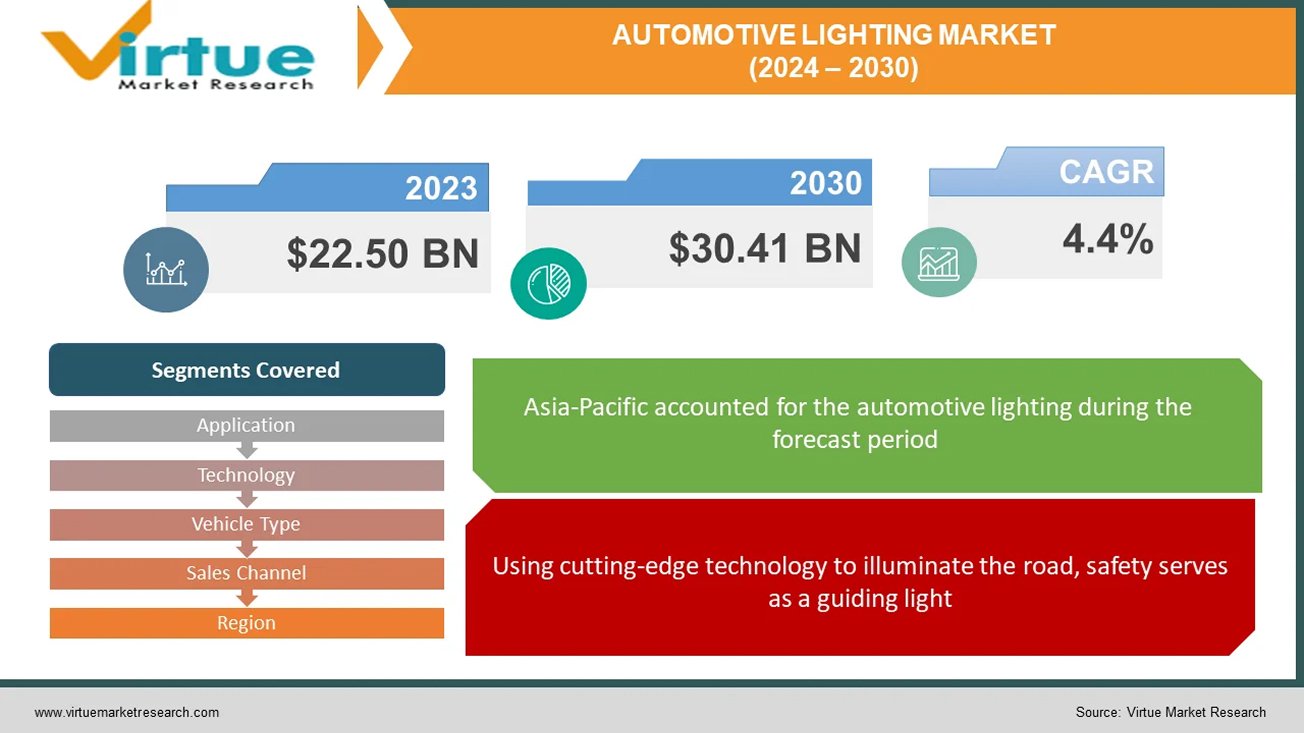
Global automotive lighting refers to all vehicle lighting systems, from headlamps that illuminate the road to taillights that communicate movements. They guarantee motorists and other road users alike safety, visibility, and style. While taillights frequently use LEDs for improved visibility, headlights are available in a variety of technologies, including LED and laser. Interior illumination, DRLs, and signal lights all have a role to play. This market, which was estimated to be worth $33.64 billion in 2022, is anticipated to rise to $67.39 billion by 2030 because of laws, luxury tastes, safety concerns, and technological developments like OLED taillights and adaptive headlights. Anticipate a future dominated by intelligent, connected, personalized, and sustainable lighting systems that enhance the safety, efficiency, and aesthetic appeal of automobiles.
Key Market Insights:
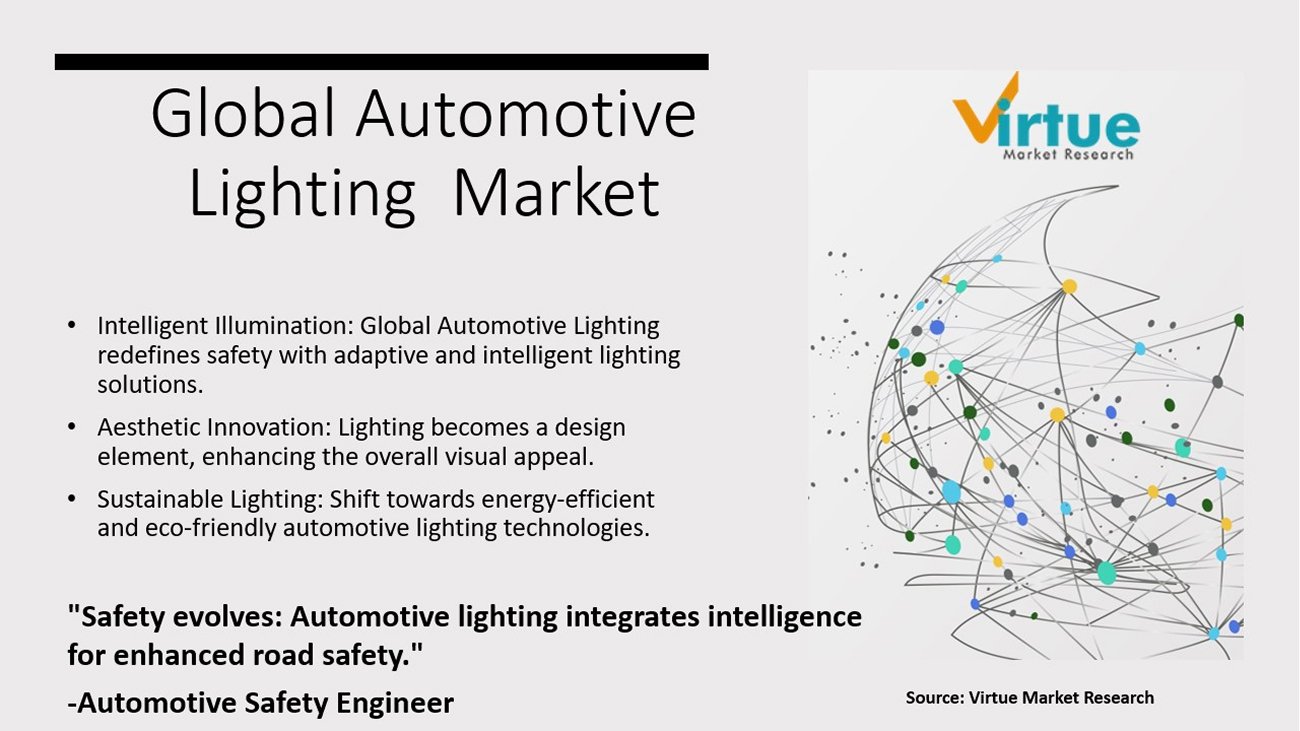
Car lighting works its magic to provide safety, visibility, and style. Headlights cut through the night, taillights express intent, and interiors shine with comfort. The billion-dollar global business is expected to rise due to consumer demand for high-end experiences, safer roads, and cutting-edge technology. Imagine dynamic messages being painted by taillights, headlights that adjust to the road, and interiors that customize their atmosphere. Driven by technological advancements like linked systems and laser beams, this future is calling. Anticipate even more visually attractive, environmentally friendly, and intelligent lighting to illuminate the way ahead, making cars safer, more efficient, and unquestionably cooler.
Global Automotive Lighting Market Drivers:
Using cutting-edge technology to illuminate the road, safety serves as a guiding light.
In the market for automobile lighting, safety is the driving force behind demand from the public and laws. While automated high beams smoothly react to traffic, adaptive headlights modify their beams so as not to blind other people. With visually striking displays, dynamic taillights convey intentions for braking and turning. Beyond these developments, integrated pedestrian identification and lane departure alerts will soon make roads safer and brighter for everyone.
Beyond Performance-Based Luxuries Redefined by Light.
Luxurious automobile lighting creates a distinct visual identity that goes beyond simple illumination. Personalized interior lighting customizes the driving experience by setting the mood with a range of colours and intensities, while intricate designs and distinctive DRLs modify exteriors. As you approach your automobile at night, welcoming lights lead the way, resulting in an interior that is perfectly lit. Not only is this symphony of light aesthetically pleasing, but it also stands as a tribute to luxury. Upcoming developments like gesture-controlled lighting and holographic displays promise to further enhance the experience.
Fuel Efficiency Takes the Lead: Illuminating Sustainability
The worldwide automotive lighting market is undergoing a significant transition towards energy-efficient solutions, as environmental concerns gain prominence. LED technology is leading the way, providing a ray of hope for the environment and drivers alike. LED lights beam brighter and use a lot less energy than conventional halogen lamps. There are some tangible advantages to this. For drivers, this translates to increased fuel economy, which lowers petrol prices and lessens reliance on fossil fuels. Greater air quality and a reduction in the transport sector's contribution to climate change are the results of reduced overall emissions.
To Learn more about this report,
Global Automotive Lighting Market Restraints and Challenges:
Although the global automotive lighting business is booming, there are still unknowns. Difficulties impede growth even as innovation propels it with eye catching features like laser beams and adaptable headlights. These technologies are luxury items due to their high cost and difficult integration, which puts producers' abilities to the test. The worldwide patchwork created by unclear legislation limits the potential of innovation. Durability issues persist, particularly when complex systems are subjected to challenging conditions. Ultimately, a lot of drivers still don't fully understand how these improvements can help them. Together, we can overcome these obstacles. The keys to reducing costs are improved production, more seamless integration, and unified regulations. Their full potential can be realized by educating customers about the safety, efficiency, and aesthetic value of these lighting wonders. By working together, we can pave the way for an even brighter and safer future for vehicle lighting.
Global Automotive Lighting Market Opportunities:
It is made possible by advanced LED technology, which gives drivers the ability to customize their illumination for the highest level of comfort and flair. Consumers that care about the environment want greener products, and vehicle lighting complies. While solar- and self-powered lighting technologies offer a future powered by clean energy, energy-efficient LEDs lower pollution. The advent of connected lighting systems heralds a new age. Envision automobiles interacting with infrastructure and one another to minimize accidents and enhance traffic efficiency. Integrated headlights with pedestrian recognition provide unmatched safety, while dramatic taillights with eye-catching displays alert onlookers to your intentions. The possibilities are endless in the future. Gesture-controlled interior illumination, holographic displays projected onto the road, and even light fixtures with self-healing capabilities.
AUTOMOTIVE LIGHTING MARKET REPORT COVERAGE:
To Learn more about this report,
Global Automotive Lighting Market Segmentation: By Application
Exterior Lighting
Interior Lighting
Due to laws requiring safety features like headlights, taillights, and brake lights, exterior lighting presently holds the most market share in the vehicle lighting industry. The dominance of this market is partly attributed to advancements in safety-focused technologies such as adaptive headlights and daytime running lights. The market value of external lighting is increased by the quick adoption of technology like LED bulbs and laser lights, which improve performance and aesthetics. Conversely, the interior lighting market is expected to increase at the fastest rate in the upcoming years. Innovations like ambient lighting and technology breakthroughs like LED and OLED displays, driven by consumer demand for comfort and personalisation, open new possibilities. The spread of sophisticated interior lighting systems is further driven by the growing emphasis on safety and the expansion of the luxury car market.
Global Automotive Lighting Market Segmentation: By Technology
Halogen
LED (Light-Emitting Diode)
Xenon
Emerging Technologies
The worldwide vehicle lighting market is currently dominated by halogen because of its more affordable price, advanced technology, and useful illumination. With its dependable supply chain and affordable option for manufacturers and cost-conscious customers, halogen holds the biggest market share. The fastest-growing market right now is LEDs, which are predicted to shortly overtake halogen. The rapid expansion of LEDs is driven by their higher efficiency, longer lifespan, flexibility in design, and technological breakthroughs including enhanced brightness. Because LEDs use less energy and produce fewer emissions and better fuel economy, they are becoming more and more popular in the changing automotive lighting market.
Global Automotive Lighting Market Segmentation: By Vehicle Type
Passenger Cars
Commercial Vehicles
Passenger automobiles rule the worldwide automotive lighting market. The sheer number of passenger cars produced which surpasses that of business vehicles and fuels the need for lighting systems is the primary cause of this popularity. The growing demand for personal automobiles in developing nations is a result of rising disposable income, which in turn drives the rise of the passenger car market. The importance that consumers place on safety and aesthetics elements helps to drive market expansion. But in the upcoming years, the market for electric and hybrid cars is expected to develop at the quickest rate. The exponential rise of the worldwide electric car market, which is still expanding and shows no signs of slowing down, is what is driving this surge. Specialised lighting solutions are required since electric and hybrid vehicles have different lighting requirements because of their specific functionality and design aesthetics.
Global Automotive Lighting Market Segmentation: By Sales Channel
OEM (Original Equipment Manufacturers)
Aftermarket
Most lighting systems sold nowadays are sold by OEMs (Original Equipment Manufacturers), primarily because manufacturers pre-install lighting systems in new cars. But in the next years, the aftermarket is expected to develop at the quickest rate. This spike in demand for replacement parts, especially lighting systems, can be linked to several variables, one of them being the average age of cars. The industry is expanding because of consumers' growing desire to personalise their cars with aftermarket lighting upgrades such LED upgrades and decorative lighting. The availability and affordability of technologies like adaptive headlights and laser lights in the aftermarket, together with other advancements in lighting technology, are driving demand even more. Moreover, the growing market for electric cars (EVs).
To Learn more about this report,
Global Automotive Lighting Market Segmentation: By Region
North America
Asia-Pacific
Europe
South America
Middle East and Africa
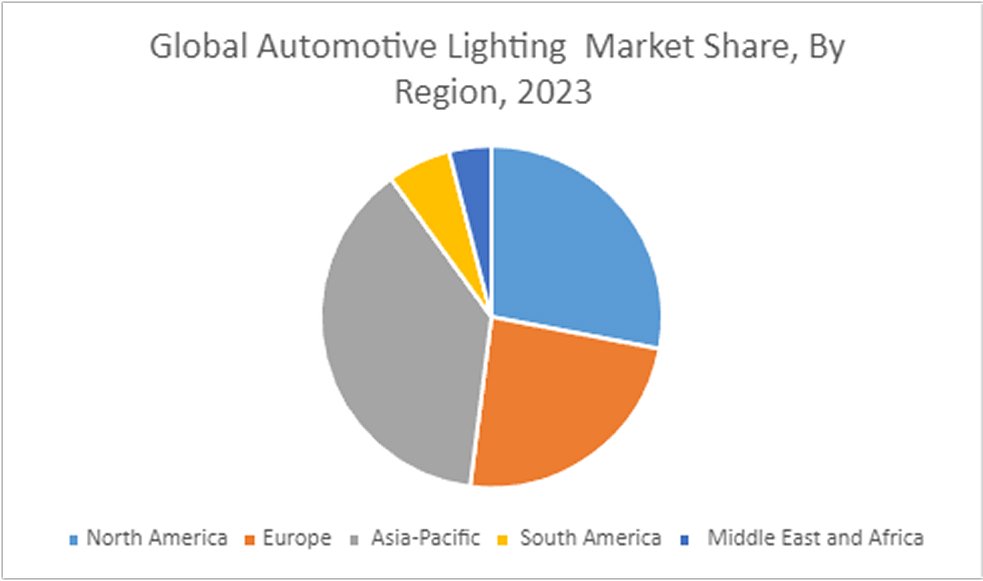
Throughout the forecast period, Asia Pacific is anticipated to be the automotive lighting market with the highest profitability. Over the past few years, Asia Pacific countries like China and India have seen notable increases in automotive manufacturing and sales, primarily in the medium-to premium luxury car segment. Asia Pacific is predicted to see an increase in the manufacturing of passenger cars, with India experiencing the strongest growth rate. Depending on the state of the national economy, the area offers a suitable selection of both high-end and cheap cars. For instance, there is a substantial demand for halogen, Xenon/HID, and LED since China and India produce more economy and mid-range automobiles. On the other hand, luxury car adoption rates are greater in South Korea and Japan, where LED lighting is the norm.
COVID-19 Impact Analysis on the Global Automotive Lighting Market:
A brief shadow was thrown by COVID-19 over the worldwide automotive lighting market. Production was stopped by lockdowns and supply chain disruptions, while luxury lighting upgrades were shelved by consumers on a tight budget. Resources became scarce, and R&D stagnated. Still, the market is recovering thanks to resurgent demand and rearranged priorities. While energy-efficient LEDs are being pushed towards adoption by sustainability, safety concerns are driving interest in features like pedestrian detection and adaptive headlights. The digital push of the epidemic creates opportunities for intelligent, networked lighting systems that may interact with infrastructure and other cars. Ultimately, the industry is positioned to shine brighter, focused on safety, sustainability, and a connected future, even though the pandemic dimmed its brilliance.
Recent Trends and Developments in the Global Automotive Lighting Market:
A development collaboration between OSRAM Continental and REHAU aims to incorporate lighting into external components, providing automobile manufacturers with innovative lighting options that improve functionality and design flexibility. For rear combination lamps, Hella unveiled a revolutionary lighting innovation called Hella FlatLight technology. A Memorandum of Understanding (MoU) was signed by Samvardhana Motherson Automotive Systems Group BV (SMRPBV), a division of Motherson Group, and Marelli Automotive Lighting to investigate a technology collaboration focused on intelligently lighted external body components. Valeo debuted their revolutionary 360° lighting system at the Shanghai Auto Show. This technology surrounds the car with a band of light, projecting instantaneous, clear signs that other drivers can see from a distance. Pedestrians, cyclists, and scooter riders are especially susceptible to these signals
Key Players:
AMS Osram
Cree
Hella
Hyundai Mobis
Koito
Luminus Devices
Magneti Marelli
Osram Licht AG
Stanley Electric
Valeo
Chapter 1. GLOBAL K12 ONLINE EDUCATION MARKET– Scope & Methodology
1.1. Market Segmentation
1.2. Scope, Assumptions & Limitations
1.3. Research Methodology
1.4. Primary Sources
1.5. Secondary Sources
Chapter 2. GLOBAL K12 ONLINE EDUCATION MARKET– Executive Summary
Fill out the form below and our team will get back to you shortly
FAQ's
The growth of the Global K12 Online Education Market is driven by rising demand for personalized, flexible, and skills-based learning environments that support academic continuity and equal learning opportunities across diverse student groups. Key factors include increasing adoption of adaptive learning platforms, generative AI tools, interactive digital curriculum, real-time analytics, and gamified instruction that enhance student engagement and learning outcomes.
The Global K12 Online Education Market faces challenges such as digital infrastructure gaps, lack of universal access to modern devices, and difficulty integrating new platforms with legacy school systems. Other key hurdles include cybersecurity and student data privacy concerns, varying curriculum standards across regions, inconsistent teacher readiness for virtual instruction, screen fatigue, and persistent socio-economic learning disparities. Budget constraints and intense market competition also complicate long-term sustainability and quality scalability.
Key players in the Global K12 Online Education Market include BYJU’S, Khan Academy, K12 (Stride, Inc.), Pearson, McGraw-Hill Education, IXL Learning, DreamBox Learning, Outschool, Age of Learning (ABCmouse), VIPKid, PowerSchool, Schoology, Google Classroom, Seesaw Learning, and Nearpod.
North America holds the largest share of the Global K12 Online Education Market, driven by strong digital education infrastructure, extensive device availability, high adoption of analytics-based and AI-enabled learning solutions, and significant investment from public school districts and EdTech innovators. Broad implementation of virtual learning platforms, standardized digital curriculum, and STEM and college-readiness programs strengthens regional market leadership.
Asia-Pacific is the fastest-growing region in the Global K12 Online Education Market, supported by rapid expansion of digital learning adoption, increased government-led education technology initiatives, high mobile and smartphone penetration, demand for affordable online tutoring and exam preparation services, and growing student populations across emerging economies. Accelerating localization of content and partnerships among global and regional EdTech providers further amplifies growth.
More related reports
Get expert-driven market research reports from a leading research partner to help you navigate the future of the global industry.
Report Code: VMR-203 | Published Date: July 2025 | Format: Excel and PDF
The 3D Scanning Market was valued at USD 2.28 billion in 2024 and is projected to reach a market size of USD 5.37 billion by the end of 2030. Over the forecast period of 2025-2030, the market is projected to grow at a CA...
Report Code: VMR-14818 | Published Date: July 2024 | Format: Excel and PDF
The Global Passwordless Authentication Market is expected to grow from USD 22.70 billion in 2025 to approximately USD 49.13 billion by 2030, at a 16.7% CAGR from 2026-2030.
Report Code: VMR-435 | Published Date: March 2024 | Format: Excel and PDF
The Equity Management Software Market was valued at USD 591.85 million in 2023. Over the forecast period of 2024-2030, it is projected to reach USD 1508.47 million by 2030, growing at a CAGR of 14.3%.
Report Code: VMR-15816 | Published Date: March 2024 | Format: Excel and PDF
The global intellectual property (IP) services market was valued at USD 2.8 billion and is projected to reach a market size of USD 6.38 billion by the end of 2030. Over the forecast period of 2024–2030, the market is pro...
“We received a complex piece of work for our niche market from Virtue Market research in short period of time. I appreciate the quality and content of the final files we received. Thanks for the support”
Medical Devices Company based in Europe
“We received a complex piece of work for our niche market from Virtue Market research in short period of time. I appreciate the quality and content of the final files we received. Thanks for the support”
Medical Devices Company based in Europe
“We received a complex piece of work for our niche market from Virtue Market research in short period of time. I appreciate the quality and content of the final files we received. Thanks for the support”
Medical Devices Company based in Europe
“We received a complex piece of work for our niche market from Virtue Market research in short period of time. I appreciate the quality and content of the final files we received. Thanks for the support”
Medical Devices Company based in Europe
“We received a complex piece of work for our niche market from Virtue Market research in short period of time. I appreciate the quality and content of the final files we received. Thanks for the support”
Medical Devices Company based in Europe
“We received a complex piece of work for our niche market from Virtue Market research in short period of time. I appreciate the quality and content of the final files we received. Thanks for the support”