Industry 4.0 Market Research Report – Segmentation by Technology (Industrial IoT, Artificial Intelligence & Machine Learning, Digital Twin, Blockchain, Additive Manufacturing, Cloud Computing); By Vertical (Automotive, Healthcare & Pharmaceuticals, Electronics & Consumer Goods, Energy & Utilities, Aerospace & Defense); By Component (Hardware, Software, Services); By Application (Smart Factory, Predictive Maintenance, Supply Chain Management) – Forecast (2025 – 2030)
Global Industry 4.0 Market Market Size (2025 – 2030)
The global Industry 4.0 Market was valued at approximately USD 164.7 billion in 2024 and is on a trajectory to reach an estimated USD 322.75 billion by the end of 2030. The market is projected to grow at a CAGR of 11.8% during the forecast period of 2025-2030.
The industry 4.0 Market, often hailed as the fourth industrial revolution, represents a profound and fundamental transformation of manufacturing and industrial production. This revolution is not merely an upgrade of existing factory automation but a holistic integration of cyber-physical systems, creating a seamless fusion between the physical world of machinery and the digital realm of data and intelligence. At its core, Industry 4.0 is about building "smart factories" where intelligent networks of machines, sensors, and systems communicate and cooperate with each other and with humans in real time, largely autonomously. This creates a living, breathing digital ecosystem that spans the entire value chain, from initial product conception and supply chain logistics to production, distribution, and post-sale services. The current market landscape is a dynamic and intricate tapestry woven from cutting-edge technologies like the Industrial Internet of Things (IIoT), Artificial Intelligence (AI), Digital Twins, blockchain, and additive manufacturing. IIoT acts as the central nervous system, with billions of interconnected sensors gathering vast oceans of data from the factory floor. AI and machine learning then serve as the brain, analyzing this data to uncover insights, predict failures, optimize processes, and enable intelligent decision-making without human intervention. Digital Twins—virtual replicas of physical assets and processes—allow for simulation, testing, and optimization in a risk-free digital environment before a single screw is turned in the real world. This capability drastically reduces development cycles, minimizes waste, and enhances innovation. The paradigm shift driven by Industry 4.0 extends far beyond the factory walls. It is revolutionizing supply chains, transforming them from linear, often opaque chains into interconnected, transparent, and responsive digital supply networks. It enables unprecedented levels of mass customization, allowing companies to produce highly personalized products with the efficiency of mass production, effectively catering to the "batch size of one." The ultimate vision is an industrial environment that is not only hyper-efficient and productive but also inherently agile, resilient, and sustainable. By optimizing energy consumption, predicting maintenance needs to prevent downtime, and minimizing material waste, Industry 4.0 offers a concrete pathway toward a more circular and environmentally responsible industrial model. The market’s momentum is fueled by the undeniable competitive advantages it offers: radical improvements in operational efficiency, enhanced product quality, greater business model flexibility, and the creation of entirely new, data-driven revenue streams. As enterprises navigate an increasingly volatile global landscape, the adoption of Industry 4.0 principles is no longer a strategic option but a fundamental imperative for survival and growth.
Key Market Insights:
In 2024, the global installed base of Industrial IoT (IIoT) sensors is estimated to generate approximately 28.5 zettabytes of data. However, a striking paradox exists where less than 7% of this collected data is effectively analyzed for strategic, predictive, or prescriptive insights, highlighting a significant gap between data collection capabilities and data utilization maturity.
A clear trend in 2024 shows that for every $1 million invested in new physical industrial machinery, an average of $180,000 is now being allocated to the development and maintenance of its corresponding Digital Twin. This represents a dedicated 18% investment in virtual counterparts for simulation and predictive maintenance.
Spending on securing Operational Technology (OT) networks within Industry 4.0 budgets has surged. In 2024, OT security protocols constitute nearly 15% of the total cybersecurity expenditure in the manufacturing sector, a direct response to a 200% increase in targeted cyber-attacks on industrial control systems over the last two years.
Companies implementing AI-driven predictive maintenance solutions in 2024 are reporting an average reduction in unplanned machine downtime of 45% and a decrease in overall maintenance costs by up to 30%, making it the application with the fastest and most tangible return on investment.
Approximately 40% of all new industrial data processing deployments in 2024 are occurring at the network edge, rather than in centralized cloud data centers. This shift to edge computing is driven by the need for sub-10-millisecond latency for real-time applications like robotic control and quality inspection.
The talent shortage in Industry 4.0 is quantifiable. In 2024, it is estimated that projects will be delayed by an average of 5 months due to a lack of qualified personnel, such as data scientists, OT security experts, and robotics engineers, costing the industry billions in deferred revenue.
In 2024, over 60% of the industrial use of additive manufacturing (3D printing) is not for final part production but for creating custom jigs, fixtures, and tools for the assembly line, which has been shown to reduce tooling lead times by up to 90%.
The adoption of Industry 4.0 solutions by Small and Medium-sized Enterprises (SMEs) is being powered by Software-as-a-Service (SaaS) models. In 2024, cloud-based industrial software subscriptions account for over 55% of new software spending by SMEs, lowering the barrier to entry significantly.
Market Drivers:
A primary driver is the urgent need for enhanced operational resilience.
In the wake of global supply chain disruptions, geopolitical instability, and climate-related events, manufacturers are aggressively seeking ways to build shock-proof operations. Industry 4.0 technologies provide the essential toolkit, enabling real-time supply chain visibility, autonomous production adjustments, and predictive capabilities that allow enterprises to anticipate disruptions and adapt with unprecedented speed and agility. This shift from reactive problem-solving to proactive, data-driven resilience is a core catalyst for market growth, transforming capital expenditure on technology into a strategic business continuity insurance policy.
The Economic Imperative of Mass Customization:The modern consumer demands personalized products, a trend that fundamentally challenges traditional mass-production models.
Industry 4.0 is the key that unlocks profitable mass customization. By integrating technologies like additive manufacturing for on-demand parts, modular robotics for flexible assembly lines, and AI for managing complex orders, companies can cater to individual customer preferences at scale. This ability to deliver a "batch size of one" with the efficiency of mass manufacturing creates immense competitive differentiation and opens up new, high-margin revenue streams, making its adoption an economic imperative for consumer-facing industries.
Market Restraints and Challenges:
The primary restraint impeding the industry 4.0 market is the immense complexity and cost of integrating modern digital technologies with legacy operational technology (OT) systems in "brownfield" facilities. This challenge is compounded by a severe global shortage of skilled talent with expertise in both data science and industrial engineering. Furthermore, the exponential increase in connected devices creates a vast attack surface, raising significant cybersecurity concerns and demanding robust, specialized security protocols to protect critical industrial processes from potentially catastrophic breaches.
Market Opportunities:
A monumental opportunity lies in the creation and monetization of data-driven services, transitioning from selling products to selling outcomes (e.g., "power-by-the-hour"). This "servitization" model, enabled by IIoT and analytics, creates recurring revenue streams. There is also a burgeoning market for developing specialized AI-powered platforms for sustainable manufacturing, optimizing energy usage and waste reduction to meet ESG goals. Furthermore, the application of digital twin and VR/AR technologies for remote training and upskilling the industrial workforce presents a massive, untapped opportunity to address the critical skills gap.
INDUSTRY 4.0 MARKET REPORT COVERAGE:
REPORT METRIC
DETAILS
Market Size Available
2024 - 2030
Base Year
2024
Forecast Period
2025 - 2030
CAGR
11.8%
Segments Covered
By Technology, Vertical, Component, Application and Region
Various Analyses Covered
Global, Regional & Country Level Analysis, Segment-Level Analysis, DROC, PESTLE Analysis, Porter’s Five Forces Analysis, Competitive Landscape, Analyst Overview on Investment Opportunities
Regional Scope
North America, Europe, APAC, Latin America, Middle East & Africa
Key Companies Profiled
Siemens, Schneider Electric, Rockwell Automation, ABB, Mitsubishi Electric, Honeywell International Inc., Robert Bosch GmbH (Bosch Rexroth), General Electric, Microsoft Corporation, Oracle, SAP SE, NVIDIA Corporation, Dassault Systèmes, Emerson Electric Co., IBM Corporation
Global Industry 4.0 Market Segmentation:
Global Industry 4.0 Market Segmentation by Technology:
Artificial Intelligence & Machine Learning (AI & ML) is the fastest-growing technology segment. As IIoT reaches maturity in data collection, the focus is now squarely on interpreting this data. AI/ML is the engine that transforms raw data into actionable intelligence, enabling predictive maintenance, generative design, and autonomous process optimization, delivering the highest value.
Industrial Internet of Things (IIoT) remains the most dominant segment. It is the foundational layer upon which the entire Industry 4.0 edifice is built. The vast network of sensors, actuators, and connected devices is the essential source of the data that fuels all other analytics, AI, and control systems, representing the largest area of initial investment.
Global Industry 4.0 Market Segmentation by Vertical:
Automotive
Healthcare & Pharmaceuticals
Electronics & Consumer Goods
Energy & Utilities
Aerospace & Defense
Food & Beverage
Industrial Machinery
Healthcare & Pharmaceuticals is the fastest-growing vertical. The stringent requirements for regulatory compliance (e.g., track-and-trace), the push for personalized medicine, and the need for pristine, error-free manufacturing environments for biologics and medical devices are accelerating the adoption of smart factory technologies at an exceptional rate.
The Automotive sector is the most dominant vertical by market share. With a long history of advanced automation, the industry is now making colossal investments in smart factories to manage the complexity of electric vehicle (EV) production, battery manufacturing, and the integration of sophisticated electronics, making it the largest adopter of I4.0 solutions.
Global Industry 4.0 Market Segmentation by Component:
Hardware
Software
Services
The Services segment is the fastest-growing component. As Industry 4.0 solutions become more complex and integrated, the demand for external expertise is soaring. This includes strategic consulting, systems integration, managed security services, and data analytics-as-a-service, which are critical for companies lacking in-house capabilities to execute successful transformations.
Hardware remains the most dominant component segment by value. The physical infrastructure, including industrial robots, sensors, PLCs, gateways, and edge computing devices, constitutes the core capital expenditure for any Industry 4.0 initiative. This foundational layer represents the tangible backbone of the smart factory and commands the largest portion of initial budgets.
Global Industry 4.0 Market Segmentation by Application:
Smart Factory
Predictive Maintenance
Supply Chain Management
Industrial Automation
Quality Control
Predictive Maintenance stands out as the fastest-growing application. Its appeal lies in its direct and easily quantifiable return on investment. By using AI to predict equipment failures before they occur, companies can drastically reduce costly unplanned downtime and optimize maintenance schedules, making it a compelling entry point for I4.0 adoption.
The Smart Factory is the most dominant application. It is not a single application but a holistic concept that encompasses all others. It represents the ultimate goal of Industry 4.0—a fully integrated, data-driven, and intelligent manufacturing ecosystem. As such, it commands the largest share of strategic planning and long-term investment.
Global Industry 4.0 Market Segmentation: Regional Analysis:
North America
Europe
Asia-Pacific
Latin America
Middle East & Africa
The Asia-Pacific region dominates the Industry 4.0 market, holding a substantial share of approximately 38%. This dominance is propelled by manufacturing behemoths like China, Japan, and South Korea, coupled with strong government-led initiatives such as "Made in China 2025" and massive investments in advanced electronics and automotive production facilities.
Asia-Pacific is also the fastest-growing region. This rapid expansion is fueled by swift industrialization in Southeast Asian nations like Vietnam and Indonesia, alongside India's ambitious "Make in India" campaign. These regions offer vast "greenfield" opportunities, allowing for the construction of new, state-of-the-art smart factories from the ground up, bypassing legacy system challenges.
Global Industry 4.0 Market COVID-19 Impact Analysis:
The COVID-19 pandemic acted as a powerful, albeit unexpected, catalyst for the Industry 4.0 market. It brutally exposed the vulnerabilities of human-dependent manufacturing processes and fragile global supply chains. The crisis created an urgent business case for automation, remote monitoring, and digital supply chain solutions. Consequently, the pandemic accelerated digital transformation roadmaps, shifting investments in Industry 4.0 technologies from a long-term strategic goal to an immediate operational necessity for business survival and resilience.
Latest Market News:
March 2024: Schneider Electric announced a major collaboration with NVIDIA to optimize data center infrastructure and pioneer deployments of edge AI and digital twin technologies. This partnership aims to leverage NVIDIA's advanced computing platforms to enhance Schneider's industrial automation and energy management solutions.
April 2024: Siemens significantly expanded its Xcelerator industrial software platform by integrating generative AI capabilities. This enhancement allows engineers to use natural language prompts to rapidly generate design concepts and optimize complex manufacturing workflows, drastically speeding up innovation cycles.
August 2024: ABB introduced Visual SLAM technology in its Autonomous Mobile Robots (AMRs), utilizing AI and 3D vision to reduce commissioning time by 20% and improve performance in dynamic manufacturing environments, demonstrating practical AI applications in industrial automation.
Latest Trends and Developments:
The latest trends are gravitating towards the Industrial Metaverse, where companies use persistent, shared virtual spaces and digital twins for collaborative design, worker training, and complex process simulation. There is a strong movement towards "edge intelligence," pushing AI processing directly onto factory floor devices to enable real-time decision-making. Another key development is the convergence of IT and OT security teams and platforms to provide a unified defense against cyber threats that span both corporate and industrial networks.
Key Players in the Market:
1. Siemens
2. Schneider Electric
3. Rockwell Automation
4. ABB
5. Mitsubishi Electric
6. Honeywell International Inc.
7. Robert Bosch GmbH (Bosch Rexroth)
8. General Electric
9. Microsoft Corporation
10. Oracle
11.SAP SE
12. NVIDIA Corporation
13. Dassault Systèmes
14. Emerson Electric Co.
15. IBM Corporation
To Learn more about this report,
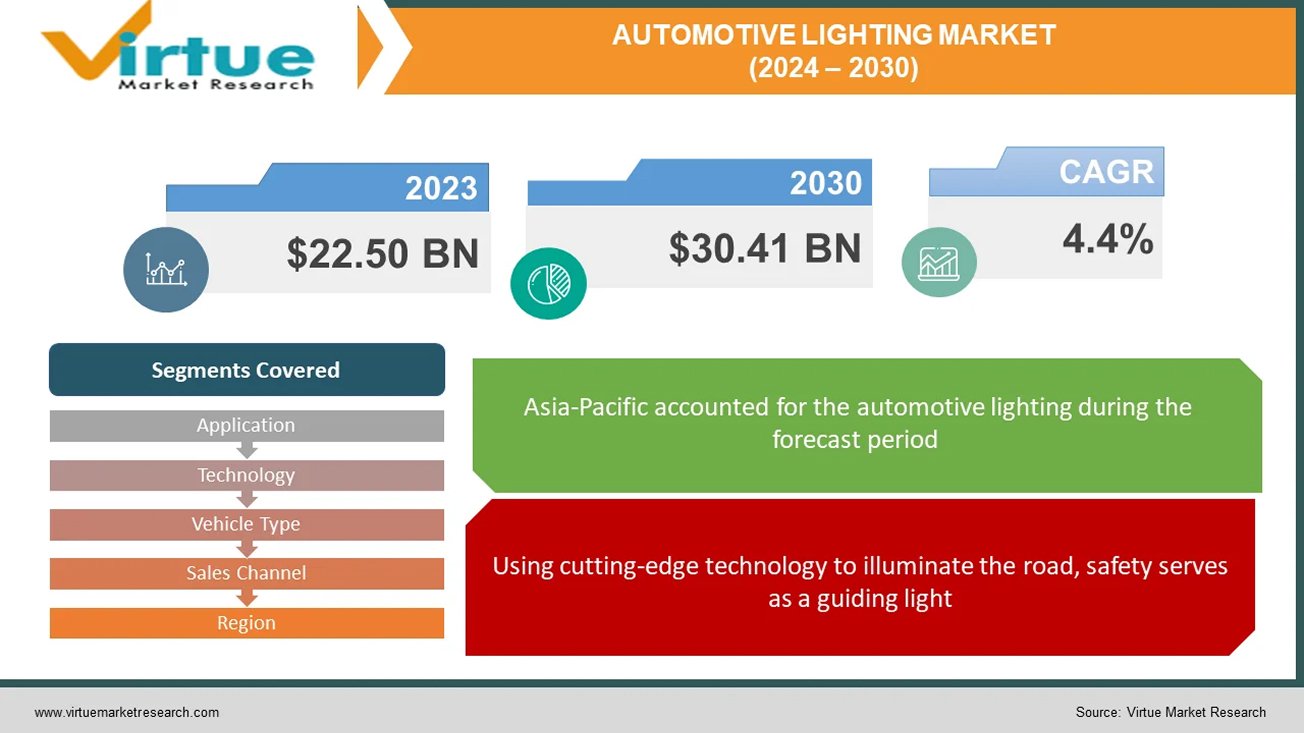
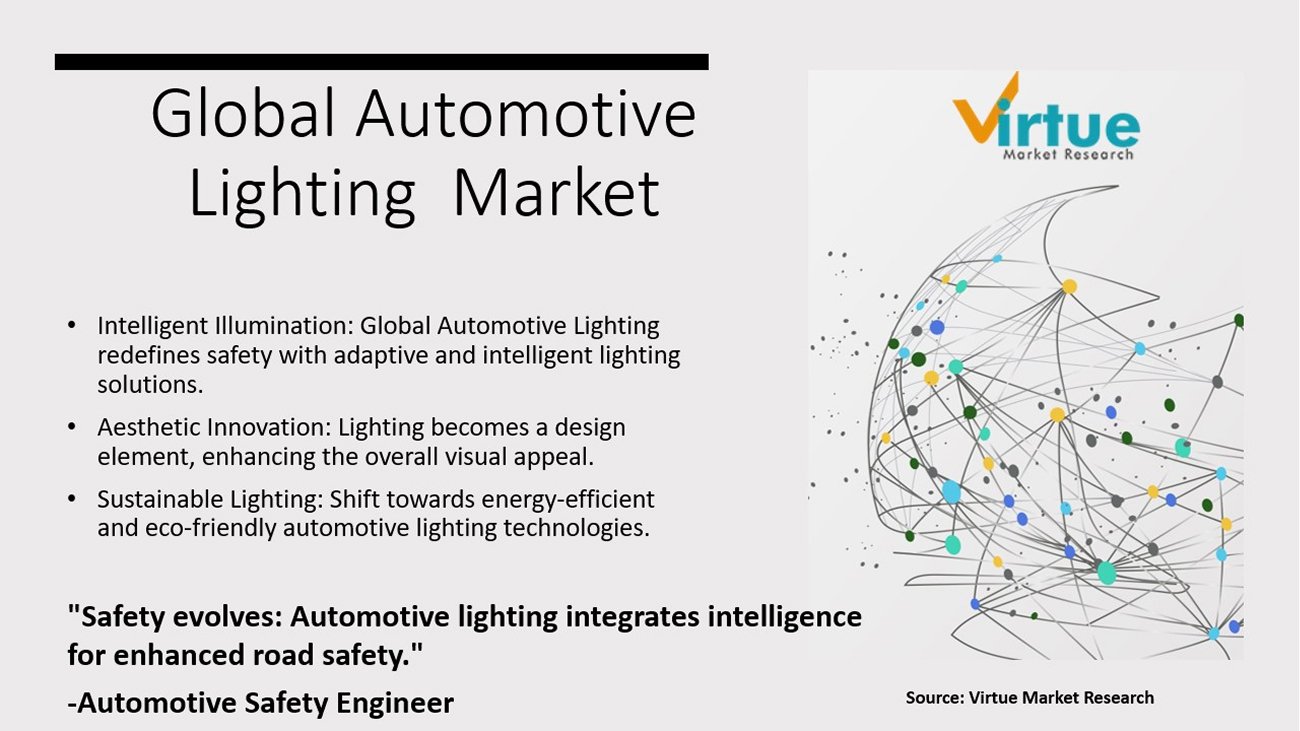
Global automotive lighting refers to all vehicle lighting systems, from headlamps that illuminate the road to taillights that communicate movements. They guarantee motorists and other road users alike safety, visibility, and style. While taillights frequently use LEDs for improved visibility, headlights are available in a variety of technologies, including LED and laser. Interior illumination, DRLs, and signal lights all have a role to play. This market, which was estimated to be worth $33.64 billion in 2022, is anticipated to rise to $67.39 billion by 2030 because of laws, luxury tastes, safety concerns, and technological developments like OLED taillights and adaptive headlights. Anticipate a future dominated by intelligent, connected, personalized, and sustainable lighting systems that enhance the safety, efficiency, and aesthetic appeal of automobiles.
Key Market Insights:
Car lighting works its magic to provide safety, visibility, and style. Headlights cut through the night, taillights express intent, and interiors shine with comfort. The billion-dollar global business is expected to rise due to consumer demand for high-end experiences, safer roads, and cutting-edge technology. Imagine dynamic messages being painted by taillights, headlights that adjust to the road, and interiors that customize their atmosphere. Driven by technological advancements like linked systems and laser beams, this future is calling. Anticipate even more visually attractive, environmentally friendly, and intelligent lighting to illuminate the way ahead, making cars safer, more efficient, and unquestionably cooler.
Global Automotive Lighting Market Drivers:
Using cutting-edge technology to illuminate the road, safety serves as a guiding light.
In the market for automobile lighting, safety is the driving force behind demand from the public and laws. While automated high beams smoothly react to traffic, adaptive headlights modify their beams so as not to blind other people. With visually striking displays, dynamic taillights convey intentions for braking and turning. Beyond these developments, integrated pedestrian identification and lane departure alerts will soon make roads safer and brighter for everyone.
Beyond Performance-Based Luxuries Redefined by Light.
Luxurious automobile lighting creates a distinct visual identity that goes beyond simple illumination. Personalized interior lighting customizes the driving experience by setting the mood with a range of colours and intensities, while intricate designs and distinctive DRLs modify exteriors. As you approach your automobile at night, welcoming lights lead the way, resulting in an interior that is perfectly lit. Not only is this symphony of light aesthetically pleasing, but it also stands as a tribute to luxury. Upcoming developments like gesture-controlled lighting and holographic displays promise to further enhance the experience.
Fuel Efficiency Takes the Lead: Illuminating Sustainability
The worldwide automotive lighting market is undergoing a significant transition towards energy-efficient solutions, as environmental concerns gain prominence. LED technology is leading the way, providing a ray of hope for the environment and drivers alike. LED lights beam brighter and use a lot less energy than conventional halogen lamps. There are some tangible advantages to this. For drivers, this translates to increased fuel economy, which lowers petrol prices and lessens reliance on fossil fuels. Greater air quality and a reduction in the transport sector's contribution to climate change are the results of reduced overall emissions.
To Learn more about this report,
Global Automotive Lighting Market Restraints and Challenges:
Although the global automotive lighting business is booming, there are still unknowns. Difficulties impede growth even as innovation propels it with eye catching features like laser beams and adaptable headlights. These technologies are luxury items due to their high cost and difficult integration, which puts producers' abilities to the test. The worldwide patchwork created by unclear legislation limits the potential of innovation. Durability issues persist, particularly when complex systems are subjected to challenging conditions. Ultimately, a lot of drivers still don't fully understand how these improvements can help them. Together, we can overcome these obstacles. The keys to reducing costs are improved production, more seamless integration, and unified regulations. Their full potential can be realized by educating customers about the safety, efficiency, and aesthetic value of these lighting wonders. By working together, we can pave the way for an even brighter and safer future for vehicle lighting.
Global Automotive Lighting Market Opportunities:
It is made possible by advanced LED technology, which gives drivers the ability to customize their illumination for the highest level of comfort and flair. Consumers that care about the environment want greener products, and vehicle lighting complies. While solar- and self-powered lighting technologies offer a future powered by clean energy, energy-efficient LEDs lower pollution. The advent of connected lighting systems heralds a new age. Envision automobiles interacting with infrastructure and one another to minimize accidents and enhance traffic efficiency. Integrated headlights with pedestrian recognition provide unmatched safety, while dramatic taillights with eye-catching displays alert onlookers to your intentions. The possibilities are endless in the future. Gesture-controlled interior illumination, holographic displays projected onto the road, and even light fixtures with self-healing capabilities.
AUTOMOTIVE LIGHTING MARKET REPORT COVERAGE:
To Learn more about this report,
Global Automotive Lighting Market Segmentation: By Application
Exterior Lighting
Interior Lighting
Due to laws requiring safety features like headlights, taillights, and brake lights, exterior lighting presently holds the most market share in the vehicle lighting industry. The dominance of this market is partly attributed to advancements in safety-focused technologies such as adaptive headlights and daytime running lights. The market value of external lighting is increased by the quick adoption of technology like LED bulbs and laser lights, which improve performance and aesthetics. Conversely, the interior lighting market is expected to increase at the fastest rate in the upcoming years. Innovations like ambient lighting and technology breakthroughs like LED and OLED displays, driven by consumer demand for comfort and personalisation, open new possibilities. The spread of sophisticated interior lighting systems is further driven by the growing emphasis on safety and the expansion of the luxury car market.
Global Automotive Lighting Market Segmentation: By Technology
Halogen
LED (Light-Emitting Diode)
Xenon
Emerging Technologies
The worldwide vehicle lighting market is currently dominated by halogen because of its more affordable price, advanced technology, and useful illumination. With its dependable supply chain and affordable option for manufacturers and cost-conscious customers, halogen holds the biggest market share. The fastest-growing market right now is LEDs, which are predicted to shortly overtake halogen. The rapid expansion of LEDs is driven by their higher efficiency, longer lifespan, flexibility in design, and technological breakthroughs including enhanced brightness. Because LEDs use less energy and produce fewer emissions and better fuel economy, they are becoming more and more popular in the changing automotive lighting market.
Global Automotive Lighting Market Segmentation: By Vehicle Type
Passenger Cars
Commercial Vehicles
Passenger automobiles rule the worldwide automotive lighting market. The sheer number of passenger cars produced which surpasses that of business vehicles and fuels the need for lighting systems is the primary cause of this popularity. The growing demand for personal automobiles in developing nations is a result of rising disposable income, which in turn drives the rise of the passenger car market. The importance that consumers place on safety and aesthetics elements helps to drive market expansion. But in the upcoming years, the market for electric and hybrid cars is expected to develop at the quickest rate. The exponential rise of the worldwide electric car market, which is still expanding and shows no signs of slowing down, is what is driving this surge. Specialised lighting solutions are required since electric and hybrid vehicles have different lighting requirements because of their specific functionality and design aesthetics.
Global Automotive Lighting Market Segmentation: By Sales Channel
OEM (Original Equipment Manufacturers)
Aftermarket
Most lighting systems sold nowadays are sold by OEMs (Original Equipment Manufacturers), primarily because manufacturers pre-install lighting systems in new cars. But in the next years, the aftermarket is expected to develop at the quickest rate. This spike in demand for replacement parts, especially lighting systems, can be linked to several variables, one of them being the average age of cars. The industry is expanding because of consumers' growing desire to personalise their cars with aftermarket lighting upgrades such LED upgrades and decorative lighting. The availability and affordability of technologies like adaptive headlights and laser lights in the aftermarket, together with other advancements in lighting technology, are driving demand even more. Moreover, the growing market for electric cars (EVs).
To Learn more about this report,
Global Automotive Lighting Market Segmentation: By Region
North America
Asia-Pacific
Europe
South America
Middle East and Africa
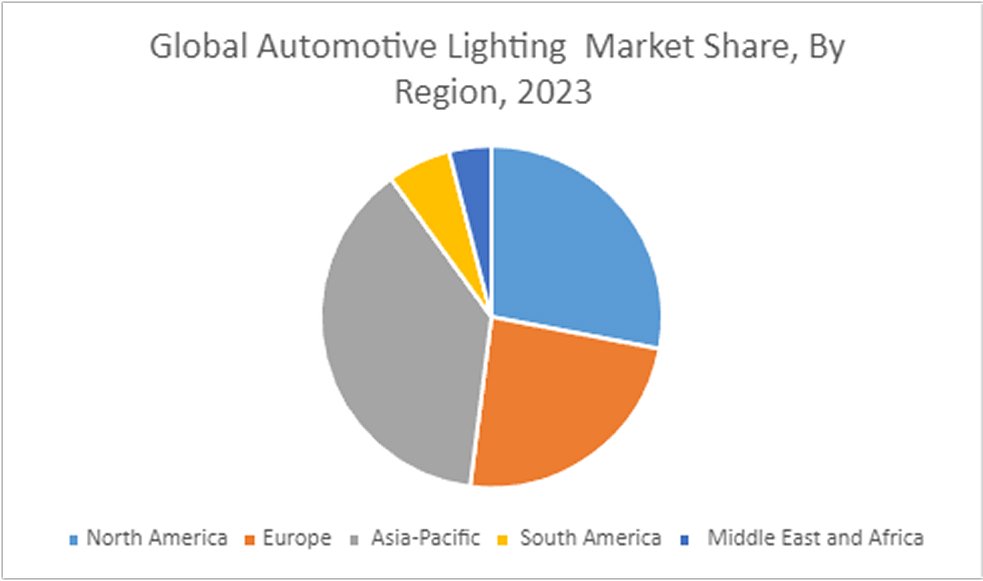
Throughout the forecast period, Asia Pacific is anticipated to be the automotive lighting market with the highest profitability. Over the past few years, Asia Pacific countries like China and India have seen notable increases in automotive manufacturing and sales, primarily in the medium-to premium luxury car segment. Asia Pacific is predicted to see an increase in the manufacturing of passenger cars, with India experiencing the strongest growth rate. Depending on the state of the national economy, the area offers a suitable selection of both high-end and cheap cars. For instance, there is a substantial demand for halogen, Xenon/HID, and LED since China and India produce more economy and mid-range automobiles. On the other hand, luxury car adoption rates are greater in South Korea and Japan, where LED lighting is the norm.
COVID-19 Impact Analysis on the Global Automotive Lighting Market:
A brief shadow was thrown by COVID-19 over the worldwide automotive lighting market. Production was stopped by lockdowns and supply chain disruptions, while luxury lighting upgrades were shelved by consumers on a tight budget. Resources became scarce, and R&D stagnated. Still, the market is recovering thanks to resurgent demand and rearranged priorities. While energy-efficient LEDs are being pushed towards adoption by sustainability, safety concerns are driving interest in features like pedestrian detection and adaptive headlights. The digital push of the epidemic creates opportunities for intelligent, networked lighting systems that may interact with infrastructure and other cars. Ultimately, the industry is positioned to shine brighter, focused on safety, sustainability, and a connected future, even though the pandemic dimmed its brilliance.
Recent Trends and Developments in the Global Automotive Lighting Market:
A development collaboration between OSRAM Continental and REHAU aims to incorporate lighting into external components, providing automobile manufacturers with innovative lighting options that improve functionality and design flexibility. For rear combination lamps, Hella unveiled a revolutionary lighting innovation called Hella FlatLight technology. A Memorandum of Understanding (MoU) was signed by Samvardhana Motherson Automotive Systems Group BV (SMRPBV), a division of Motherson Group, and Marelli Automotive Lighting to investigate a technology collaboration focused on intelligently lighted external body components. Valeo debuted their revolutionary 360° lighting system at the Shanghai Auto Show. This technology surrounds the car with a band of light, projecting instantaneous, clear signs that other drivers can see from a distance. Pedestrians, cyclists, and scooter riders are especially susceptible to these signals
Key Players:
AMS Osram
Cree
Hella
Hyundai Mobis
Koito
Luminus Devices
Magneti Marelli
Osram Licht AG
Stanley Electric
Valeo
Chapter 1. Industry 4.0 Market – SCOPE & METHODOLOGY
1.1. Market Segmentation
1.2. Scope, Assumptions & Limitations
1.3. Research Methodology
1.4. Primary End-user Application .
1.5. Secondary End-user Application Chapter 2. INDUSTRY 4.0 MARKET – EXECUTIVE SUMMARY
2.1. Market Size & Forecast – (2025 – 2030) ($M/$Bn)
2.2. Key Trends & Insights
2.2.1. Demand Side
2.2.2. Supply Side
2.3. Attractive Investment Propositions
2.4. COVID-19 Impact Analysis Chapter 3. INDUSTRY 4.0 MARKET – COMPETITION SCENARIO
3.1. Market Share Analysis & Company Benchmarking
3.2. Competitive Strategy & Development Scenario
3.3. Competitive Pricing Analysis
3.4. Supplier-Distributor Analysis Chapter 4. INDUSTRY 4.0 MARKET - ENTRY SCENARIO
4.1. Regulatory Scenario
4.2. Case Studies – Key Start-ups
4.3. Customer Analysis
4.4. PESTLE Analysis
4.5. Porters Five Force Model
4.5.1. Bargaining Frontline Workers Training of Suppliers
4.5.2. Bargaining Risk Analytics s of Customers
4.5.3. Threat of New Entrants
4.5.4. Rivalry among Existing Players
4.5.5. Threat of Substitutes Players
4.5.6. Threat of Substitutes Chapter 5. INDUSTRY 4.0 MARKET - LANDSCAPE
5.1. Value Chain Analysis – Key Stakeholders Impact Analysis
5.2. Market Drivers
5.3. Market Restraints/Challenges
5.4. Market Opportunities Chapter 6. INDUSTRY 4.0 MARKET – By Technology
6.1 Introduction/Key Findings
6.2 Industrial Internet of Things (IIoT)
6.3 Artificial Intelligence (AI) & Machine Learning (ML)
6.4 Digital Twin
6.5 Blockchain
6.6 Additive Manufacturing (3D Printing)
6.7 Cloud Computing
6.8 Cybersecurity
6.9 Edge Computing
6.10 Y-O-Y Growth trend Analysis By Technology
6.11 Absolute $ Opportunity Analysis By Technology, 2025-2030 Chapter 7. INDUSTRY 4.0 MARKET – By Vertical
7.1 Introduction/Key Findings
7.2 Automotive
7.3 Healthcare & Pharmaceuticals
7.4 Electronics & Consumer Goods
9.5 Industrial Automation
9.6 Quality Control
9.7 Y-O-Y Growth trend Analysis By Application
9.8 Absolute $ Opportunity Analysis By Application, 2025-2030
Chapter 10. INDUSTRY 4.0 MARKET – By Geography – Market Size, Forecast, Trends & Insights
10.1. North America
10.1.1. By Country
10.1.1.1. U.S.A.
10.1.1.2. Canada
10.1.1.3. Mexico
10.1.2. By Technology
10.1.3. By Vertical
10.1.4. By Component
10.1.5. By Application
10.1.6. Countries & Segments - Market Attractiveness Analysis
10.2. Europe
10.2.1. By Country
10.2.1.1. U.K.
10.2.1.2. Germany
10.2.1.3. France
10.2.1.4. Italy
10.2.1.5. Spain
10.2.1.6. Rest of Europe
10.2.2. By Technology
10.2.3. By Vertical
10.2.4. By Component
10.2.5. By Application
10.2.6. Countries & Segments - Market Attractiveness Analysis
10.3. Asia Pacific
10.3.1. By Country
10.3.1.1. China
10.3.1.2. Japan
10.3.1.3. South Korea
10.3.1.4. India
10.3.1.5. Australia & New Zealand
10.3.1.6. Rest of Asia-Pacific
10.3.2. By Technology
10.3.3. By Vertical
10.3.4. By Component
10.3.5. By Application
10.3.6. Countries & Segments - Market Attractiveness Analysis
10.4. South America
10.4.1. By Country
10.4.1.1. Brazil
10.4.1.2. Argentina
10.4.1.3. Colombia
10.4.1.4. Chile
10.4.1.5. Rest of South America
10.4.2. By Technology
10.4.3. By Vertical
10.4.4. By Component
10.4.5. By Application
10.4.6. Countries & Segments - Market Attractiveness Analysis
10.5. Middle East & Africa
10.5.1. By Country
10.5.1.1. United Arab Emirates (UAE)
10.5.1.2. Saudi Arabia
10.5.1.3. Qatar
10.5.1.4. Israel
10.5.1.5. South Africa
10.5.1.6. Nigeria
10.5.1.7. Kenya
10.5.1.8. Egypt
10.5.1.9. Rest of MEA
10.5.2. By Technology
10.5.3. By Vertical
10.5.4. By Component
10.5.5. By Application
10.5.6. Countries & Segments - Market Attractiveness Analysis
Chapter 11. INDUSTRY 4.0 MARKET – Company Profiles – (Overview, Type of Training Portfolio, Financials, Strategies & Developments)
11.1. Siemens
11.2. Schneider Electric
11.3. Rockwell Automation
11.4. ABB
11.5. Mitsubishi Electric
11.6. Honeywell International Inc.
11.7. Robert Bosch GmbH (Bosch Rexroth)
11.8. General Electric
11.9. Microsoft Corporation
11.10. Oracle
11.11. SAP SE
11.12. NVIDIA Corporation
11.13. Dassault Systèmes
11.14. Emerson Electric Co.
11.15. IBM Corporation
Fill out the form below and our team will get back to you shortly
FAQ's
The core difference lies in connectivity and intelligence. Industry 3.0 focused on automating individual, siloed tasks using computers and robotics. Industry 4.0, in contrast, is about creating an interconnected ecosystem. It uses IIoT to link all machines and systems, and then applies AI and data analytics to enable them to communicate, analyze data, and make autonomous decisions, moving from simple automation to a truly intelligent, self-optimizing system.
The most significant barrier for a medium-sized enterprise (SME) is often the challenge of "brownfield" integration. Unlike new "greenfield" factories, most SMEs must integrate modern digital technologies with a diverse array of older, legacy equipment that was not designed to be connected. This complexity, coupled with a perceived high initial cost and a lack of in-house digital skills, can make the first step seem insurmountable.
No, not anymore. While large corporations were early adopters, the rise of cloud computing and Software-as-a-Service (SaaS) models has democratized Industry 4.0. Scalable, subscription-based solutions for IIoT platforms, analytics, and manufacturing execution systems (MES) allow SMEs to adopt advanced capabilities without massive upfront capital investment, enabling them to start small, prove ROI, and scale their digital transformation journey.
5G is a critical wireless enabler. Its key features—ultra-low latency, high bandwidth, and the ability to connect a massive number of devices—are essential for advanced Industry 4.0 applications. It allows for reliable, real-time wireless communication with mobile robots (AGVs), untethered augmented reality (AR) devices for technicians, and high-frequency data collection from thousands of sensors where wired connections are impractical.
Industry 4.0 is a powerful engine for sustainability. By deploying sensors and AI, factories can meticulously monitor and optimize energy consumption in real-time, significantly reducing their carbon footprint. Predictive analytics minimizes waste by reducing defective products and optimizing raw material usage. Furthermore, enhanced tracking and data visibility across the supply chain are foundational for creating effective circular economy models, where products are designed for reuse, remanufacturing, and recycling.
More related reports
Get expert-driven market research reports from a leading research partner to help you navigate the future of the global industry.
Report Code: VMR-203 | Published Date: July 2025 | Format: Excel and PDF
The 3D Scanning Market was valued at USD 2.28 billion in 2024 and is projected to reach a market size of USD 5.37 billion by the end of 2030. Over the forecast period of 2025-2030, the market is projected to grow at a CA...
Report Code: VMR-14818 | Published Date: July 2024 | Format: Excel and PDF
The Global Passwordless Authentication Market is expected to grow from USD 22.70 billion in 2025 to approximately USD 49.13 billion by 2030, at a 16.7% CAGR from 2026-2030.
Report Code: VMR-435 | Published Date: March 2024 | Format: Excel and PDF
The Equity Management Software Market was valued at USD 591.85 million in 2023. Over the forecast period of 2024-2030, it is projected to reach USD 1508.47 million by 2030, growing at a CAGR of 14.3%.
Report Code: VMR-15816 | Published Date: March 2024 | Format: Excel and PDF
The global intellectual property (IP) services market was valued at USD 2.8 billion and is projected to reach a market size of USD 6.38 billion by the end of 2030. Over the forecast period of 2024–2030, the market is pro...
“We received a complex piece of work for our niche market from Virtue Market research in short period of time. I appreciate the quality and content of the final files we received. Thanks for the support”
Medical Devices Company based in Europe
“We received a complex piece of work for our niche market from Virtue Market research in short period of time. I appreciate the quality and content of the final files we received. Thanks for the support”
Medical Devices Company based in Europe
“We received a complex piece of work for our niche market from Virtue Market research in short period of time. I appreciate the quality and content of the final files we received. Thanks for the support”
Medical Devices Company based in Europe
“We received a complex piece of work for our niche market from Virtue Market research in short period of time. I appreciate the quality and content of the final files we received. Thanks for the support”
Medical Devices Company based in Europe
“We received a complex piece of work for our niche market from Virtue Market research in short period of time. I appreciate the quality and content of the final files we received. Thanks for the support”
Medical Devices Company based in Europe
“We received a complex piece of work for our niche market from Virtue Market research in short period of time. I appreciate the quality and content of the final files we received. Thanks for the support”