
Family Entertainment Centers Market
The Family Entertainment Centers Market was valued at USD 34.45 billion in 2023. Over the forecast period of 2024-2030 it is projected to reach USD 73.81 billion by 2030, growing at a CAGR of 11.5%.
Explore reportThe Immersive Museums & Gallery Market was valued at USD 3.9 Billion in 2025 and is projected to reach a market size of USD 7.4 Billion by the end of 2030. Over the forecast period of 2026-2030, the market is projected to grow at a CAGR of 13.8 %.
The Global Immersive Museums & Gallery Market is shifting from static exhibitions to multisensory, digitally-driven cultural experiences. Demand is accelerating as institutions replace traditional curation with narrative-led, data-enhanced storytelling that improves dwell time, revenue per visitor, and cross-selling of ancillary services. Museums are increasingly integrating projection mapping, large-format LED, and spatial audio to create “reprogrammable galleries,” allowing rapid content rotation and lowering operational risk. The market’s expansion is also supported by the surge in private operators creating ticketed experiential spaces—such as digital art halls and IP-licensed exhibitions—that monetize high-margin immersive formats more aggressively than public museums.

Key Market Insights:

Market Drivers:
Shift Toward Dynamic, Reprogrammable Cultural Spaces is boosting Immersive Museums & Gallery Market worldwide
The rise of immersive museums is driven by a fundamental rethinking of physical cultural infrastructure. Traditional museums are built around static, artifact-centric exhibits that require long planning cycles and heavy conservation protocols. Immersive galleries, by contrast, operate on “reprogrammable spatial models,” where LED environments, projection ecosystems, and spatial audio can be refreshed in weeks rather than years. This agility enables operators to monetize cultural spaces like entertainment venues—rotating IP-based shows, seasonal themes, or limited-run experiences that drive repeat visitation. Governments and private landlords increasingly view immersive galleries as anchor tenants because they deliver stable footfall without relying on permanent collections. This shift from preservation-driven economics to content-driven economics is a structural market driver, accelerating investment, partnerships, and long-term operator viability.
Convergence of Cultural Content With Entertainment IP Ecosystems is driving the Immersive Museums & Gallery Market
The most significant catalyst reshaping the immersive museum landscape is the convergence between cultural institutions and entertainment IP holders. Studios, gaming companies, and streaming platforms are licensing high-value IP for immersive formats, transforming museums from educational destinations into narrative-driven experiences with strong commercial pull. This is enabling museums to reach previously untapped demographics—Gen Z, family groups, and urban millennials who typically engage more with digital-first content. The ecosystem benefits are mutual: museums gain marketing velocity and high ticket conversion, while IP owners extend franchise life cycles without the capital intensity of theme parks. The demand for transmedia storytelling—where art, culture, and entertainment intersect—is expanding the addressable market beyond traditional museum-goers and reshaping programming strategies worldwide.
Market Restraints and Challenges:
A key market challenge lies in the high operational complexity of immersive environments, which require ongoing calibration, content updates, and technical redundancy. Many institutions underestimate the lifecycle cost of LED walls, high-lumen projectors, and real-time rendering systems, resulting in performance degradation or inconsistent visitor experience. The skills gap is equally significant—historically curatorial teams lack expertise in immersive content production, interactive systems, or experience choreography. This forces operators to rely heavily on external partners, reducing control over intellectual property and increasing long-term dependency. Additionally, immersive experiences risk audience fatigue if content cycles are not refreshed frequently enough, creating pressure for continuous reinvestment. Regulatory constraints, especially in heritage buildings, limit the ability to retrofit immersive technologies, slowing adoption across older cultural infrastructures.
Market Opportunities:
Growth lies in the emergence of cross-border content distribution networks—digital libraries of immersive exhibitions that can be licensed and deployed globally with minimal adaptation. This model mirrors the economics of streaming platforms: high upfront production cost, but scalable multi-venue monetization. Cities investing in cultural tourism are increasingly partnering with private operators to deploy these plug-and-play immersive experiences as part of urban revitalization strategies. Another major opportunity is the integration of AI-driven personalization, enabling museums to tailor real-time narratives, language, and pacing to each visitor. This shift transforms immersive galleries from fixed sequences into adaptive experiences, unlocking higher willingness to pay and opening the door for premium tiers such as private after-hours immersive sessions, corporate retreats, and hybrid digital-physical exhibitions.
IMMERSIVE MUSEUMS & GALLERY MARKET REPORT COVERAGE:
|
REPORT METRIC |
DETAILS |
|
Market Size Available |
2025 - 2030 |
|
Base Year |
2025 |
|
Forecast Period |
2026 - 2030 |
|
CAGR |
6.1% |
|
Segments Covered |
By Experience Type , Technology , Deployment Model , End-User , Component , and Region |
|
Various Analyses Covered |
Global, Regional & Country Level Analysis, Segment-Level Analysis, DROC, PESTLE Analysis, Porter’s Five Forces Analysis, Competitive Landscape, Analyst Overview on Investment Opportunities |
|
Regional Scope |
North America, Europe, APAC, Latin America, Middle East & Africa |
|
Key Companies Profiled |
teamLab Co., Ltd., Meow Wolf, Inc., Culturespaces (Atelier des Lumières operator), Grande Experiences (Grande Experience Group), Artechouse, Inc., Moment Factory Inc., Superblue Inc., Acute Art Ltd., Fever, and Théâtre des Lumières. |
Immersive Museums & Gallery Market Segmentation:

Projection-based experiences remain the largest segment because they scale across venue types with relatively predictable technical stacks: high-lumen projectors, projection mapping engines, and modular media servers. Large museums and repurposed industrial spaces favor these systems because they preserve artifact access while delivering dramatic environmental transformations without requiring personal wearables. Operators appreciate the “blank canvas” economics: one hardware investment supports many shows through content swaps, enabling rapid seasonalization and IP collaborations. Projection ecosystems also integrate well with heritage conservation constraints, allowing immersive storytelling layered over objects without physical contact, which preserves donor relationships and lowers insurance friction.
Interactive sensor-based installations are the fastest-growing experience type because they shift museums from passive consumption to participatory, measurable engagement. Advances in low-latency depth sensors, edge GPUs, and AI-driven gesture interpretation let museums tailor content flow in real-time to crowd density and behavior. This creates operational advantages: dwell time optimization, dynamic queuing, and micro-monetisation (gamified add-ons or NFT moments). Commercial operators favor sensor interactivity because it increases repeat visitation and offers granular analytics for sponsors and IP partners. Crucially, this category unlocks hybrid learning — enabling schools and research centers to run controlled experiments on narrative effectiveness, driving demand from educational institutions.
Display and projection technology forms the backbone of the market and therefore is the largest technology category. High-brightness projection, LED volume walls, and projection mapping remain first-order choices for producers because they produce consistent, high-impact visuals across large footprints. The economics of display are straightforward: hardware capex is visible, service contracts are standardized, and venue owners can amortize costs across diverse programming. Moreover, rapidly improving LED pixel density and maintenance models (front-access modules, remote diagnostics) have reduced lifecycle uncertainty, making display investments palatable for both public institutions and private experiential operators seeking long-term footfall anchors.
Sensor and interaction technologies are growing fastest due to a compound of falling sensor costs and rising expectations for personalization. LiDAR, depth cameras, wearable beacons, and computer vision stacks now enable sophisticated people-flow analytics and adaptive narratives, turning static sequences into responsive storyscapes. The growth is being catalyzed by cross-industry reuse: retail and theme-park solutions are being adapted to museum contexts, bringing mature interaction toolchains and event telemetry. This acceleration is not just hardware — middleware for sensor fusion and privacy-compliant analytics is emerging, creating recurring SaaS revenue models and making this technology an attractive target for platform investors and museum consortia.
Hardware is the largest component because early deployments are capital-intensive: projection rigs, LED walls, audio arrays, and spatial tracking rigs represent the most visible and immediate cost for any immersive installation. Institutional buyers prefer procuring hardware as a distinct line item because it is tangible, insured, and easier to fund via capital budgets. Moreover, hardware investments drive downstream ecosystems — integrators, certified maintenance providers, and supply-chain partners — which expands the vendor landscape and concentrates spend in this component, especially in flagship city-center museums where experiential quality is a reputation vector.
Software is the fastest-growing component, driven by demand for content pipelines, experience-management platforms, and analytics. Once venues have baseline hardware, the marginal ROI comes from software that enables rapid content swaps, visitor segmentation, dynamic pricing, and omnichannel ticketing. Investments in content-creation toolchains (real-time engines, volumetric playback), personalization layers, and licensing marketplaces convert one-off installations into scalable franchises. The recurring-revenue nature of software (SaaS CMS, DRM for immersive content, and analytics subscriptions) is attractive to operators seeking predictable OPEX models and to investors eyeing higher gross margins than hardware sales.

Permanent installations are the largest deployment model because established museums and cultural institutions prefer enduring assets that can anchor long-term programming, donor campaigns, and local tourism strategies. Permanent installs support membership models, multi-year partnerships with IP holders, and stable educational programming that aligns with institutional missions. They also allow for higher upfront quality—robust acoustics, integrated HVAC for visitor comfort, and installed redundancies—leading to better lifetime experiences and stronger brand equity. For municipal stakeholders, permanent immersive galleries become part of cultural infrastructure and are frequently bundled into urban regeneration projects.
Temporary and pop-up installations are the fastest-growing deployment model because they dramatically lower entry barriers for new producers and enable aggressive monetization strategies. Pop-ups capitalize on scarcity and FOMO: limited-run shows with IP licensing deliver outsized ticket yields and create marketing velocity that permanent venues cannot match. This model is favored by mall operators, entertainment producers, and IP owners because it minimizes long-term commitments while validating concepts quickly in different markets. The modularity of modern systems — plug-and-play LED rigs, portable audio zones, and cloud-deployed content management — has made touring immersive exhibitions economically viable at scale.
Traditional museums remain the largest end-user segment because national and city museums have responsibility for broad public missions and typically possess both the floor space and funding mechanisms necessary for large immersive projects. Museums use immersive technologies to diversify audience profiles, extend interpretive reach for collections, and secure new forms of sponsorship and philanthropic support. Their institutional gravitas also attracts high-value collaborations with universities and cultural foundations, positioning museums as the primary long-term adopters of deep, conservation-sensitive immersive installations that balance objective scholarship with public engagement.
Theme parks and entertainment venues are the fastest-growing end-user segment, translating immersive museum technologies into high-throughput, high-margin experiences. These operators have well-developed consumer-facing revenue models—F&B, retail, and dynamic ticketing—that scale immersion into profitable ecosystems. Their appetite for IP partnerships and willingness to iterate quickly on guest flows accelerates adoption of real-time rendering, synchronized multisensory rigs, and mixed-reality attractions. The cross-fertilization between parks and galleries is creating a new sub-market for mid-sized “edutainment” venues that blend rigorous curation with theme-park economics.

North America remains the largest regional market due to a mature institutional ecosystem, deep private investment, and a dense marketplace for entertainment IP. The U.S., in particular, benefits from a robust private museum sector, sponsorship cultures, and venture capital flowing into experiential retail and entertainment startups. The region’s integrator ecosystem is mature—low friction for procuring complex hardware, established service networks for maintenance, and experienced creative studios that convert IP into museum-grade shows. Additionally, North American operators have pioneered dynamic pricing models and membership bundles that extract greater lifetime value from immersive assets, reinforcing the region’s dominant position.
Asia-Pacific is the fastest-growing region driven by aggressive urbanization, government cultural-tourism strategies, and mall developers actively reconfiguring retail into experience economies. Cities across China, Southeast Asia, and select Indian metros are investing in large experiential precincts, often as part of destination tourism strategies tied to cultural diplomacy and city branding. Private operators are rapidly deploying modular immersive formats that scale across tier-1 and tier-2 cities, supported by local content studios and domestic IP owners hungry for experiential channels. The region’s growth is also propelled by public digital-heritage funding and OEM partnerships that localize content efficiently, reducing production lead times and enabling rapid roll-outs.
The pandemic forced institutions to accelerate digital experimentation and rethink physical attendance economics: museums converted interpretation into short-run, high-throughput immersive formats that recover lost tourism faster than legacy exhibits. Operators discovered that projection-led and pop-up models scale quickly in repurposed urban real estate, giving faster payback while digital channels drive pre-visit discovery and dynamic pricing. Simultaneously, audience behavior shifted: visitors now expect contactless, narrative-driven experiences with measurable personalization and post-visit digital engagement. These structural shifts made immersive experiences both a resilience play (rapidly redeployable content) and a strategic revenue lever for cultural institutions and private operators.
Latest Trends and Developments:
Key Players in the Market:
Market News:
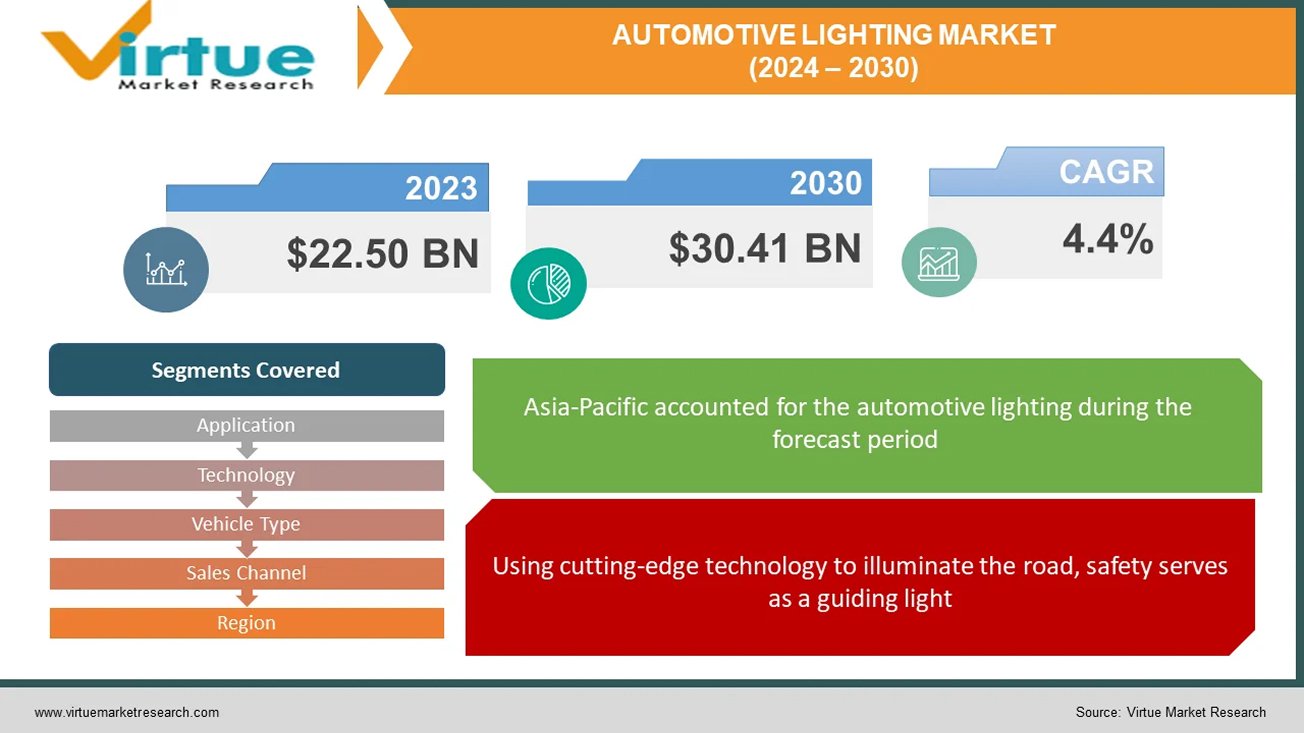
Global automotive lighting refers to all vehicle lighting systems, from headlamps that illuminate the road to taillights that communicate movements. They guarantee motorists and other road users alike safety, visibility, and style. While taillights frequently use LEDs for improved visibility, headlights are available in a variety of technologies, including LED and laser. Interior illumination, DRLs, and signal lights all have a role to play. This market, which was estimated to be worth $33.64 billion in 2022, is anticipated to rise to $67.39 billion by 2030 because of laws, luxury tastes, safety concerns, and technological developments like OLED taillights and adaptive headlights. Anticipate a future dominated by intelligent, connected, personalized, and sustainable lighting systems that enhance the safety, efficiency, and aesthetic appeal of automobiles.
Car lighting works its magic to provide safety, visibility, and style. Headlights cut through the night, taillights express intent, and interiors shine with comfort. The billion-dollar global business is expected to rise due to consumer demand for high-end experiences, safer roads, and cutting-edge technology. Imagine dynamic messages being painted by taillights, headlights that adjust to the road, and interiors that customize their atmosphere. Driven by technological advancements like linked systems and laser beams, this future is calling. Anticipate even more visually attractive, environmentally friendly, and intelligent lighting to illuminate the way ahead, making cars safer, more efficient, and unquestionably cooler.
In the market for automobile lighting, safety is the driving force behind demand from the public and laws. While automated high beams smoothly react to traffic, adaptive headlights modify their beams so as not to blind other people. With visually striking displays, dynamic taillights convey intentions for braking and turning. Beyond these developments, integrated pedestrian identification and lane departure alerts will soon make roads safer and brighter for everyone.
Luxurious automobile lighting creates a distinct visual identity that goes beyond simple illumination. Personalized interior lighting customizes the driving experience by setting the mood with a range of colours and intensities, while intricate designs and distinctive DRLs modify exteriors. As you approach your automobile at night, welcoming lights lead the way, resulting in an interior that is perfectly lit. Not only is this symphony of light aesthetically pleasing, but it also stands as a tribute to luxury. Upcoming developments like gesture-controlled lighting and holographic displays promise to further enhance the experience.
The worldwide automotive lighting market is undergoing a significant transition towards energy-efficient solutions, as environmental concerns gain prominence. LED technology is leading the way, providing a ray of hope for the environment and drivers alike. LED lights beam brighter and use a lot less energy than conventional halogen lamps. There are some tangible advantages to this. For drivers, this translates to increased fuel economy, which lowers petrol prices and lessens reliance on fossil fuels. Greater air quality and a reduction in the transport sector's contribution to climate change are the results of reduced overall emissions.
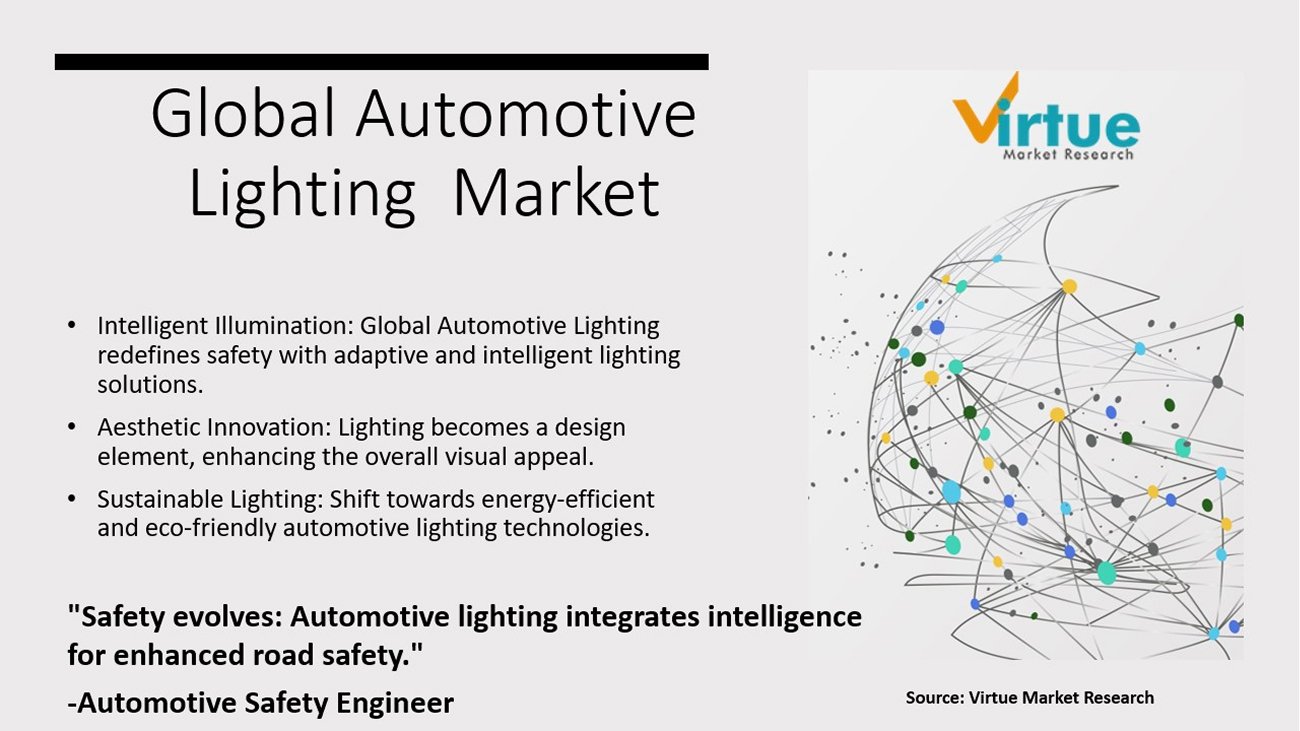
Although the global automotive lighting business is booming, there are still unknowns. Difficulties impede growth even as innovation propels it with eye catching features like laser beams and adaptable headlights. These technologies are luxury items due to their high cost and difficult integration, which puts producers' abilities to the test. The worldwide patchwork created by unclear legislation limits the potential of innovation. Durability issues persist, particularly when complex systems are subjected to challenging conditions. Ultimately, a lot of drivers still don't fully understand how these improvements can help them. Together, we can overcome these obstacles. The keys to reducing costs are improved production, more seamless integration, and unified regulations. Their full potential can be realized by educating customers about the safety, efficiency, and aesthetic value of these lighting wonders. By working together, we can pave the way for an even brighter and safer future for vehicle lighting.
It is made possible by advanced LED technology, which gives drivers the ability to customize their illumination for the highest level of comfort and flair. Consumers that care about the environment want greener products, and vehicle lighting complies. While solar- and self-powered lighting technologies offer a future powered by clean energy, energy-efficient LEDs lower pollution. The advent of connected lighting systems heralds a new age. Envision automobiles interacting with infrastructure and one another to minimize accidents and enhance traffic efficiency. Integrated headlights with pedestrian recognition provide unmatched safety, while dramatic taillights with eye-catching displays alert onlookers to your intentions. The possibilities are endless in the future. Gesture-controlled interior illumination, holographic displays projected onto the road, and even light fixtures with self-healing capabilities.

Due to laws requiring safety features like headlights, taillights, and brake lights, exterior lighting presently holds the most market share in the vehicle lighting industry. The dominance of this market is partly attributed to advancements in safety-focused technologies such as adaptive headlights and daytime running lights. The market value of external lighting is increased by the quick adoption of technology like LED bulbs and laser lights, which improve performance and aesthetics. Conversely, the interior lighting market is expected to increase at the fastest rate in the upcoming years. Innovations like ambient lighting and technology breakthroughs like LED and OLED displays, driven by consumer demand for comfort and personalisation, open new possibilities. The spread of sophisticated interior lighting systems is further driven by the growing emphasis on safety and the expansion of the luxury car market.
The worldwide vehicle lighting market is currently dominated by halogen because of its more affordable price, advanced technology, and useful illumination. With its dependable supply chain and affordable option for manufacturers and cost-conscious customers, halogen holds the biggest market share. The fastest-growing market right now is LEDs, which are predicted to shortly overtake halogen. The rapid expansion of LEDs is driven by their higher efficiency, longer lifespan, flexibility in design, and technological breakthroughs including enhanced brightness. Because LEDs use less energy and produce fewer emissions and better fuel economy, they are becoming more and more popular in the changing automotive lighting market.
Passenger automobiles rule the worldwide automotive lighting market. The sheer number of passenger cars produced which surpasses that of business vehicles and fuels the need for lighting systems is the primary cause of this popularity. The growing demand for personal automobiles in developing nations is a result of rising disposable income, which in turn drives the rise of the passenger car market. The importance that consumers place on safety and aesthetics elements helps to drive market expansion. But in the upcoming years, the market for electric and hybrid cars is expected to develop at the quickest rate. The exponential rise of the worldwide electric car market, which is still expanding and shows no signs of slowing down, is what is driving this surge. Specialised lighting solutions are required since electric and hybrid vehicles have different lighting requirements because of their specific functionality and design aesthetics.
Most lighting systems sold nowadays are sold by OEMs (Original Equipment Manufacturers), primarily because manufacturers pre-install lighting systems in new cars. But in the next years, the aftermarket is expected to develop at the quickest rate. This spike in demand for replacement parts, especially lighting systems, can be linked to several variables, one of them being the average age of cars. The industry is expanding because of consumers' growing desire to personalise their cars with aftermarket lighting upgrades such LED upgrades and decorative lighting. The availability and affordability of technologies like adaptive headlights and laser lights in the aftermarket, together with other advancements in lighting technology, are driving demand even more. Moreover, the growing market for electric cars (EVs).
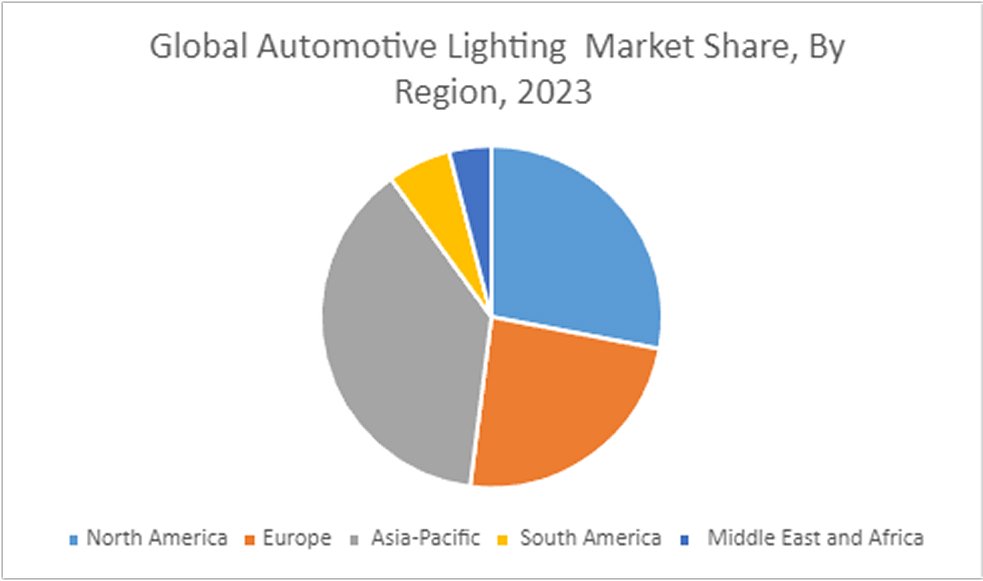
Throughout the forecast period, Asia Pacific is anticipated to be the automotive lighting market with the highest profitability. Over the past few years, Asia Pacific countries like China and India have seen notable increases in automotive manufacturing and sales, primarily in the medium-to premium luxury car segment. Asia Pacific is predicted to see an increase in the manufacturing of passenger cars, with India experiencing the strongest growth rate. Depending on the state of the national economy, the area offers a suitable selection of both high-end and cheap cars. For instance, there is a substantial demand for halogen, Xenon/HID, and LED since China and India produce more economy and mid-range automobiles. On the other hand, luxury car adoption rates are greater in South Korea and Japan, where LED lighting is the norm.
A brief shadow was thrown by COVID-19 over the worldwide automotive lighting market. Production was stopped by lockdowns and supply chain disruptions, while luxury lighting upgrades were shelved by consumers on a tight budget. Resources became scarce, and R&D stagnated. Still, the market is recovering thanks to resurgent demand and rearranged priorities. While energy-efficient LEDs are being pushed towards adoption by sustainability, safety concerns are driving interest in features like pedestrian detection and adaptive headlights. The digital push of the epidemic creates opportunities for intelligent, networked lighting systems that may interact with infrastructure and other cars. Ultimately, the industry is positioned to shine brighter, focused on safety, sustainability, and a connected future, even though the pandemic dimmed its brilliance.
A development collaboration between OSRAM Continental and REHAU aims to incorporate lighting into external components, providing automobile manufacturers with innovative lighting options that improve functionality and design flexibility. For rear combination lamps, Hella unveiled a revolutionary lighting innovation called Hella FlatLight technology. A Memorandum of Understanding (MoU) was signed by Samvardhana Motherson Automotive Systems Group BV (SMRPBV), a division of Motherson Group, and Marelli Automotive Lighting to investigate a technology collaboration focused on intelligently lighted external body components. Valeo debuted their revolutionary 360° lighting system at the Shanghai Auto Show. This technology surrounds the car with a band of light, projecting instantaneous, clear signs that other drivers can see from a distance. Pedestrians, cyclists, and scooter riders are especially susceptible to these signals
Shift toward dynamic, reprogrammable cultural spaces and convergence of cultural content with entertainment IP ecosystems are key drivers of the Immersive Museums & Gallery Market.
The Global Immersive Museums & Gallery Market faces significant barrier that is the high operational complexity of immersive environments, which require ongoing calibration, content updates, and technical redundancy.
Key players include teamLab Co., Ltd., Meow Wolf, Inc., Culturespaces (Atelier des Lumières operator), Grande Experiences (Grande Experience Group), Artechouse, Inc., Moment Factory Inc., Superblue Inc., Acute Art Ltd., Fever, and Théâtre des Lumières.
North America remains the largest regional market due to a mature institutional ecosystem, deep private investment, and a dense marketplace for entertainment IP.
Asia-Pacific is the fastest-growing region driven by aggressive urbanization, government cultural-tourism strategies, and mall developers actively reconfiguring retail into experience economies
Joining thousands of companies around the world committed to making the Excellent Business Solutions.

Specify your preferred Countries, Segments, or timeframes
Unlock Country Level Outlook, Trends, Cross-country Comparability, or supply Chain Variations.



Analyst Support
Every order comes with Analyst Support.

Customization
We offer customization to cater your needs to fullest.

Verified Analysis
We value integrity, quality and authenticity the most.

