Home Energy Management System Market Research Report – Segmentation by Product (Hardware, Software, Services), Application (Energy Monitoring and Management, Demand Response, Load Control, Renewable Energy Integration, Smart Thermostat and Climate Control), and Region - Size, Share, Growth Analysis | Forecast (2025– 2030)
Home Energy Management System Market (2025 – 2030)
The Global Home Energy Management System Market was valued at USD 3.8 billion in 2024 and will grow at a CAGR of 13.4% from 2025 to 2030. The market is expected to reach USD 7.13 billion by 2030.
The Home Energy Management System (HEMS) Market centers around technologies and platforms that enable residential consumers to monitor, control, and optimize their energy consumption. These systems integrate smart devices, sensors, software, and data analytics to provide real-time feedback on electricity use, helping homeowners save energy and reduce costs. The growing focus on sustainability, coupled with the rising adoption of smart home technologies and stringent government regulations on energy efficiency, is driving this market's rapid growth. Increasing demand for automation, renewable energy integration, and the emergence of dynamic energy pricing further enhance the relevance of HEMS solutions across residential settings. With advancements in IoT, AI, and cloud-based platforms, home energy management systems are transitioning from optional luxuries to essential tools for managing modern households efficiently and sustainably.
Key market insights:
In 2024, the hardware segment held over 45% of the market share due to the widespread use of devices like smart thermostats, load controllers, and sensors in residential energy management systems.
Cloud-based HEMS solutions accounted for more than 55% of the software and service market, benefiting from real-time analytics, scalability, and ease of remote access.
North America contributed approximately 38% of the global revenue in 2024, driven by strong utility involvement, smart grid infrastructure, and consumer awareness of energy conservation.
The adoption of HEMS integrated with solar power and battery storage systems saw a 16% year-over-year growth in 2024, as homeowners sought energy independence and cost savings.
Energy consumption monitoring applications made up more than 40% of usage patterns in 2024, underscoring the demand for visibility and actionable insights on household energy behavior.
The integration of voice assistants like Alexa and Google Assistant into HEMS platforms grew by 22% in 2024, making energy control more intuitive and accessible.
Europe saw a 12.6% increase in HEMS installations, supported by government incentives and programs promoting net-zero buildings and smart meters.
Mobile applications associated with HEMS witnessed a user penetration rate of over 60% globally, as consumers increasingly preferred app-based control of their energy ecosystems.
Global Home Energy Management System Market Drivers
Rising energy costs and need for savings is driving the market growth
As global energy prices continue to rise, homeowners are increasingly looking for ways to reduce their utility bills without compromising on comfort or convenience. Home energy management systems offer a solution by enabling users to track their electricity consumption in real time and make informed decisions about their usage. By monitoring high-consumption devices and adjusting patterns of use, these systems help lower monthly energy bills. Consumers are also more aware of energy waste caused by standby power or inefficient appliances, and HEMS provides the tools to detect and eliminate such inefficiencies. With dynamic electricity pricing models gaining popularity, homeowners equipped with HEMS can schedule power usage during off-peak hours, reducing overall costs. Additionally, systems that learn user behavior and automatically adjust settings—such as smart thermostats—further contribute to energy and cost savings. These systems represent not just a tool for efficiency but a form of empowerment for users who now have control over how much they consume and when. The growing pressure on household finances, especially in regions experiencing inflation or economic uncertainty, amplifies the attractiveness of these solutions. Therefore, rising energy costs continue to be a powerful catalyst driving the global expansion of the home energy management system market.
Integration with smart homes and IoT devices is driving the market growth
The surge in smart home adoption has significantly bolstered the demand for home energy management systems. Consumers are increasingly embracing connected devices such as smart lights, thermostats, plugs, and home assistants, creating an ecosystem where interoperability and automation are paramount. HEMS acts as the nerve center of this ecosystem, coordinating device operations to maximize energy efficiency while maintaining user comfort. Internet of Things (IoT) technology lies at the heart of this transformation, enabling real-time data collection, remote monitoring, and automated decision-making. Homeowners can receive usage alerts, schedule device operation, or remotely control appliances from mobile apps. Many modern HEMS platforms now feature AI-powered recommendations and machine learning capabilities that optimize performance based on usage patterns and external factors like weather. This seamless integration with the broader smart home infrastructure allows for an elevated user experience and better energy outcomes. As smart home devices become more affordable and intuitive, the compatibility with HEMS is becoming a key differentiator for consumers seeking comprehensive home automation solutions. Moreover, builders and developers are beginning to integrate HEMS into new housing projects as a standard feature, accelerating mainstream adoption. The convergence of IoT, automation, and user convenience ensures that HEMS is no longer an isolated product but a critical component of the modern connected home.
Government policies and carbon reduction goals is driving the market growth
Government regulations and sustainability goals are playing a vital role in driving the home energy management system market. Nations worldwide are adopting ambitious carbon reduction targets, and energy efficiency in residential buildings is a key pillar of these initiatives. To meet environmental objectives, many governments are implementing regulations that require or incentivize the installation of energy monitoring and management systems. Programs offering tax rebates, subsidies, or direct incentives for installing HEMS are gaining traction in countries like the United States, Germany, and Japan. Moreover, new building codes increasingly mandate energy-efficient infrastructure, including smart meters and connected thermostats, fostering the inclusion of HEMS in construction practices. Governments are also encouraging utility companies to adopt demand-response strategies, and HEMS facilitates homeowner participation in these programs. By adjusting power consumption during peak demand periods, households can support grid stability and benefit from lower rates. As climate change concerns intensify and international agreements like the Paris Accord gain prominence, residential energy management becomes a shared responsibility between governments, utility providers, and consumers. The public sector’s backing not only accelerates the adoption of HEMS but also fosters innovation through grants and research funding. As these policies become more stringent and widespread, the role of home energy management systems in achieving national sustainability targets is expected to grow even more prominent.
Global Home Energy Management System Market Challenges and Restraints
High initial investment and complexity is restricting the market growth
Despite their long-term cost-saving potential, home energy management systems often come with high upfront costs, which can deter many potential users. The total expense typically includes hardware such as smart meters, thermostats, sensors, gateways, and sometimes solar integration equipment. On top of this, software subscriptions, installation, and ongoing maintenance add to the financial burden. For middle- and lower-income households, these costs can be prohibitive, especially in regions without government subsidies or incentives. In addition to the expense, system complexity presents a significant barrier. Users unfamiliar with technology may find the interfaces difficult to navigate or the options overwhelming. While newer systems aim to be more user-friendly, a learning curve still exists, and it can dissuade less tech-savvy individuals from adoption. Moreover, integrating HEMS with legacy home infrastructure or appliances may require additional customization or even replacement of existing systems, raising costs and complexity further. For utilities and service providers, this complexity also increases support and troubleshooting requirements. Unless manufacturers focus on affordability, simplicity, and interoperability, adoption may remain confined to early adopters and high-income segments. Addressing this challenge requires product innovation, educational campaigns, and enhanced support services to encourage broader market penetration.
Data privacy and cybersecurity concerns is restricting the market growth
As home energy management systems increasingly rely on cloud platforms, remote access, and real-time data analytics, cybersecurity becomes a significant concern. HEMS collects a wealth of sensitive information, including detailed household energy usage patterns, occupancy behavior, and even daily routines. If compromised, such data could be used maliciously, including surveillance or predicting when a home is unoccupied. The growing number of connected devices also increases the number of potential entry points for cyberattacks. Cases of smart home systems being hacked highlight the vulnerabilities that exist in the broader IoT ecosystem. Without strong encryption protocols, secure authentication methods, and consistent firmware updates, HEMS users remain at risk. Additionally, not all manufacturers have the resources or expertise to build secure systems, and some may cut corners to reduce costs. Regulatory frameworks on data privacy vary widely across regions, adding to the complexity of maintaining compliance. For instance, GDPR in Europe imposes strict data handling requirements that not all global vendors may be prepared for. Consumers are becoming increasingly aware of these issues and may hesitate to adopt connected energy systems unless clear, trustworthy, and transparent security measures are in place. The challenge for HEMS providers is to implement robust cybersecurity solutions without compromising performance, user experience, or affordability.
Market Opportunities
The home energy management system market presents several compelling opportunities for expansion, driven by evolving consumer behaviors, regulatory support, and technological advancements. One of the most promising areas is the integration of HEMS with renewable energy sources like solar panels and residential wind turbines. As homeowners become producers of energy, the need for efficient management, storage, and usage becomes critical. HEMS that facilitate energy storage decisions, battery discharge timing, and real-time grid interaction will be in high demand. Additionally, demand response programs open new revenue streams for consumers and opportunities for providers to offer value-added services. Another growing opportunity lies in emerging economies, where urbanization and rising middle-class incomes are accelerating smart home adoption. Here, localized HEMS solutions tailored to specific energy infrastructure and user preferences can unlock massive potential. Furthermore, there's room for innovation in user engagement and gamification—using dashboards, rewards, and visual insights to motivate energy-saving behaviors. Health and comfort features, like indoor air quality monitoring and climate control, are also being integrated into HEMS platforms, expanding their utility beyond energy alone. The convergence of HEMS with EV charging infrastructure is another opportunity, as households begin to optimize charging based on energy pricing and availability. Collaborations between utility providers and tech firms can enhance product offerings and accelerate grid-wide efficiencies. Companies investing in modular, scalable, and cost-effective solutions will have the advantage in this fast-evolving landscape. As smart cities and net-zero building initiatives gain momentum, the home energy management system market stands at the intersection of policy, innovation, and everyday living, offering vast untapped potential.
HOME ENERGY MANAGEMENT SYSTEM MARKET REPORT COVERAGE:
REPORT METRIC
DETAILS
Market Size Available
2024 - 2030
Base Year
2024
Forecast Period
2025 - 2030
CAGR
13.4%
Segments Covered
By Product, application, and Region
Various Analyses Covered
Global, Regional & Country Level Analysis, Segment-Level Analysis, DROC, PESTLE Analysis, Porter’s Five Forces Analysis, Competitive Landscape, Analyst Overview on Investment Opportunities
Regional Scope
North America, Europe, APAC, Latin America, Middle East & Africa
Key Companies Profiled
Schneider Electric, Honeywell, Panasonic, Siemens, and Ecobee.
Home Energy Management System Market segmentation
Home Energy Management System Market Segmentation By product:
• Hardware
• Software
• Services
The hardware segment is currently the most dominant in the home energy management system market, holding over 45% market share in 2024. This segment includes smart plugs, thermostats, smart meters, and controllers that are essential for monitoring and managing household energy usage. The rise in smart appliance adoption and increased consumer interest in tangible, device-based solutions for energy savings are contributing to its dominance. Hardware forms the physical backbone of any HEMS setup, without which software and services cannot function effectively.
Home Energy Management System Market Segmentation By application:
• Energy Monitoring and Management
• Demand Response
• Load Control
• Renewable Energy Integration
• Smart Thermostat and Climate Control
Energy monitoring and management emerged as the most dominant application segment, accounting for over 40% of the total market in 2024. This is largely due to increasing consumer interest in understanding their energy usage patterns to reduce costs and waste. The application helps users identify inefficiencies, make behavioral changes, and take control of energy expenditure. As awareness of energy efficiency continues to grow, this segment is expected to maintain its lead throughout the forecast period.
Home Energy Management System Market Regional segmentation
North America
Asia-Pacific
Europe
South America
Middle East and Africa
North America remained the most dominant region in the global home energy management system market in 2024, contributing nearly 38% of total revenue. This leadership position is attributed to a high level of technological adoption, strong infrastructure for smart grids, and widespread use of smart home devices. The United States, in particular, has been proactive in deploying HEMS through both private-sector innovations and public policy initiatives. Government rebates and utility incentives have encouraged homeowners to adopt these systems. Additionally, the region’s commitment to sustainability and energy efficiency goals drives the demand for intelligent energy solutions. The presence of major technology companies and startups focusing on smart home and energy management has further accelerated innovation and consumer interest. Moreover, increasing awareness among consumers regarding dynamic pricing, energy independence, and environmental impact has boosted the adoption rate. The integration of HEMS with solar PV and energy storage solutions is also significantly higher in North America compared to other regions, thanks to favorable policies and better affordability. While other regions are growing rapidly, North America's mature market, proactive regulation, and technological edge position it as the continued leader in the HEMS space.
COVID-19 Impact Analysis on the Home Energy Management System Market
The COVID-19 pandemic had a mixed yet ultimately positive impact on the global home energy management system market. Initially, disruptions in the global supply chain led to delays in hardware production and shipment, affecting system installations and new projects. However, as remote working and lockdowns became the norm, energy consumption patterns within homes drastically shifted. Residential energy usage surged, drawing attention to the need for better control and management of electricity consumption. Homeowners began actively seeking solutions that could reduce costs and provide visibility into their usage, making HEMS more relevant than ever. The heightened awareness of health, safety, and indoor environment quality during the pandemic also aligned with HEMS features that include air quality monitoring and smart climate control. The increased time spent at home further motivated consumers to invest in smart technologies, with many opting to install smart meters, thermostats, and mobile apps that helped optimize energy use. Moreover, governments in several regions used economic recovery packages to promote sustainable development, which included grants and incentives for energy efficiency technologies. The pandemic also accelerated the digital transformation of the energy sector, pushing utilities and tech firms to innovate rapidly. As a result, cloud-based HEMS platforms and remote energy audits gained popularity. Although the economic slowdown temporarily constrained household spending in some regions, the long-term behavioral shifts triggered by COVID-19 reinforced the value proposition of HEMS. The industry emerged from the pandemic more resilient, with stronger consumer interest and an expanded range of use cases, setting the stage for sustained growth.
Latest trends/Developments
Several key trends are shaping the current and future trajectory of the global home energy management system market. One of the most significant developments is the shift toward AI-driven analytics and predictive modeling. By analyzing user behavior, weather conditions, and energy tariffs, HEMS platforms can now optimize energy consumption proactively. Another major trend is the integration of HEMS with renewable energy systems and battery storage. Consumers are increasingly looking for solutions that can coordinate energy generation, usage, and storage, thereby reducing reliance on the grid. The emergence of real-time energy marketplaces and peer-to-peer energy trading is opening up new roles for HEMS as enablers of decentralized energy management. The adoption of voice-activated control through assistants like Alexa and Google Home is making these systems more user-friendly and intuitive. Additionally, the rise of 5G connectivity is enhancing the speed and reliability of HEMS data transfer, improving responsiveness and performance. On the business side, service providers are shifting from product-based models to subscription and platform-as-a-service offerings, which include regular updates, analytics, and support. Sustainability and energy transparency are becoming brand differentiators, and HEMS companies are responding by offering real-time dashboards, carbon footprint tracking, and integration with smart appliances. Global energy regulations are also shaping development, with more products designed to comply with energy labeling and smart grid standards. Lastly, HEMS adoption is being fueled by smart city initiatives, where intelligent infrastructure includes residential energy optimization as part of larger urban planning frameworks. Together, these trends are pushing the HEMS market toward broader adoption, smarter systems, and deeper integration with daily life.
Key Players:
Schneider Electric
Honeywell International Inc.
Panasonic Corporation
Johnson Controls
General Electric
Siemens AG
Eaton Corporation
Alarm.com
Nest Labs (Google)
Ecobee
To Learn more about this report,
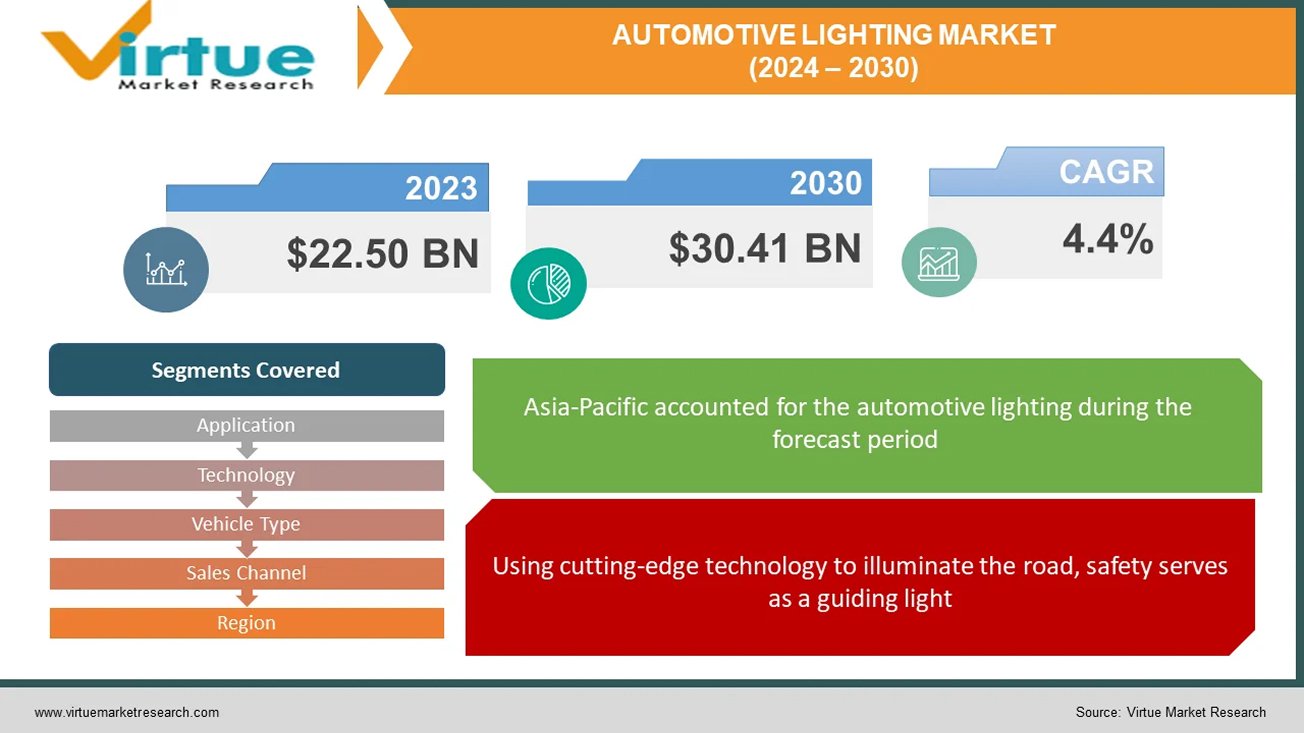
Global automotive lighting refers to all vehicle lighting systems, from headlamps that illuminate the road to taillights that communicate movements. They guarantee motorists and other road users alike safety, visibility, and style. While taillights frequently use LEDs for improved visibility, headlights are available in a variety of technologies, including LED and laser. Interior illumination, DRLs, and signal lights all have a role to play. This market, which was estimated to be worth $33.64 billion in 2022, is anticipated to rise to $67.39 billion by 2030 because of laws, luxury tastes, safety concerns, and technological developments like OLED taillights and adaptive headlights. Anticipate a future dominated by intelligent, connected, personalized, and sustainable lighting systems that enhance the safety, efficiency, and aesthetic appeal of automobiles.
Key Market Insights:
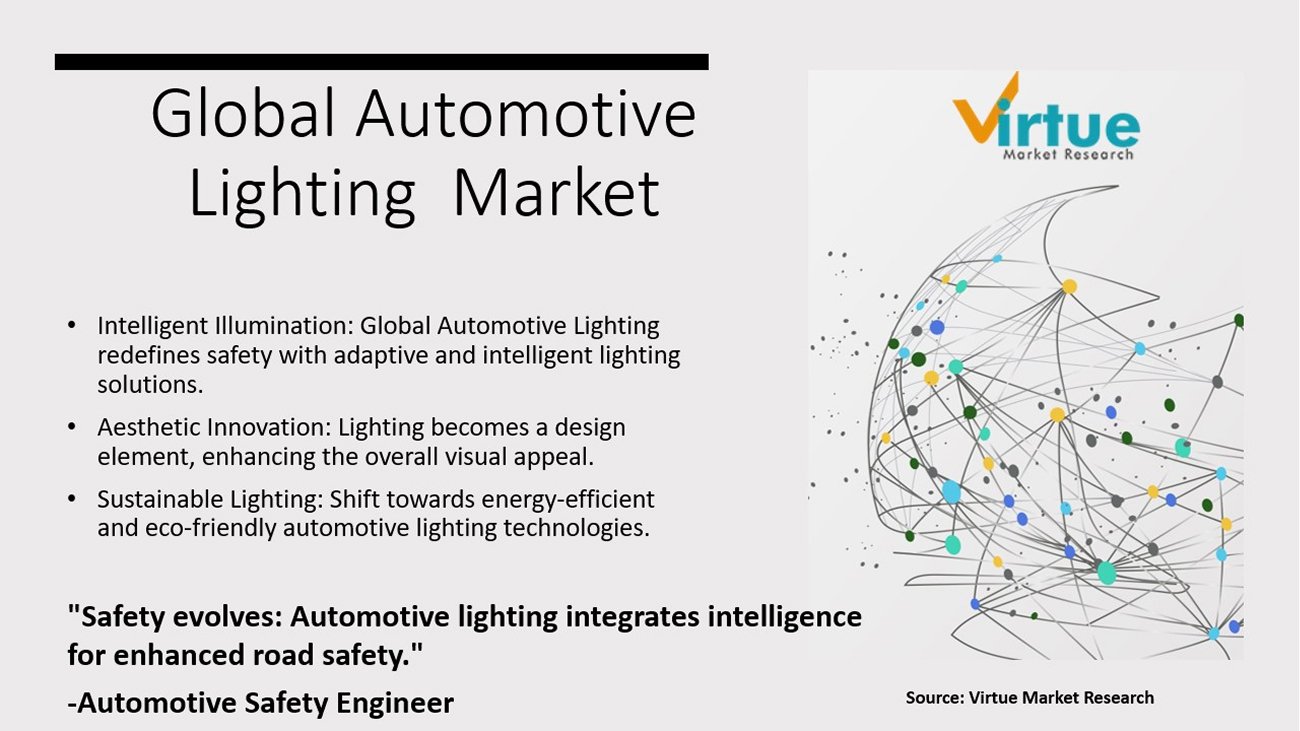
Car lighting works its magic to provide safety, visibility, and style. Headlights cut through the night, taillights express intent, and interiors shine with comfort. The billion-dollar global business is expected to rise due to consumer demand for high-end experiences, safer roads, and cutting-edge technology. Imagine dynamic messages being painted by taillights, headlights that adjust to the road, and interiors that customize their atmosphere. Driven by technological advancements like linked systems and laser beams, this future is calling. Anticipate even more visually attractive, environmentally friendly, and intelligent lighting to illuminate the way ahead, making cars safer, more efficient, and unquestionably cooler.
Global Automotive Lighting Market Drivers:
Using cutting-edge technology to illuminate the road, safety serves as a guiding light.
In the market for automobile lighting, safety is the driving force behind demand from the public and laws. While automated high beams smoothly react to traffic, adaptive headlights modify their beams so as not to blind other people. With visually striking displays, dynamic taillights convey intentions for braking and turning. Beyond these developments, integrated pedestrian identification and lane departure alerts will soon make roads safer and brighter for everyone.
Beyond Performance-Based Luxuries Redefined by Light.
Luxurious automobile lighting creates a distinct visual identity that goes beyond simple illumination. Personalized interior lighting customizes the driving experience by setting the mood with a range of colours and intensities, while intricate designs and distinctive DRLs modify exteriors. As you approach your automobile at night, welcoming lights lead the way, resulting in an interior that is perfectly lit. Not only is this symphony of light aesthetically pleasing, but it also stands as a tribute to luxury. Upcoming developments like gesture-controlled lighting and holographic displays promise to further enhance the experience.
Fuel Efficiency Takes the Lead: Illuminating Sustainability
The worldwide automotive lighting market is undergoing a significant transition towards energy-efficient solutions, as environmental concerns gain prominence. LED technology is leading the way, providing a ray of hope for the environment and drivers alike. LED lights beam brighter and use a lot less energy than conventional halogen lamps. There are some tangible advantages to this. For drivers, this translates to increased fuel economy, which lowers petrol prices and lessens reliance on fossil fuels. Greater air quality and a reduction in the transport sector's contribution to climate change are the results of reduced overall emissions.
To Learn more about this report,
Global Automotive Lighting Market Restraints and Challenges:
Although the global automotive lighting business is booming, there are still unknowns. Difficulties impede growth even as innovation propels it with eye catching features like laser beams and adaptable headlights. These technologies are luxury items due to their high cost and difficult integration, which puts producers' abilities to the test. The worldwide patchwork created by unclear legislation limits the potential of innovation. Durability issues persist, particularly when complex systems are subjected to challenging conditions. Ultimately, a lot of drivers still don't fully understand how these improvements can help them. Together, we can overcome these obstacles. The keys to reducing costs are improved production, more seamless integration, and unified regulations. Their full potential can be realized by educating customers about the safety, efficiency, and aesthetic value of these lighting wonders. By working together, we can pave the way for an even brighter and safer future for vehicle lighting.
Global Automotive Lighting Market Opportunities:
It is made possible by advanced LED technology, which gives drivers the ability to customize their illumination for the highest level of comfort and flair. Consumers that care about the environment want greener products, and vehicle lighting complies. While solar- and self-powered lighting technologies offer a future powered by clean energy, energy-efficient LEDs lower pollution. The advent of connected lighting systems heralds a new age. Envision automobiles interacting with infrastructure and one another to minimize accidents and enhance traffic efficiency. Integrated headlights with pedestrian recognition provide unmatched safety, while dramatic taillights with eye-catching displays alert onlookers to your intentions. The possibilities are endless in the future. Gesture-controlled interior illumination, holographic displays projected onto the road, and even light fixtures with self-healing capabilities.
AUTOMOTIVE LIGHTING MARKET REPORT COVERAGE:
To Learn more about this report,
Global Automotive Lighting Market Segmentation: By Application
Exterior Lighting
Interior Lighting
Due to laws requiring safety features like headlights, taillights, and brake lights, exterior lighting presently holds the most market share in the vehicle lighting industry. The dominance of this market is partly attributed to advancements in safety-focused technologies such as adaptive headlights and daytime running lights. The market value of external lighting is increased by the quick adoption of technology like LED bulbs and laser lights, which improve performance and aesthetics. Conversely, the interior lighting market is expected to increase at the fastest rate in the upcoming years. Innovations like ambient lighting and technology breakthroughs like LED and OLED displays, driven by consumer demand for comfort and personalisation, open new possibilities. The spread of sophisticated interior lighting systems is further driven by the growing emphasis on safety and the expansion of the luxury car market.
Global Automotive Lighting Market Segmentation: By Technology
Halogen
LED (Light-Emitting Diode)
Xenon
Emerging Technologies
The worldwide vehicle lighting market is currently dominated by halogen because of its more affordable price, advanced technology, and useful illumination. With its dependable supply chain and affordable option for manufacturers and cost-conscious customers, halogen holds the biggest market share. The fastest-growing market right now is LEDs, which are predicted to shortly overtake halogen. The rapid expansion of LEDs is driven by their higher efficiency, longer lifespan, flexibility in design, and technological breakthroughs including enhanced brightness. Because LEDs use less energy and produce fewer emissions and better fuel economy, they are becoming more and more popular in the changing automotive lighting market.
Global Automotive Lighting Market Segmentation: By Vehicle Type
Passenger Cars
Commercial Vehicles
Passenger automobiles rule the worldwide automotive lighting market. The sheer number of passenger cars produced which surpasses that of business vehicles and fuels the need for lighting systems is the primary cause of this popularity. The growing demand for personal automobiles in developing nations is a result of rising disposable income, which in turn drives the rise of the passenger car market. The importance that consumers place on safety and aesthetics elements helps to drive market expansion. But in the upcoming years, the market for electric and hybrid cars is expected to develop at the quickest rate. The exponential rise of the worldwide electric car market, which is still expanding and shows no signs of slowing down, is what is driving this surge. Specialised lighting solutions are required since electric and hybrid vehicles have different lighting requirements because of their specific functionality and design aesthetics.
Global Automotive Lighting Market Segmentation: By Sales Channel
OEM (Original Equipment Manufacturers)
Aftermarket
Most lighting systems sold nowadays are sold by OEMs (Original Equipment Manufacturers), primarily because manufacturers pre-install lighting systems in new cars. But in the next years, the aftermarket is expected to develop at the quickest rate. This spike in demand for replacement parts, especially lighting systems, can be linked to several variables, one of them being the average age of cars. The industry is expanding because of consumers' growing desire to personalise their cars with aftermarket lighting upgrades such LED upgrades and decorative lighting. The availability and affordability of technologies like adaptive headlights and laser lights in the aftermarket, together with other advancements in lighting technology, are driving demand even more. Moreover, the growing market for electric cars (EVs).
To Learn more about this report,
Global Automotive Lighting Market Segmentation: By Region
North America
Asia-Pacific
Europe
South America
Middle East and Africa
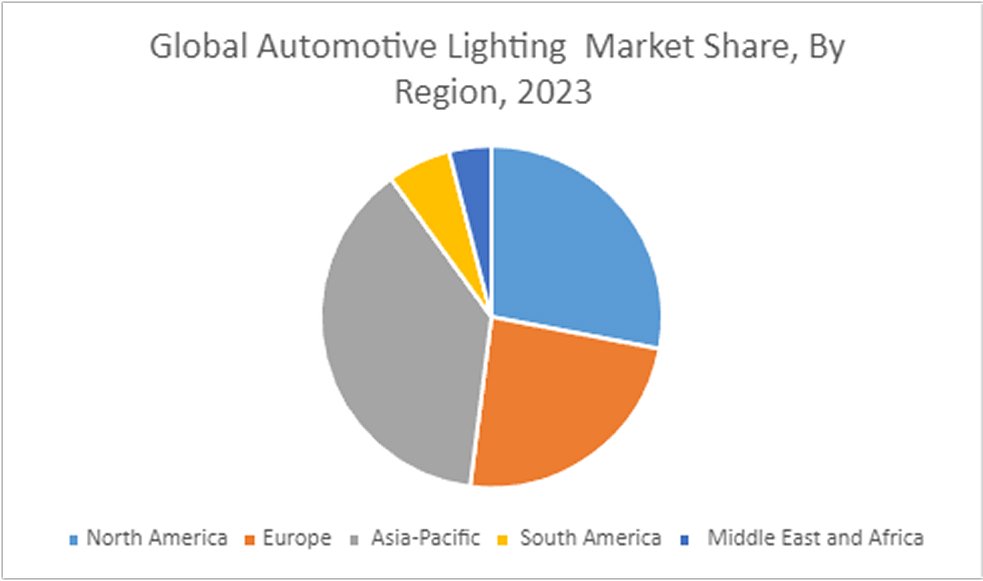
Throughout the forecast period, Asia Pacific is anticipated to be the automotive lighting market with the highest profitability. Over the past few years, Asia Pacific countries like China and India have seen notable increases in automotive manufacturing and sales, primarily in the medium-to premium luxury car segment. Asia Pacific is predicted to see an increase in the manufacturing of passenger cars, with India experiencing the strongest growth rate. Depending on the state of the national economy, the area offers a suitable selection of both high-end and cheap cars. For instance, there is a substantial demand for halogen, Xenon/HID, and LED since China and India produce more economy and mid-range automobiles. On the other hand, luxury car adoption rates are greater in South Korea and Japan, where LED lighting is the norm.
COVID-19 Impact Analysis on the Global Automotive Lighting Market:
A brief shadow was thrown by COVID-19 over the worldwide automotive lighting market. Production was stopped by lockdowns and supply chain disruptions, while luxury lighting upgrades were shelved by consumers on a tight budget. Resources became scarce, and R&D stagnated. Still, the market is recovering thanks to resurgent demand and rearranged priorities. While energy-efficient LEDs are being pushed towards adoption by sustainability, safety concerns are driving interest in features like pedestrian detection and adaptive headlights. The digital push of the epidemic creates opportunities for intelligent, networked lighting systems that may interact with infrastructure and other cars. Ultimately, the industry is positioned to shine brighter, focused on safety, sustainability, and a connected future, even though the pandemic dimmed its brilliance.
Recent Trends and Developments in the Global Automotive Lighting Market:
A development collaboration between OSRAM Continental and REHAU aims to incorporate lighting into external components, providing automobile manufacturers with innovative lighting options that improve functionality and design flexibility. For rear combination lamps, Hella unveiled a revolutionary lighting innovation called Hella FlatLight technology. A Memorandum of Understanding (MoU) was signed by Samvardhana Motherson Automotive Systems Group BV (SMRPBV), a division of Motherson Group, and Marelli Automotive Lighting to investigate a technology collaboration focused on intelligently lighted external body components. Valeo debuted their revolutionary 360° lighting system at the Shanghai Auto Show. This technology surrounds the car with a band of light, projecting instantaneous, clear signs that other drivers can see from a distance. Pedestrians, cyclists, and scooter riders are especially susceptible to these signals
Key Players:
AMS Osram
Cree
Hella
Hyundai Mobis
Koito
Luminus Devices
Magneti Marelli
Osram Licht AG
Stanley Electric
Valeo
Chapter 1. HOME ENERGY MANAGEMENT SYSTEM MARKET – SCOPE & METHODOLOGY
1.1. Market Segmentation
1.2. Scope, Assumptions & Limitations
1.3. Research Methodology
1.4. Primary Sources
1.5. Secondary Sources Chapter 2. HOME ENERGY MANAGEMENT SYSTEM MARKET – EXECUTIVE SUMMARY
2.1. Market Size & Forecast – (2025 – 2030) ($M/$Bn)
2.2. Key Trends & Insights
2.2.1. Demand Side
2.2.2. Supply Side
2.3. Attractive Investment Propositions
2.4. COVID-19 Impact Analysis Chapter 3. HOME ENERGY MANAGEMENT SYSTEM MARKET – COMPETITION SCENARIO
3.1. Market Share Analysis & Company Benchmarking
3.2. Competitive Strategy & Development Scenario
3.3. Competitive Pricing Analysis
3.4. Supplier-Distributor Analysis Chapter 4. HOME ENERGY MANAGEMENT SYSTEM MARKET - ENTRY SCENARIO
4.1. Regulatory Scenario
4.2. Case Studies – Key Start-ups
4.3. Customer Analysis
4.4. PESTLE Analysis
4.5. Porters Five Force Model
4.5.1. Bargaining Power of Suppliers
4.5.2. Bargaining Powers of Customers
4.5.3. Threat of New Entrants
4.5.4. Rivalry among Existing Players
4.5.5. Threat of Substitutes Players
4.5.6. Threat of Substitutes Chapter 5. HOME ENERGY MANAGEMENT SYSTEM MARKET - LANDSCAPE
5.1. Value Chain Analysis – Key Stakeholders Impact Analysis
5.2. Market Drivers
5.3. Market Restraints/Challenges
5.4. Market Opportunities Chapter 6. HOME ENERGY MANAGEMENT SYSTEM MARKET – By Product
6.1 Introduction/Key Findings
6.2 Hardware
6.3 Software
6.4 Services
6.5 Y-O-Y Growth trend Analysis By Product
6.6 Absolute $ Opportunity Analysis By Product , 2025-2030
Chapter 7. HOME ENERGY MANAGEMENT SYSTEM MARKET – By Application
7.1 Introduction/Key Findings
7.2 Energy Monitoring and Management
7.3 Demand Response
7.4 Load Control
7.5 Renewable Energy Integration
7.6 Smart Thermostat and Climate Control
7.7 Y-O-Y Growth trend Analysis By Application
7.8 Absolute $ Opportunity Analysis By Application , 2025-2030
Chapter 8. HOME ENERGY MANAGEMENT SYSTEM MARKET - By Geography – Market Size, Forecast, Trends & Insights
8.1. North America
8.1.1. By Country
8.1.1.1. U.S.A.
8.1.1.2. Canada
8.1.1.3. Mexico
8.1.2. By Application
8.1.3. By Product
8.1.4. Countries & Segments - Market Attractiveness Analysis
8.2. Europe
8.2.1. By Country
8.2.1.1. U.K.
8.2.1.2. Germany
8.2.1.3. France
8.2.1.4. Italy
8.2.1.5. Spain
8.2.1.6. Rest of Europe
8.2.2. By Product
8.2.3. By Application
8.2.4. Countries & Segments - Market Attractiveness Analysis
8.3. Asia Pacific
8.3.1. By Country
8.3.1.1. China
8.3.1.2. Japan
8.3.1.3. South Korea
8.3.1.4. India
8.3.1.5. Australia & New Zealand
8.3.1.6. Rest of Asia-Pacific
8.3.2. By Product
8.3.3. By Application
8.3.4. Countries & Segments - Market Attractiveness Analysis
8.4. South America
8.4.1. By Country
8.4.1.1. Brazil
8.4.1.2. Argentina
8.4.1.3. Colombia
8.4.1.4. Chile
8.4.1.5. Rest of South America
8.4.2. By Product
8.4.3. By Application
8.4.4. Countries & Segments - Market Attractiveness Analysis
8.5. Middle East & Africa
8.5.1. By Country
8.5.1.1. United Arab Emirates (UAE)
8.5.1.2. Saudi Arabia
8.5.1.3. Qatar
8.5.1.4. Israel
8.5.1.5. South Africa
8.5.1.6. Nigeria
8.5.1.7. Kenya
8.5.1.8. Egypt
8.5.1.8. Rest of MEA
8.5.2. By Product
8.5.3. By Application
8.5.4. Countries & Segments - Market Attractiveness Analysis
Chapter 9. HOME ENERGY MANAGEMENT SYSTEM MARKET – Company Profiles – (Overview, Packaging Product, Portfolio, Financials, Strategies & Developments)
9.1 Schneider Electric
9.2 Honeywell International Inc.
9.3 Panasonic Corporation
9.4 Johnson Controls
9.5 General Electric
9.6 Siemens AG
9.7 Eaton Corporation
9.8 Alarm.com
9.9 Nest Labs (Google)
9.10 Ecobee
Report Code: VMR-18936 | Published Date: December 2025 | Format: Excel and PDF
In 2025, the global Distribution Grid Automation Market was valued at approximately USD 18.4 billion. The market is projected to expand at a compound annual growth rate of around 11.7% during 2026–2030, reaching USD 32.1...
Report Code: VMR-9988 | Published Date: October 2024 | Format: Excel and PDF
The Global Energy Storage Systems Market was valued at USD 45.3 billion in 2023 and is projected to grow at a CAGR of 10.3% from 2024 to 2030, reaching approximately USD 90 billion by 2030.
Report Code: VMR-6921 | Published Date: October 2024 | Format: Excel and PDF
The Thermal Energy Storage Market was valued at USD 6.8 Billion in 2024 and is projected to reach a market size of USD 14.11 Billion by the end of 2030. Over the forecast period of 2025-2030, the market is projected to g...
Report Code: VMR-18636 | Published Date: September 2025 | Format: Excel and PDF
The Space Battery Market was valued at USD 3.38 Billion in 2024 and is projected to reach a market size of USD 5.88 Billion by the end of 2030. Over the forecast period of 2025-2030, the market is projected to grow at a...
Report Code: VMR-19022 | Published Date: January 2026 | Format: Excel and PDF
The Electricity Infrastructure Single-Point-of-Failure Analysis Market was valued at USD 478.5 Million in 2025 and is projected to reach a market size of USD 1142.83 Million by the end of 2030. Over the forecast period o...
“We received a complex piece of work for our niche market from Virtue Market research in short period of time. I appreciate the quality and content of the final files we received. Thanks for the support”
Medical Devices Company based in Europe
“We received a complex piece of work for our niche market from Virtue Market research in short period of time. I appreciate the quality and content of the final files we received. Thanks for the support”
Medical Devices Company based in Europe
“We received a complex piece of work for our niche market from Virtue Market research in short period of time. I appreciate the quality and content of the final files we received. Thanks for the support”
Medical Devices Company based in Europe
“We received a complex piece of work for our niche market from Virtue Market research in short period of time. I appreciate the quality and content of the final files we received. Thanks for the support”
Medical Devices Company based in Europe
“We received a complex piece of work for our niche market from Virtue Market research in short period of time. I appreciate the quality and content of the final files we received. Thanks for the support”
Medical Devices Company based in Europe
“We received a complex piece of work for our niche market from Virtue Market research in short period of time. I appreciate the quality and content of the final files we received. Thanks for the support”