Generative Design Market Research Report – Segmented By Component (Software, Services); by Deployment (On-Premises, Cloud-Based); By End User Vertical (Aerospace and Defense, Automotive, Architecture and Construction, Consumer Goods, Industrial Manufacturing, Healthcare, Oil and Gas); and Region - Size, Share, Growth Analysis | Forecast (2024 – 2030)
Global Generative Design Market Size (2024 – 2030)
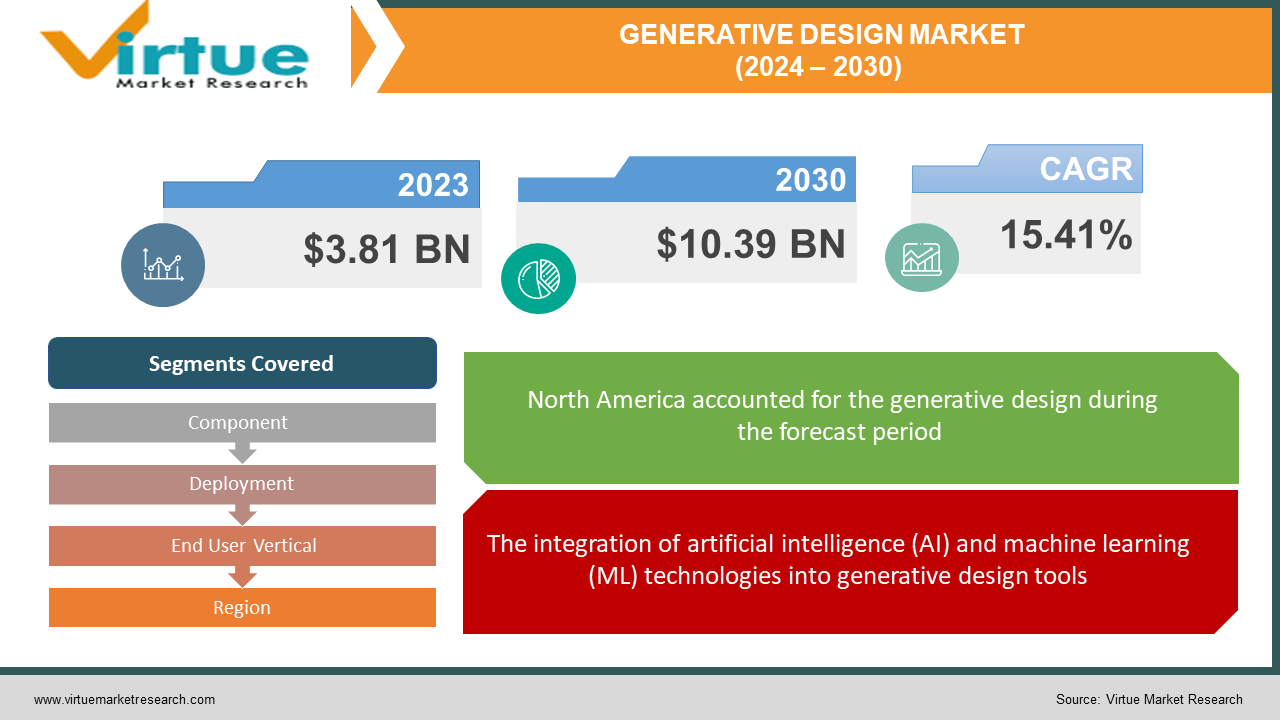
The global generative design market was valued at USD 3.81 billion in 2023 and is projected to reach a market size of USD 10.39 billion by the end of 2030. Over the forecast period of 2024–2030, the market is projected to grow at a CAGR of 15.41%.
Generative design refers to a design approach that involves using algorithms and computational processes to explore multiple design possibilities and generate solutions based on specified parameters or constraints. This approach is particularly prominent in fields such as architecture, product design, and engineering. The generative design market has been growing as technology continues to advance and industries seek more efficient and innovative design solutions. Generative design is a design exploration process that uses artificial intelligence (AI) to automatically generate multiple design solutions based on a set of constraints and objectives. The software iteratively tests and refines these designs, eventually producing a design that is optimized for performance, weight, cost, or other factors. Generative design tools are often integrated with computer-aided design (CAD) software, allowing a seamless transition from generative design exploration to detailed design and engineering phases. Industries such as automotive, aerospace, architecture, and manufacturing have been early adopters of generative design. It helps in creating optimized and lightweight structures, improving performance, and reducing material usage. Generative design can lead to more efficient and cost-effective designs by optimizing for factors such as material usage, weight, and manufacturing processes. This is particularly crucial in industries where efficiency and resource optimization are key considerations. The generative design market is evolving with the integration of artificial intelligence (AI) and machine learning (ML) techniques. These technologies enhance the ability of generative design tools to learn from past designs and continuously improve the quality of generated solutions. Collaboration features and cloud-based solutions are becoming more common, enabling teams to work on generative design projects collaboratively and access computing resources on demand. Collaboration features and cloud-based solutions are becoming more common, enabling teams to work on generative design projects collaboratively and access computing resources on demand.
Key Market Insights:
The significant growth signifies the increasing adoption of generative design technology across sectors. Companies are increasingly seeking new ways to optimize products and processes, and generative design offers a powerful tool for exploring a broader range of design possibilities. Continuous progress in AI algorithms and techniques enables generative design software to create increasingly complex and efficient designs. Generative design can help optimize material usage and reduce production costs, leading to significant savings for manufacturers. The generative design market is expected to experience continued strong growth in the coming years, driven by evolving AI technology, increasing awareness, and expanding applications. Interoperability between different software platforms and seamless integration with existing workflows will be crucial for wider adoption. Advancements in AI and machine learning will lead to more sophisticated and autonomous design processes. The adoption of generative design aligns with the broader trend of Industry 4.0, where companies are embracing advanced technologies, automation, and data exchange to enhance manufacturing processes. Generative design plays a crucial role in creating designs optimized for digital manufacturing. Generative design is finding applications across diverse industries beyond traditional manufacturing. This includes fields like healthcare, consumer goods, and even fashion, showcasing the versatility of the approach. Collaborative features and cloud-based solutions are gaining importance, allowing multiple team members to work on generative design projects simultaneously. This fosters efficient collaboration and improves the overall project workflow. The market for generative design software is becoming increasingly competitive, with both established software giants and emerging startups entering the space. This competition is driving innovation and the development of more user-friendly and powerful generative design tools.
Generative Design Market Drivers:
The integration of artificial intelligence (AI) and machine learning (ML) technologies into generative design tools.
The integration of artificial intelligence (AI) and machine learning (ML) technologies into generative design tools has been a significant driver. These technologies enhance the capabilities of generative design by enabling the software to learn from past designs, understand user preferences, and continuously improve the quality of generated solutions ML algorithms can analyze vast amounts of design data, learn from successful designs, and identify patterns. This learning process enables generative design tools to offer more intelligent and context-aware design suggestions. Machine learning algorithms can assist designers by predicting design preferences, offering real-time feedback, and even automating certain aspects of the design process. This helps bridge the gap between complex algorithms and the human designer, making generative design more accessible. The iterative nature of generative design is well-suited for machine learning. As designers interact with the tool and make selections, the system can learn from these interactions, improving its recommendations over time. The integration of AI and ML technologies is making generative design tools more powerful and user-friendly. This has broadened the appeal of generative design beyond experts, attracting a wider range of users across various industries who can benefit from AI-driven design optimization. Advanced deep learning algorithms, particularly convolutional neural networks (CNNs), play a crucial role in analyzing complex shapes, understanding design constraints, and predicting performance outcomes. This opens doors to exploring previously unimaginable design possibilities. These innovative AI models pit two neural networks against each other, one generating design and the other critiquing them. This adversarial process fosters rapid design evolution, leading to highly refined and aesthetically pleasing outcomes. The availability of cloud-based high-performance computing (HPC) resources allows massive computational tasks to be distributed across numerous servers. This significantly accelerates the design iteration process, enabling more rapid exploration and optimization of design possibilities. Generative design is being used to develop sustainable and energy-efficient buildings. AI algorithms can optimize building shapes for thermal insulation, natural light utilization, and even earthquake resistance.
The pressure to innovate pushes companies to explore new frontiers in design and functionality.
The pressure to innovate and stay ahead of the curve is fiercer than ever, pushing companies to explore new frontiers in design and functionality. This is where generative design steps in, acting as a catalyst for breakthrough products that redefine industries. By optimizing wing structures using generative design, Airbus achieved a 1% reduction in weight, translating to significant fuel savings and emission reductions. This breakthrough paved the way for lighter, more sustainable aircraft designs.GE Aviation employed generative design to optimize the complex internal components of the GE9X engine, resulting in improved fuel efficiency and thrust-to-weight ratio. This innovation redefined engine performance and set a new standard for fuel efficiency in large turbofan engines. The lightweight and aerodynamically efficient components of the BMW i8, created using generative design, contribute to its impressive fuel efficiency and performance. This pioneering approach to car design demonstrates the potential for lightweightness and optimization in the automotive industry. Algorithms can analyze vast datasets of molecules to identify potential drug candidates, accelerating the search for new treatments. Generative design can aid in the development of new materials with tailored properties for specific applications, leading to innovative and sustainable material solutions. Generative design can optimize building designs for energy efficiency, resource utilization, and occupant comfort, paving the way for greener and more sustainable living spaces.
Integration with additive manufacturing is a significant driver for the market.
The synergy between generative design and additive manufacturing processes has emerged as a significant driver for the market. Additive manufacturing, including 3D printing, allows for the efficient production of complex geometries, and generative design is well-suited to create such intricate designs. Additive manufacturing processes excel at creating complex, geometrically intricate designs. Generative design complements this by generating designs that maximize the benefits of additive manufacturing, including reduced material waste and the ability to produce structures that were previously challenging or impossible to manufacture. The combination of generative design and additive manufacturing enables the creation of highly customized and optimized components. This is particularly valuable in industries such as healthcare (e.g., patient-specific implants) and aerospace, where bespoke solutions are increasingly sought after. Generative design facilitates rapid prototyping by generating numerous design iterations quickly. This aligns with the iterative nature of additive manufacturing, allowing for faster product development cycles and reducing time-to-market. The growing adoption of additive manufacturing processes and the need for customized, complex components are propelling the demand for generative design tools. Industries leveraging additive manufacturing, including healthcare, aerospace, and automotive, are particularly inclined towards incorporating generative design into their workflows.
Generative Design Market Restraints and Challenges:
High Cost and Limited Accessibility Relating to the Generative Design Market.
Generative design software can be expensive, posing a barrier to entry for smaller companies and individuals. This limited accessibility hinders the broader adoption of the technology and its democratization. Running complex generative design algorithms often requires powerful computing resources, leading to additional hardware costs. This further accentuates the accessibility issue for smaller players. Utilizing generative design effectively requires specialized knowledge and training in both design principles and the software itself. This skill gap creates another hurdle for wider adoption.
Integration and Workflow Disruption in the Generative Design Market.
Generative design software needs to seamlessly integrate with existing design workflows and software used by engineers and designers. A lack of smooth integration can create compatibility issues and disrupt established workflows, causing resistance to adoption. The resistance to change and the difficulty of integrating generative design into established workflows can slow down adoption. Companies may be hesitant to disrupt their existing processes, even if generative design offers significant advantages. Overcoming this challenge requires careful planning, training, and a phased approach to integration. Generative design software often operates in isolation, lacking seamless integration with established CAD tools, simulation software, and project management platforms used by design teams. This incompatibility creates data silos, hinders information flow, and disrupts efficient workflows. Transitioning from traditional design methods to AI-driven approaches can be a steep learning curve for designers and engineers. This, coupled with potential anxieties about automation replacing human creativity, can lead to resistance and reluctance to adopt new tools. Integrating a new technology like generative design requires robust change management strategies. Lack of clear communication, training, and support can breed confusion and resistance, stalling the adoption process. Implementing generative design in a phased manner, starting with smaller projects and pilot programs, can ease the transition and provide opportunities for learning and feedback. This incremental approach builds confidence and paves the way for wider adoption.
Data quality and quantity concerns regarding the adaptation of the generative design market.
The quality and quantity of data fed into the algorithms profoundly impact the outcome. Inaccurate or incomplete data can lead to flawed or suboptimal designs, raising reliability concerns. Collecting, cleaning, and managing diverse data sets from various sources like material properties, manufacturing constraints, and performance requirements can be complex and resource-intensive. Algorithmic bias introduced through biased data sets can lead to discriminatory design outcomes. Ensuring data fairness and mitigating bias is crucial for responsible AI development in generative design. The complex algorithms behind generative design can be opaque, making it difficult to understand the rationale behind specific design suggestions. This lack of transparency can raise concerns about trust and control for designers. Developing methods to explain how AI algorithms arrive at specific design solutions is crucial for building trust and enabling human-AI collaboration. Proving the safety and reliability of AI-generated designs, particularly for critical applications like medical devices or aerospace components, requires rigorous verification and testing processes.
Global Generative Design Market Opportunities:
Generative design empowers personalized design like never before, catering to individual preferences and maximizing functionality. Optimizing material usage, minimizing waste, and reducing manufacturing energy are fundamental benefits of generative design. This translates to eco-friendly products, sustainable buildings, and a more resource-efficient future. AI-powered design tools are becoming more user-friendly and accessible, allowing smaller companies and individuals to tap into the power of generative design. This democratization fosters wider innovation and empowers diverse voices to contribute to the design landscape. Generative design can assist in discovering new materials with tailored properties, pushing the boundaries of material science. This opens doors to lighter, stronger, and more sustainable materials for diverse applications. Generative design can handle complex constraints and optimize designs for extreme environments, paving the way for groundbreaking advancements. Generative design enables unprecedented levels of innovation in product development. By exploring a multitude of design possibilities, companies can create more efficient, lightweight, and optimized products. This is particularly relevant in industries such as automotive, aerospace, and consumer goods. Companies that leverage generative design to drive innovation can gain a competitive edge by delivering products with enhanced performance, reduced material usage, and improved sustainability. Generative design facilitates the creation of highly customized and personalized products. It allows designers to optimize designs based on individual preferences, requirements, and constraints. In industries like fashion, consumer electronics, and healthcare, the ability to offer personalized products can be a significant market differentiator. Generative design opens opportunities for creating unique and tailor-made solutions for customers. Generative design is finding applications in industries beyond its traditional domains, such as healthcare, architecture, and urban planning. Identifying and exploring new use cases presents opportunities for market expansion. The diversification of generative design applications broadens their market reach, creating new revenue streams and partnerships across various sectors.
GLOBAL GENERATIVE DESIGN MARKET REPORT COVERAGE:
REPORT METRIC
DETAILS
Market Size Available
2023 - 2030
Base Year
2023
Forecast Period
2024 - 2030
CAGR
15.41%
Segments Covered
By Component, Deployment, End User Vertical, and Region
Various Analyses Covered
Global, Regional & Country Level Analysis, Segment-Level Analysis, DROC, PESTLE Analysis, Porter’s Five Forces Analysis, Competitive Landscape, Analyst Overview on Investment Opportunities
Regional Scope
North America, Europe, APAC, Latin America, Middle East & Africa
Global Generative Design Market Segmentation: By Component
Software
Services
The software segment currently holds the largest share of the generative design market, accounting for approximately 70% as of 2023. This dominance is driven by the essential role software plays in powering the entire generative design process, from algorithm execution to design optimization and visualization. General-purpose generative design software currently reigns supreme within the software segment. These platforms offer a broad range of functionalities, catering to various applications and industries. Prominent examples include Fusion 360, NX Generative Design Module, and SolidWorks Generative Design. Industry-specific generative design software is experiencing the most rapid growth within the software segment. These solutions cater to the unique needs and challenges of specific sectors, such as aerospace, automotive, or architecture. This targeted approach offers deeper functionality and tailored optimization capabilities, leading to increased adoption and market share growth. While holding a smaller share compared to software, the services segment is still significant, accounting for approximately 30% of the generative design market. This segment provides crucial support for companies navigating the adoption and integration of generative design into their workflows. Consulting services currently dominate the services segment. These services offer expertise in choosing the right software, integrating it with existing workflows, and training teams to effectively utilize generative design tools. This guidance is particularly valuable for companies with limited experience in this technology. Data management and AI training services are experiencing the fastest growth within the services segment. As the reliance on data and AI algorithms increases in generative design, the need for expert assistance in data curation, cleaning, and training becomes crucial. These services ensure the quality and accuracy of data, leading to optimized designs and increased trust in technology.
Global Generative Design Market Segmentation: By Deployment
On-Premises
Cloud-Based
While steadily declining, on-premises deployment currently holds approximately 60% of the generative design market share. This dominance is primarily driven by established enterprises with dedicated design teams and resources that value control, security, and customization of their software environment. Large, custom-built generative design solutions are still prevalent within the on-premises segment. These tailor-made systems cater to the specific needs and workflows of large companies, offering high levels of control and integration with existing infrastructure. Hybrid deployments are emerging as the fastest-growing type within the on-premises segment. These solutions combine on-premises software with cloud-based features, allowing companies to retain certain aspects of control while benefiting from the scalability and accessibility of the cloud.
Rising at a rapid pace, cloud-based deployments now hold approximately 40% of the generative design market share. This growth is fueled by increased affordability, scalability, and accessibility for smaller companies and individual users. Cloud platforms also facilitate collaboration and real-time data sharing, making them attractive for dynamic design teams. Subscription-based Generative Design as a Service (GDaaS) platforms currently dominate the cloud segment. These platforms offer readily available software on a pay-as-you-go basis, removing upfront investment and making generative design accessible to a wider range of users. Industry-specific cloud-based solutions are experiencing the fastest growth within the cloud segment. These platforms cater to the unique needs and challenges of specific sectors, offering pre-trained algorithms and optimization tools tailored to their applications. This targeted approach simplifies adoption and leads to more efficient design results.
Global Generative Design Market Segmentation: By End User Vertical
Aerospace and Defense
Automotive
Architecture and Construction
Consumer Goods
Industrial Manufacturing, Healthcare, Oil & Gas
Aerospace & Defense holds a 25% share, driven by its focus on light-weighting, fuel efficiency, and performance optimization of aircraft and spacecraft components. Aerospace and defense hold the dominant position due to their established adoption of generative design and the high value placed on performance optimization in critical applications. The significant research and development investments in this sector further contribute to its leadership in generative design adoption. Architecture & Construction holds a 15% share, driven by the pursuit of sustainable energy-efficient buildings with optimized material usage and structural integrity. Industrial manufacturing, healthcare, and oil and gas combined share 30%, with the potential for significant growth in specific applications within each sector. Architecture and construction are witnessing the most rapid growth due to the convergence of sustainability concerns, rising material costs, and the increasing availability of user-friendly generative design software tailored for architects and engineers. This opens possibilities for optimized buildings with minimized environmental impact and improved energy efficiency.
Global Generative Design Market Segmentation: Regional Analysis
North America
Asia-Pacific
Europe
South America
Middle East and Africa
North America holds the largest share of the generative design market, accounting for approximately 45%. This dominant position is driven by several factors, such as the strong presence of established technology companies and software vendors. High adoption in the aerospace, automotive, and consumer goods sectors; growing awareness of generative design's benefits; and investments in research and development.
Europe claims approximately 30% of the market share. Key factors contributing to this significant presence include a focus on sustainability and energy efficiency in architecture and construction, a strong manufacturing sector with increasing adoption of generative design for optimization and cost reduction, government initiatives, and funding programs supporting innovation in generative design.
Asia-Pacific demonstrated the fastest growth, currently holding 20% of the market share. Asia-Pacific is experiencing the most rapid growth due to a combination of factors, including its dynamic manufacturing sector, rising investments in infrastructure development, and a growing pool of tech-savvy individuals and startups. This region is expected to witness continued strong growth in the coming years, potentially challenging North America's dominant position in the long run.
COVID-19 Impact Analysis on the Global Generative Design Market.
The COVID-19 pandemic has had a complex and multifaceted impact on the global 5G services market, resulting in both challenges and opportunities. Global lockdowns and trade restrictions disrupted supply chains, hindering access to critical materials and hardware needed for generative design implementations. This led to project delays and increased costs. The pandemic caused an economic downturn, leading to reduced investment in R&D and technology adoption, including generative design. This affected demand, particularly for expensive on-premises software solutions. Companies focused on immediate survival needs and adjusted their budgets, often postponing non-essential investments like generative design projects. This caused a temporary slowdown in market growth. The pandemic highlighted the need for cost-cutting and production optimization across industries. This prompted some companies to explore generative design as a tool for material savings, performance improvement, and overall efficiency gains. The shift towards remote work and accessibility boosted the adoption of cloud-based generative design platforms. This provided easier access and flexible subscription models, attracting smaller companies and individual users. The pandemic heightened awareness of sustainability and resilience in design and manufacturing. Generative design emerged as a valuable tool for optimizing resource usage, designing eco-friendly products, and creating resilient supply chains, increasing its relevance in post-pandemic recovery plans. The initial phase of the pandemic saw a slowdown in the generative design market. However, this was mainly due to temporary disruptions and adjustments. The pandemic ultimately highlighted the long-term potential of generative design for addressing critical challenges like efficiency, sustainability, and resilience. This, coupled with the rise of cloud-based solutions and increasing awareness of their benefits, is expected to fuel the market's growth in the post-pandemic era.
Latest Trends/ Developments:
Generative design is being used to minimize material usage, reduce waste, and promote the use of sustainable materials. From buildings to vehicles, generative design is optimizing structures and components for reduced energy consumption and carbon footprint. Tools are being developed to integrate life cycle analysis into the design process, considering the environmental impact of materials and production throughout the product's life. More sophisticated AI algorithms are enabling more complex design tasks, handling multi-objective optimization, and generating truly innovative solutions. Generative AI models are expanding the possibilities of design by creating unexpected forms and functionalities, pushing the boundaries of human imagination. Companies from different industries are partnering to develop generative design solutions for shared challenges, like sustainable packaging or lightweight medical devices. Online communities and open-source platforms are fostering knowledge sharing and accelerating the development of new generative design tools and methodologies. Developers are creating pre-trained algorithms and optimization tools for specific industries, like aerospace, automotive, and architecture, delivering faster and better results. Generative design tools are seamlessly integrated with existing software used in different industries, reducing disruption and enabling smooth adoption. Industry-specific databases and real-world data are being leveraged to train algorithms and generate designs that are optimized for specific contexts and challenges.
Key Players:
Altair Engineering Inc
Bentley Systems Inc
Caracol AM
Autodesk Inc
MSC Software Corporation (Hexagon AB)
Diabatix
ANSYS Inc
Parameters
Desktop Metal Inc
nTopology
OmniFlow
To Learn more about this report,
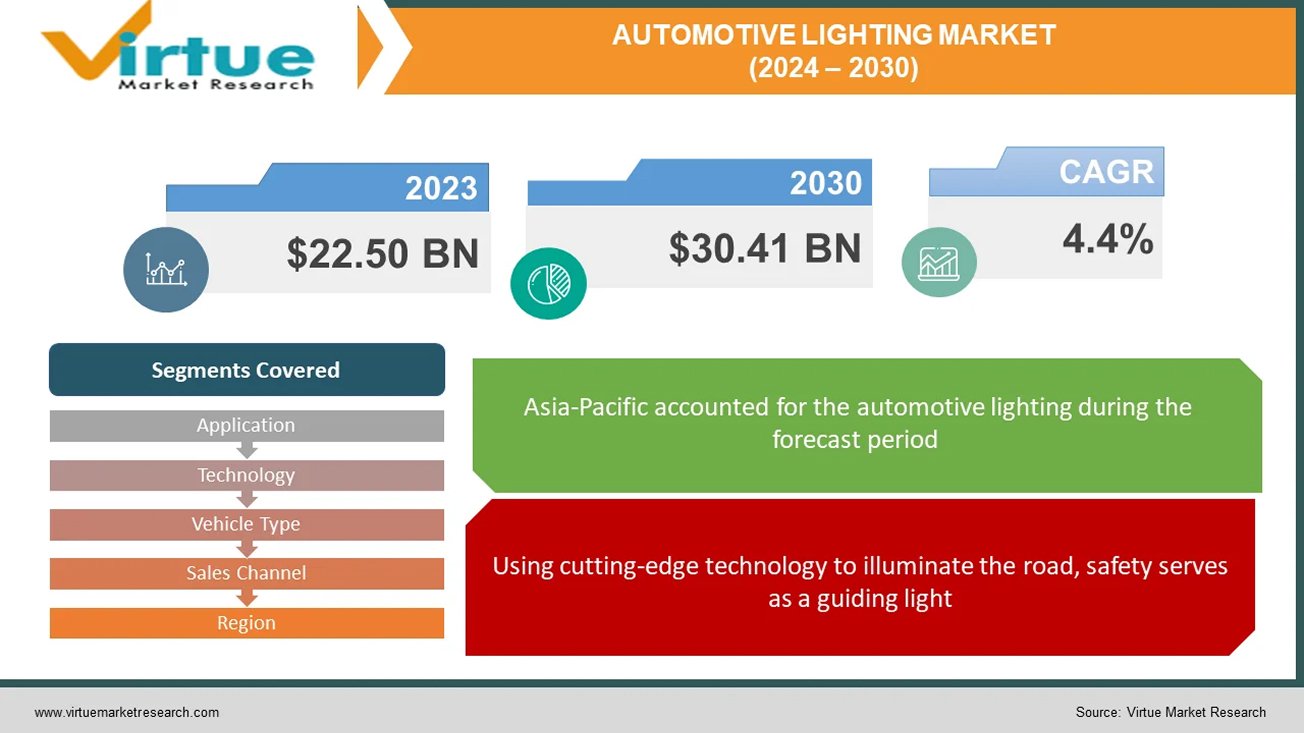
Global automotive lighting refers to all vehicle lighting systems, from headlamps that illuminate the road to taillights that communicate movements. They guarantee motorists and other road users alike safety, visibility, and style. While taillights frequently use LEDs for improved visibility, headlights are available in a variety of technologies, including LED and laser. Interior illumination, DRLs, and signal lights all have a role to play. This market, which was estimated to be worth $33.64 billion in 2022, is anticipated to rise to $67.39 billion by 2030 because of laws, luxury tastes, safety concerns, and technological developments like OLED taillights and adaptive headlights. Anticipate a future dominated by intelligent, connected, personalized, and sustainable lighting systems that enhance the safety, efficiency, and aesthetic appeal of automobiles.
Key Market Insights:
Car lighting works its magic to provide safety, visibility, and style. Headlights cut through the night, taillights express intent, and interiors shine with comfort. The billion-dollar global business is expected to rise due to consumer demand for high-end experiences, safer roads, and cutting-edge technology. Imagine dynamic messages being painted by taillights, headlights that adjust to the road, and interiors that customize their atmosphere. Driven by technological advancements like linked systems and laser beams, this future is calling. Anticipate even more visually attractive, environmentally friendly, and intelligent lighting to illuminate the way ahead, making cars safer, more efficient, and unquestionably cooler.
Global Automotive Lighting Market Drivers:
Using cutting-edge technology to illuminate the road, safety serves as a guiding light.
In the market for automobile lighting, safety is the driving force behind demand from the public and laws. While automated high beams smoothly react to traffic, adaptive headlights modify their beams so as not to blind other people. With visually striking displays, dynamic taillights convey intentions for braking and turning. Beyond these developments, integrated pedestrian identification and lane departure alerts will soon make roads safer and brighter for everyone.
Beyond Performance-Based Luxuries Redefined by Light.
Luxurious automobile lighting creates a distinct visual identity that goes beyond simple illumination. Personalized interior lighting customizes the driving experience by setting the mood with a range of colours and intensities, while intricate designs and distinctive DRLs modify exteriors. As you approach your automobile at night, welcoming lights lead the way, resulting in an interior that is perfectly lit. Not only is this symphony of light aesthetically pleasing, but it also stands as a tribute to luxury. Upcoming developments like gesture-controlled lighting and holographic displays promise to further enhance the experience.
Fuel Efficiency Takes the Lead: Illuminating Sustainability
The worldwide automotive lighting market is undergoing a significant transition towards energy-efficient solutions, as environmental concerns gain prominence. LED technology is leading the way, providing a ray of hope for the environment and drivers alike. LED lights beam brighter and use a lot less energy than conventional halogen lamps. There are some tangible advantages to this. For drivers, this translates to increased fuel economy, which lowers petrol prices and lessens reliance on fossil fuels. Greater air quality and a reduction in the transport sector's contribution to climate change are the results of reduced overall emissions.
To Learn more about this report,
Global Automotive Lighting Market Restraints and Challenges:
Although the global automotive lighting business is booming, there are still unknowns. Difficulties impede growth even as innovation propels it with eye catching features like laser beams and adaptable headlights. These technologies are luxury items due to their high cost and difficult integration, which puts producers' abilities to the test. The worldwide patchwork created by unclear legislation limits the potential of innovation. Durability issues persist, particularly when complex systems are subjected to challenging conditions. Ultimately, a lot of drivers still don't fully understand how these improvements can help them. Together, we can overcome these obstacles. The keys to reducing costs are improved production, more seamless integration, and unified regulations. Their full potential can be realized by educating customers about the safety, efficiency, and aesthetic value of these lighting wonders. By working together, we can pave the way for an even brighter and safer future for vehicle lighting.
Global Automotive Lighting Market Opportunities:
It is made possible by advanced LED technology, which gives drivers the ability to customize their illumination for the highest level of comfort and flair. Consumers that care about the environment want greener products, and vehicle lighting complies. While solar- and self-powered lighting technologies offer a future powered by clean energy, energy-efficient LEDs lower pollution. The advent of connected lighting systems heralds a new age. Envision automobiles interacting with infrastructure and one another to minimize accidents and enhance traffic efficiency. Integrated headlights with pedestrian recognition provide unmatched safety, while dramatic taillights with eye-catching displays alert onlookers to your intentions. The possibilities are endless in the future. Gesture-controlled interior illumination, holographic displays projected onto the road, and even light fixtures with self-healing capabilities.
AUTOMOTIVE LIGHTING MARKET REPORT COVERAGE:
To Learn more about this report,
Global Automotive Lighting Market Segmentation: By Application
Exterior Lighting
Interior Lighting
Due to laws requiring safety features like headlights, taillights, and brake lights, exterior lighting presently holds the most market share in the vehicle lighting industry. The dominance of this market is partly attributed to advancements in safety-focused technologies such as adaptive headlights and daytime running lights. The market value of external lighting is increased by the quick adoption of technology like LED bulbs and laser lights, which improve performance and aesthetics. Conversely, the interior lighting market is expected to increase at the fastest rate in the upcoming years. Innovations like ambient lighting and technology breakthroughs like LED and OLED displays, driven by consumer demand for comfort and personalisation, open new possibilities. The spread of sophisticated interior lighting systems is further driven by the growing emphasis on safety and the expansion of the luxury car market.
Global Automotive Lighting Market Segmentation: By Technology
Halogen
LED (Light-Emitting Diode)
Xenon
Emerging Technologies
The worldwide vehicle lighting market is currently dominated by halogen because of its more affordable price, advanced technology, and useful illumination. With its dependable supply chain and affordable option for manufacturers and cost-conscious customers, halogen holds the biggest market share. The fastest-growing market right now is LEDs, which are predicted to shortly overtake halogen. The rapid expansion of LEDs is driven by their higher efficiency, longer lifespan, flexibility in design, and technological breakthroughs including enhanced brightness. Because LEDs use less energy and produce fewer emissions and better fuel economy, they are becoming more and more popular in the changing automotive lighting market.
Global Automotive Lighting Market Segmentation: By Vehicle Type
Passenger Cars
Commercial Vehicles
Passenger automobiles rule the worldwide automotive lighting market. The sheer number of passenger cars produced which surpasses that of business vehicles and fuels the need for lighting systems is the primary cause of this popularity. The growing demand for personal automobiles in developing nations is a result of rising disposable income, which in turn drives the rise of the passenger car market. The importance that consumers place on safety and aesthetics elements helps to drive market expansion. But in the upcoming years, the market for electric and hybrid cars is expected to develop at the quickest rate. The exponential rise of the worldwide electric car market, which is still expanding and shows no signs of slowing down, is what is driving this surge. Specialised lighting solutions are required since electric and hybrid vehicles have different lighting requirements because of their specific functionality and design aesthetics.
Global Automotive Lighting Market Segmentation: By Sales Channel
OEM (Original Equipment Manufacturers)
Aftermarket
Most lighting systems sold nowadays are sold by OEMs (Original Equipment Manufacturers), primarily because manufacturers pre-install lighting systems in new cars. But in the next years, the aftermarket is expected to develop at the quickest rate. This spike in demand for replacement parts, especially lighting systems, can be linked to several variables, one of them being the average age of cars. The industry is expanding because of consumers' growing desire to personalise their cars with aftermarket lighting upgrades such LED upgrades and decorative lighting. The availability and affordability of technologies like adaptive headlights and laser lights in the aftermarket, together with other advancements in lighting technology, are driving demand even more. Moreover, the growing market for electric cars (EVs).
To Learn more about this report,
Global Automotive Lighting Market Segmentation: By Region
North America
Asia-Pacific
Europe
South America
Middle East and Africa
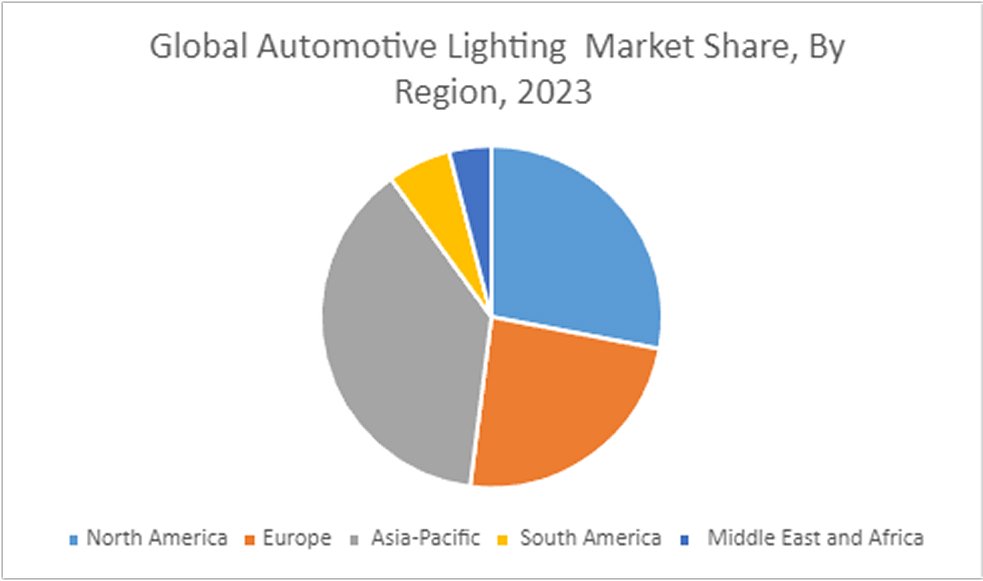
Throughout the forecast period, Asia Pacific is anticipated to be the automotive lighting market with the highest profitability. Over the past few years, Asia Pacific countries like China and India have seen notable increases in automotive manufacturing and sales, primarily in the medium-to premium luxury car segment. Asia Pacific is predicted to see an increase in the manufacturing of passenger cars, with India experiencing the strongest growth rate. Depending on the state of the national economy, the area offers a suitable selection of both high-end and cheap cars. For instance, there is a substantial demand for halogen, Xenon/HID, and LED since China and India produce more economy and mid-range automobiles. On the other hand, luxury car adoption rates are greater in South Korea and Japan, where LED lighting is the norm.
COVID-19 Impact Analysis on the Global Automotive Lighting Market:
A brief shadow was thrown by COVID-19 over the worldwide automotive lighting market. Production was stopped by lockdowns and supply chain disruptions, while luxury lighting upgrades were shelved by consumers on a tight budget. Resources became scarce, and R&D stagnated. Still, the market is recovering thanks to resurgent demand and rearranged priorities. While energy-efficient LEDs are being pushed towards adoption by sustainability, safety concerns are driving interest in features like pedestrian detection and adaptive headlights. The digital push of the epidemic creates opportunities for intelligent, networked lighting systems that may interact with infrastructure and other cars. Ultimately, the industry is positioned to shine brighter, focused on safety, sustainability, and a connected future, even though the pandemic dimmed its brilliance.
Recent Trends and Developments in the Global Automotive Lighting Market:
A development collaboration between OSRAM Continental and REHAU aims to incorporate lighting into external components, providing automobile manufacturers with innovative lighting options that improve functionality and design flexibility. For rear combination lamps, Hella unveiled a revolutionary lighting innovation called Hella FlatLight technology. A Memorandum of Understanding (MoU) was signed by Samvardhana Motherson Automotive Systems Group BV (SMRPBV), a division of Motherson Group, and Marelli Automotive Lighting to investigate a technology collaboration focused on intelligently lighted external body components. Valeo debuted their revolutionary 360° lighting system at the Shanghai Auto Show. This technology surrounds the car with a band of light, projecting instantaneous, clear signs that other drivers can see from a distance. Pedestrians, cyclists, and scooter riders are especially susceptible to these signals
Key Players:
AMS Osram
Cree
Hella
Hyundai Mobis
Koito
Luminus Devices
Magneti Marelli
Osram Licht AG
Stanley Electric
Valeo
Chapter 1. Generative Design Market – Scope & Methodology
1.1 Market Segmentation
1.2 Scope, Assumptions & Limitations
1.3 Research Methodology
1.4 Primary Sources
1.5 Secondary Sources Chapter 2. Generative Design Market – Executive Summary
2.1 Market Size & Forecast – (2024 – 2030) ($M/$Bn)
2.2 Key Trends & Insights
2.2.1 Demand Side
2.2.2 Supply Side
2.3 Attractive Investment Propositions
2.4 COVID-19 Impact Analysis Chapter 3. Generative Design Market – Competition Scenario
3.1 Market Share Analysis & Company Benchmarking
3.2 Competitive Strategy & Development Scenario
3.3 Competitive Pricing Analysis
3.4 Supplier-Distributor Analysis Chapter 4. Generative Design Market - Entry Scenario
4.1 Regulatory Scenario
4.2 Case Studies – Key Start-ups
4.3 Customer Analysis
4.4 PESTLE Analysis
4.5 Porters Five Force Model
4.5.1 Bargaining Power of Suppliers
4.5.2 Bargaining Powers of Customers
4.5.3 Threat of New Entrants
4.5.4 Rivalry among Existing Players
4.5.5 Threat of Substitutes Chapter 5. Generative Design Market – Landscape
5.1 Value Chain Analysis – Key Stakeholders Impact Analysis
5.2 Market Drivers
5.3 Market Restraints/Challenges
5.4 Market Opportunities Chapter 6. Generative Design Market – By Component
6.1 Introduction/Key Findings
6.2 Software
6.3 Services
6.4 Y-O-Y Growth trend Analysis By Component
6.5 Absolute $ Opportunity Analysis By Component, 2024-2030 Chapter 7. Generative Design Market – By Deployment
7.1 Introduction/Key Findings
7.2 On-Premises
7.3 Cloud-Based
7.4 Y-O-Y Growth trend Analysis By Deployment
7.5 Absolute $ Opportunity Analysis By Deployment, 2024-2030 Chapter 8. Generative Design Market – By End User Vertical
8.1 Introduction/Key Findings
8.2 Aerospace and Defense
8.3 Automotive
8.4 Architecture and Construction
8.5 Consumer Goods
8.6 Industrial Manufacturing, Healthcare, Oil & Gas
8.7 Y-O-Y Growth trend Analysis By End User Vertical
8.8 Absolute $ Opportunity Analysis By End User Vertical, 2024-2030 Chapter 9. Generative Design Market , By Geography – Market Size, Forecast, Trends & Insights
9.1 North America
9.1.1 By Country
9.1.1.1 U.S.A.
9.1.1.2 Canada
9.1.1.3 Mexico
9.1.2 By Component
9.1.3 By Deployment
9.1.4 By End User Vertical
9.1.5 Countries & Segments - Market Attractiveness Analysis
9.2 Europe
9.2.1 By Country
9.2.1.1 U.K
9.2.1.2 Germany
9.2.1.3 France
9.2.1.4 Italy
9.2.1.5 Spain
9.2.1.6 Rest of Europe
9.2.2 By Component
9.2.3 By Deployment
9.2.4 By End User Vertical
9.2.5 Countries & Segments - Market Attractiveness Analysis
9.3 Asia Pacific
9.3.1 By Country
9.3.1.1 China
9.3.1.2 Japan
9.3.1.3 South Korea
9.3.1.4 India
9.3.1.5 Australia & New Zealand
9.3.1.6 Rest of Asia-Pacific
9.3.2 By Component
9.3.3 By Deployment
9.3.4 By End User Vertical
9.3.5 Countries & Segments - Market Attractiveness Analysis
9.4 South America
9.4.1 By Country
9.4.1.1 Brazil
9.4.1.2 Argentina
9.4.1.3 Colombia
9.4.1.4 Chile
9.4.1.5 Rest of South America
9.4.2 By Component
9.4.3 By Deployment
9.4.4 By End User Vertical
9.4.5 Countries & Segments - Market Attractiveness Analysis
9.5 Middle East & Africa
9.5.1 By Country
9.5.1.1 United Arab Emirates (UAE)
9.5.1.2 Saudi Arabia
9.5.1.3 Qatar
9.5.1.4 Israel
9.5.1.5 South Africa
9.5.1.6 Nigeria
9.5.1.7 Kenya
9.5.1.8 Egypt
9.5.1.9 Rest of MEA
9.5.2 By Component
9.5.3 By Deployment
9.5.4 By End User Vertical
9.5.5 Countries & Segments - Market Attractiveness Analysis Chapter 10. Generative Design Market – Company Profiles – (Overview, By Component Portfolio, Financials, Strategies & Developments)
10.1 Altair Engineering Inc
10.2 Bentley Systems Inc
10.3 Caracol AM
10.4 Autodesk Inc
10.5 MSC Software Corporation (Hexagon AB)
10.6 Diabatix
10.7 ANSYS Inc
10.8 Parameters
10.9 Desktop Metal Inc
10.10 nTopology
10.11 OmniFlow
Fill out the form below and our team will get back to you shortly
FAQ's
The global generative design market was valued at USD 3.81 billion in 2023 and is projected to reach a market size of USD 10.39 billion by the end of 2030. Over the forecast period of 2024–2030, the market is projected to grow at a CAGR of 15.41%.
Technological Advancements, Artificial Intelligence and Machine Learning, Consumer Demand, Government Initiatives, Evolving Ecosystems, and Integration with Additive Manufacturing.
North America holds the largest share of the generative design market, accounting for approximately 45%.
Asia-Pacific demonstrates the fastest growth, currently holding 20% of the market share.
Artificial Intelligence and Machine Learning, Tech-Driven Advancements, Industry-Specific Solutions, Sustainability Focus, Advanced AI and Computing Power, Collaboration, and Partnerships.
More related reports
Get expert-driven market research reports from a leading research partner to help you navigate the future of the global industry.
Report Code: VMR-203 | Published Date: July 2025 | Format: Excel and PDF
The 3D Scanning Market was valued at USD 2.28 billion in 2024 and is projected to reach a market size of USD 5.37 billion by the end of 2030. Over the forecast period of 2025-2030, the market is projected to grow at a CA...
Report Code: VMR-14818 | Published Date: July 2024 | Format: Excel and PDF
The Global Passwordless Authentication Market is expected to grow from USD 22.70 billion in 2025 to approximately USD 49.13 billion by 2030, at a 16.7% CAGR from 2026-2030.
Report Code: VMR-435 | Published Date: March 2024 | Format: Excel and PDF
The Equity Management Software Market was valued at USD 591.85 million in 2023. Over the forecast period of 2024-2030, it is projected to reach USD 1508.47 million by 2030, growing at a CAGR of 14.3%.
Report Code: VMR-15816 | Published Date: March 2024 | Format: Excel and PDF
The global intellectual property (IP) services market was valued at USD 2.8 billion and is projected to reach a market size of USD 6.38 billion by the end of 2030. Over the forecast period of 2024–2030, the market is pro...
“We received a complex piece of work for our niche market from Virtue Market research in short period of time. I appreciate the quality and content of the final files we received. Thanks for the support”
Medical Devices Company based in Europe
“We received a complex piece of work for our niche market from Virtue Market research in short period of time. I appreciate the quality and content of the final files we received. Thanks for the support”
Medical Devices Company based in Europe
“We received a complex piece of work for our niche market from Virtue Market research in short period of time. I appreciate the quality and content of the final files we received. Thanks for the support”
Medical Devices Company based in Europe
“We received a complex piece of work for our niche market from Virtue Market research in short period of time. I appreciate the quality and content of the final files we received. Thanks for the support”
Medical Devices Company based in Europe
“We received a complex piece of work for our niche market from Virtue Market research in short period of time. I appreciate the quality and content of the final files we received. Thanks for the support”
Medical Devices Company based in Europe
“We received a complex piece of work for our niche market from Virtue Market research in short period of time. I appreciate the quality and content of the final files we received. Thanks for the support”