The Beacons Management Software Market was valued at USD 1.4 billion in 2024 and is projected to reach a market size of USD 6.27 billion by the end of 2030. Over the forecast period of 2025-2030, the market is projected to grow at a CAGR of 28.4%.
Beacons, small devices employing Bluetooth, transmit signals to nearby smart devices, broadcasting location and identity. Beacon Management Software allows companies to manage, monitor, and update these beacons for insight and control. As businesses become more digital, location tech and integrated sales methods gain value. Businesses use beacons to enhance customer interaction through targeted messages based on location, aid indoor navigation in large spaces, and track assets for immediate alerts if items relocate. For instance, retail stores might send coupons as customers approach certain departments. Airports use beacons for wayfinding, and manufacturers attach them to tools to prevent delays. Beacon Management Software lets users set beacon range and frequency and provides battery life monitoring. Companies use gathered info to target campaigns and study traffic to refine store layouts. Healthcare manages equipment and guides patients, retailers offer special offers and gather shopping data, and museums give exhibit context. Data privacy is a concern, requiring openness and opt-out options. Regular maintenance is also needed. Careful setup is key to providing benefit without impacting privacy.
Key Market Insights:
About 35% of all applications for beacon management software in 2024 were related to proximity marketing.
Cloud-based systems were used in more than 45% of cases because they can be scaled easily and integrated with analytics platforms without issue.
The retail sector made up the biggest part of the market, bringing in almost 30% of global revenue.
The Asia-Pacific area is predicted to see annual growth of over 25% until 2030, with China and India leading the way as they increase their use of retail technology.
Market Drivers:
Using New Tech and Knowing Customers to Beat Online Stores with Beacons is Driving Market Growth.
Stores are using little gadgets called beacons to do cool things as folks walk around inside. Beacons can send special deals to people's phones nearby. They also count how many people go to each part of the store. Special Applications can help stores control these beacons. So, they can change the messages on the fly and see reports about what's happening. This helps stores set up the store in a way that makes sense and makes better use of their marketing money. Stores with walls compete with online stores. Beacons are one way to mix shopping in person with the perks of online shopping. This makes customers happier, more loyal, and likely to buy stuff.
The Rising Government Spending in Smart Infrastructure is Driving Market.
Beacons can show people exactly where to go inside. This is sweet in places like hospitals, airports, museums, and huge workplaces. Applications help keep track of all the beacons. It can control where they are placed, how strong they broadcast, and update them. Plus, it can chart locations. Governments are spending more on smart buildings and airports. That's why more people want beacon tech that guides them inside.
Market Restraints and Challenges:
Putting many beacons in big areas has problems like signals getting mixed up, batteries not lasting long, and it being hard to control lots of devices. To fix these issues, the software that controls the beacons needs to be strong enough to deal with changing device setups. It should also be capable of predicting when things might break down so that repairs can be done before problems happen. This keeps the system working without interruptions. Also, using beacons to track people's locations can make people worry about their privacy. This is especially true where there are strict rules about protecting people's data, like the GDPR. To handle these worries, companies must use software that keeps data anonymous, gets clear permission from users to collect their location, and provides reports about how they follow the rules. By doing this, companies can keep people's trust and meet the legal standards. In practice, this involves a few key steps. First, when setting up beacon networks, thorough testing is needed to find and fix signal interference issues. Second, battery life can be improved by choosing energy-saving beacons and using software to adjust how often they send signals. Third, managing a large network requires software that can automatically keep track of all the devices, update their settings, and find any problems. For privacy, companies should first be clear with users about how their location data is being used. They should also provide easy ways for users to agree to or refuse location tracking. The software should be designed to anonymize data to ensure it cannot be linked back to individual users. Finally, regular checks should be done to ensure all these systems are working correctly and that the company is still following the law. These actions are crucial for using beacon technology responsibly and keeping users' data safe.
Market Opportunities:
The incorporation of artificial intelligence and machine learning into software designed for the administration of beacons improves its ability to perform data analysis. AI and machine learning algorithms are applied to scrutinize the patterns in how users behave, forecast how many people will visit a location, and determine the best places to put beacons so they are as engaging as possible. This type of system makes it possible to make choices based on current information and change advertising campaigns as needed. Healthcare facilities are installing beacons to assist people when visiting, keep track of objects such as wheelchairs, and monitor where doctors and nurses are located inside the building. In the hospitality sector, accommodation providers are making use of beacons to enable guests to enter rooms without keys, provide them with directions, and automate processes related to customer service. The increased implementation of beacon technology in different fields presents opportunities for growth for business-to-business organizations that provide solutions for managing beacons that are specifically designed for industries. The Beacon-as-a-Service model lets businesses implement beacon technology without needing to spend a lot of money up front. Small and medium-sized businesses are beginning to favour subscription-based payment options for beacons and the platforms used to manage them. This enables them to incorporate solutions that are aware of users' locations without large capital expenditure.
BEACONS MANAGEMENT SOFTWARE MARKET
REPORT METRIC
DETAILS
Market Size Available
2024 - 2030
Base Year
2024
Forecast Period
2025 - 2030
CAGR
28.4 %
Segments Covered
By Type, Deployment Mode, Application Industry, Distribution Channel and Region
Various Analyses Covered
Global, Regional & Country Level Analysis, Segment-Level Analysis, DROC, PESTLE Analysis, Porter’s Five Forces Analysis, Competitive Landscape, Analyst Overview on Investment Opportunities
Regional Scope
North America, Europe, APAC, Latin America, Middle East & Africa
Proximity marketing dominates the most. This is mainly because many stores use it. They send messages to people's phones when they're near specific products. This influences what people buy right then and there. It works well at getting customers involved right away and allows stores to change their marketing based on where people are in the store. Proximity marketing is really helpful for stores that have actual physical locations.
On the other hand, indoor navigation is growing the quickest. Places like hospitals, airports, and big shopping centers are starting to use them more. These places need to help people move around easily and know where they are inside the building. More people want smart buildings and easy-to-use directions, which is why indoor navigation is becoming so popular.
Segmentation by Deployment Mode:
Cloud-Based
On-Premises
Cloud deployment has become a dominating model due to its flexibility, remote accessibility, and ability to scale across locations. This makes it attractive to retail chains and service-based companies needing centralized control and fast deployment. Centralized control gives companies better oversight of operations and the ability to implement changes quickly across their entire network. A rapid rollout capability is critical for keeping pace with market demands and maintaining a competitive edge.
On-Premises is also the fastest-growing model because small and medium-sized enterprises (SMEs) and multi-site operators are searching for budget-friendly, scalable solutions. Cloud platforms work well with customer experience systems and data analysis tools, which support the ongoing move to digital methods. The cloud's scalable nature lets SMEs adjust their resources as their needs change without big upfront investments. Cloud solutions can provide insights into customer behavior and market trends to help businesses make informed choices and improve customer relationships. As companies strive to remain competitive in an increasingly competitive market, the cloud's role in enabling agility and innovation will only become more apparent.
Segmentation by Application Industry:
Retail
Healthcare
BFSI
Transportation & Logistics
Hospitality
Others
In the current market, retail dominates as the main area for beacon applications. Retailers are using these solutions to enhance their marketing by targeting customers based on location, gaining immediate insights into customer behavior, and boosting engagement within stores. By positioning beacons strategically, shops can send specific deals to shoppers' smartphones, track how customers move through the store, and refine the general shopping atmosphere. This makes beacons critical for physical stores that wish to stay competitive against web-based competitors.
Looking at growth trends, healthcare is the quickest-expanding sector for beacon use. Hospitals are installing these devices to help people find their way around inside, monitor where equipment is located, and improve how staff members work together. As patient satisfaction, the need to operate economically, and adherence to rules become more important, more healthcare facilities are starting to use beacon systems. These systems assist in many ways, from guiding visitors to making sure important medical devices are always where they should be and streamlining how medical teams communicate.
Market Segmentation: Regional Analysis:
North America
Europe
Asia-Pacific
Latin America
Middle East & Africa
In 2024, North America held the largest share of the proximity marketing market. This can be attributed to the region's early acceptance of this technology. Many retail companies in North America are putting money into digital changes, which has further propelled the market. The strong presence of major tech suppliers and the increasing application of proximity marketing in fields like healthcare and smart campuses have also played a role in North America's leading position.
Asia-Pacific is experiencing the quickest market expansion. This growth is fuelled by the move toward digital systems in the retail and infrastructure sectors of countries like India, China, and Southeast Asia. The rise in smartphone use and increasing funds being allocated to smart city projects are driving the need for beacon solutions in this area. Europe is also showing consistent market growth. This is partly due to upgrades in smart buildings and the use of indoor navigation systems in the tourism sector in Europe.
COVID-19 Impact Analysis:
The COVID-19 pandemic brought rapid changes to how people interact with technology, as society worked to minimize physical contact. One change was the rise in demand for technologies that offer contactless experiences. This situation created more chances to use beacons in areas like controlling crowd size, making digital check-ins easier, and sending out safety warnings. Shops began using beacons to help shoppers move safely through stores and keep an eye on how many people were inside at any given time. This aided in sticking to safety guidelines and made shopping a less risky experience. The use of beacons wasn't just limited to shops; healthcare also put them to use. By directing patients and staff, beacons cut down on how many times people needed to touch things, lowering the risk of spreading the virus. The events of the pandemic showed how crucial it is to have ways to communicate information quickly and offer solutions that don't need physical contact. Because of this, there's been a push for beacon management systems that is expected to continue in the future. As different industries look for ways to make processes safer and more streamlined, beacons are likely to become a key part of these plans. The pandemic not only sped up the use of current technology but also showed the need for more developments in contactless tech to deal with current and future problems.
Latest Trends and Developments:
Beacon tech is changing how people interact with experiences in stores and at events. These changes aim to make these experiences more interesting and personal. Blended beacon solutions, which bring together Bluetooth Low Energy (BLE) with Wi-Fi or Ultra-Wideband (UWB) tech, are making location identification much more precise. This precision helps in offering very specific content or actions based on where someone is. Current software gives businesses the ability to foresee when beacons might require servicing. Also, they can oversee battery use. These abilities ensure the beacons run efficiently and cut down on energy use. This efficiency is crucial for large setups where changing batteries or fixing beacons often can be a big job. Self-service dashboards are allowing marketing teams to take charge of planning and running their beacon campaigns. This control means they can quickly change strategies and messages in response to real-time data and consumer behavior. The flexibility leads to more relevant and successful campaigns. The latest platforms are built to work with various beacon communication methods. Those methods include iBeacon, Eddystone, and AltBeacon. This wide-range compatibility makes it simpler to integrate beacons into different types of systems without needing custom solutions. It simplifies IT management. It also offers a more consistent consumer experience across different places and apps.
Key Players in the Market:
Kontakt.io
Estimote Inc.
Gimbal Inc.
BlueCats
Beaconstac
Aruba Networks (HPE)
Zebra Technologies
Cisco Systems
Radius Networks
Quuppa
To Learn more about this report,
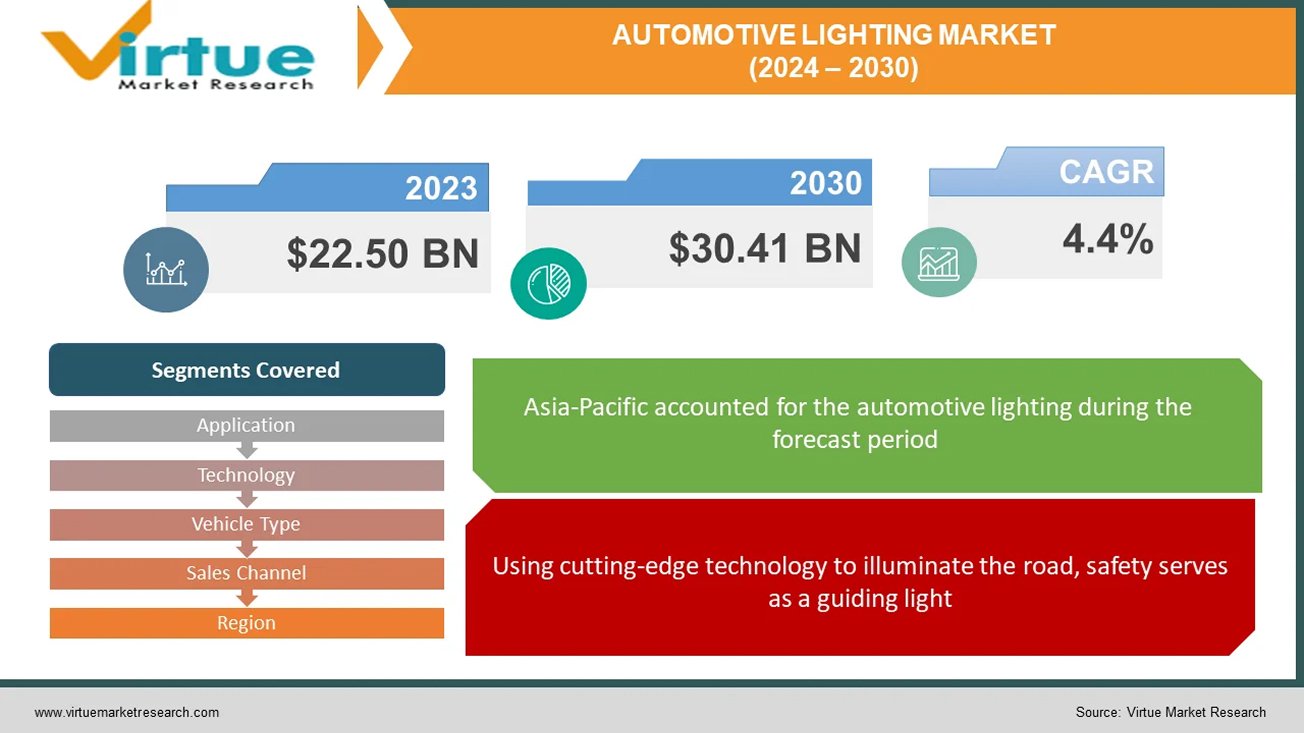
Global automotive lighting refers to all vehicle lighting systems, from headlamps that illuminate the road to taillights that communicate movements. They guarantee motorists and other road users alike safety, visibility, and style. While taillights frequently use LEDs for improved visibility, headlights are available in a variety of technologies, including LED and laser. Interior illumination, DRLs, and signal lights all have a role to play. This market, which was estimated to be worth $33.64 billion in 2022, is anticipated to rise to $67.39 billion by 2030 because of laws, luxury tastes, safety concerns, and technological developments like OLED taillights and adaptive headlights. Anticipate a future dominated by intelligent, connected, personalized, and sustainable lighting systems that enhance the safety, efficiency, and aesthetic appeal of automobiles.
Key Market Insights:
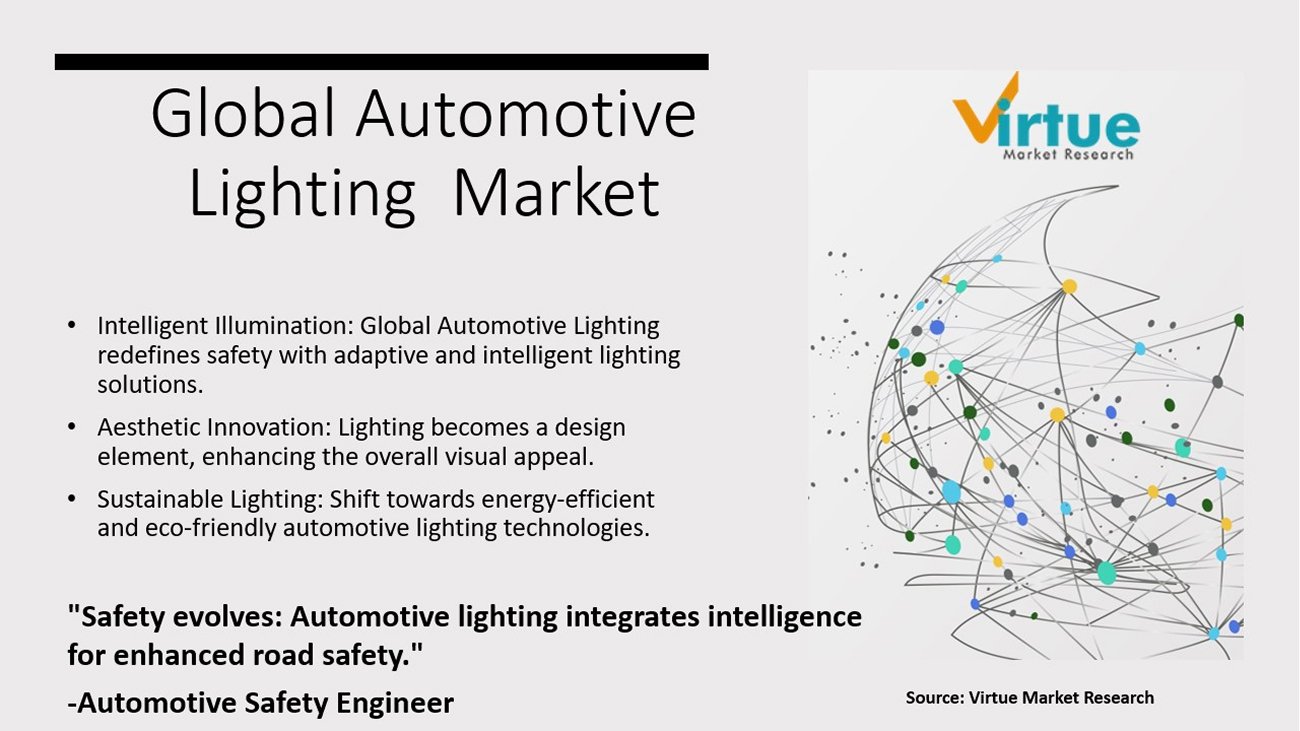
Car lighting works its magic to provide safety, visibility, and style. Headlights cut through the night, taillights express intent, and interiors shine with comfort. The billion-dollar global business is expected to rise due to consumer demand for high-end experiences, safer roads, and cutting-edge technology. Imagine dynamic messages being painted by taillights, headlights that adjust to the road, and interiors that customize their atmosphere. Driven by technological advancements like linked systems and laser beams, this future is calling. Anticipate even more visually attractive, environmentally friendly, and intelligent lighting to illuminate the way ahead, making cars safer, more efficient, and unquestionably cooler.
Global Automotive Lighting Market Drivers:
Using cutting-edge technology to illuminate the road, safety serves as a guiding light.
In the market for automobile lighting, safety is the driving force behind demand from the public and laws. While automated high beams smoothly react to traffic, adaptive headlights modify their beams so as not to blind other people. With visually striking displays, dynamic taillights convey intentions for braking and turning. Beyond these developments, integrated pedestrian identification and lane departure alerts will soon make roads safer and brighter for everyone.
Beyond Performance-Based Luxuries Redefined by Light.
Luxurious automobile lighting creates a distinct visual identity that goes beyond simple illumination. Personalized interior lighting customizes the driving experience by setting the mood with a range of colours and intensities, while intricate designs and distinctive DRLs modify exteriors. As you approach your automobile at night, welcoming lights lead the way, resulting in an interior that is perfectly lit. Not only is this symphony of light aesthetically pleasing, but it also stands as a tribute to luxury. Upcoming developments like gesture-controlled lighting and holographic displays promise to further enhance the experience.
Fuel Efficiency Takes the Lead: Illuminating Sustainability
The worldwide automotive lighting market is undergoing a significant transition towards energy-efficient solutions, as environmental concerns gain prominence. LED technology is leading the way, providing a ray of hope for the environment and drivers alike. LED lights beam brighter and use a lot less energy than conventional halogen lamps. There are some tangible advantages to this. For drivers, this translates to increased fuel economy, which lowers petrol prices and lessens reliance on fossil fuels. Greater air quality and a reduction in the transport sector's contribution to climate change are the results of reduced overall emissions.
To Learn more about this report,
Global Automotive Lighting Market Restraints and Challenges:
Although the global automotive lighting business is booming, there are still unknowns. Difficulties impede growth even as innovation propels it with eye catching features like laser beams and adaptable headlights. These technologies are luxury items due to their high cost and difficult integration, which puts producers' abilities to the test. The worldwide patchwork created by unclear legislation limits the potential of innovation. Durability issues persist, particularly when complex systems are subjected to challenging conditions. Ultimately, a lot of drivers still don't fully understand how these improvements can help them. Together, we can overcome these obstacles. The keys to reducing costs are improved production, more seamless integration, and unified regulations. Their full potential can be realized by educating customers about the safety, efficiency, and aesthetic value of these lighting wonders. By working together, we can pave the way for an even brighter and safer future for vehicle lighting.
Global Automotive Lighting Market Opportunities:
It is made possible by advanced LED technology, which gives drivers the ability to customize their illumination for the highest level of comfort and flair. Consumers that care about the environment want greener products, and vehicle lighting complies. While solar- and self-powered lighting technologies offer a future powered by clean energy, energy-efficient LEDs lower pollution. The advent of connected lighting systems heralds a new age. Envision automobiles interacting with infrastructure and one another to minimize accidents and enhance traffic efficiency. Integrated headlights with pedestrian recognition provide unmatched safety, while dramatic taillights with eye-catching displays alert onlookers to your intentions. The possibilities are endless in the future. Gesture-controlled interior illumination, holographic displays projected onto the road, and even light fixtures with self-healing capabilities.
AUTOMOTIVE LIGHTING MARKET REPORT COVERAGE:
To Learn more about this report,
Global Automotive Lighting Market Segmentation: By Application
Exterior Lighting
Interior Lighting
Due to laws requiring safety features like headlights, taillights, and brake lights, exterior lighting presently holds the most market share in the vehicle lighting industry. The dominance of this market is partly attributed to advancements in safety-focused technologies such as adaptive headlights and daytime running lights. The market value of external lighting is increased by the quick adoption of technology like LED bulbs and laser lights, which improve performance and aesthetics. Conversely, the interior lighting market is expected to increase at the fastest rate in the upcoming years. Innovations like ambient lighting and technology breakthroughs like LED and OLED displays, driven by consumer demand for comfort and personalisation, open new possibilities. The spread of sophisticated interior lighting systems is further driven by the growing emphasis on safety and the expansion of the luxury car market.
Global Automotive Lighting Market Segmentation: By Technology
Halogen
LED (Light-Emitting Diode)
Xenon
Emerging Technologies
The worldwide vehicle lighting market is currently dominated by halogen because of its more affordable price, advanced technology, and useful illumination. With its dependable supply chain and affordable option for manufacturers and cost-conscious customers, halogen holds the biggest market share. The fastest-growing market right now is LEDs, which are predicted to shortly overtake halogen. The rapid expansion of LEDs is driven by their higher efficiency, longer lifespan, flexibility in design, and technological breakthroughs including enhanced brightness. Because LEDs use less energy and produce fewer emissions and better fuel economy, they are becoming more and more popular in the changing automotive lighting market.
Global Automotive Lighting Market Segmentation: By Vehicle Type
Passenger Cars
Commercial Vehicles
Passenger automobiles rule the worldwide automotive lighting market. The sheer number of passenger cars produced which surpasses that of business vehicles and fuels the need for lighting systems is the primary cause of this popularity. The growing demand for personal automobiles in developing nations is a result of rising disposable income, which in turn drives the rise of the passenger car market. The importance that consumers place on safety and aesthetics elements helps to drive market expansion. But in the upcoming years, the market for electric and hybrid cars is expected to develop at the quickest rate. The exponential rise of the worldwide electric car market, which is still expanding and shows no signs of slowing down, is what is driving this surge. Specialised lighting solutions are required since electric and hybrid vehicles have different lighting requirements because of their specific functionality and design aesthetics.
Global Automotive Lighting Market Segmentation: By Sales Channel
OEM (Original Equipment Manufacturers)
Aftermarket
Most lighting systems sold nowadays are sold by OEMs (Original Equipment Manufacturers), primarily because manufacturers pre-install lighting systems in new cars. But in the next years, the aftermarket is expected to develop at the quickest rate. This spike in demand for replacement parts, especially lighting systems, can be linked to several variables, one of them being the average age of cars. The industry is expanding because of consumers' growing desire to personalise their cars with aftermarket lighting upgrades such LED upgrades and decorative lighting. The availability and affordability of technologies like adaptive headlights and laser lights in the aftermarket, together with other advancements in lighting technology, are driving demand even more. Moreover, the growing market for electric cars (EVs).
To Learn more about this report,
Global Automotive Lighting Market Segmentation: By Region
North America
Asia-Pacific
Europe
South America
Middle East and Africa
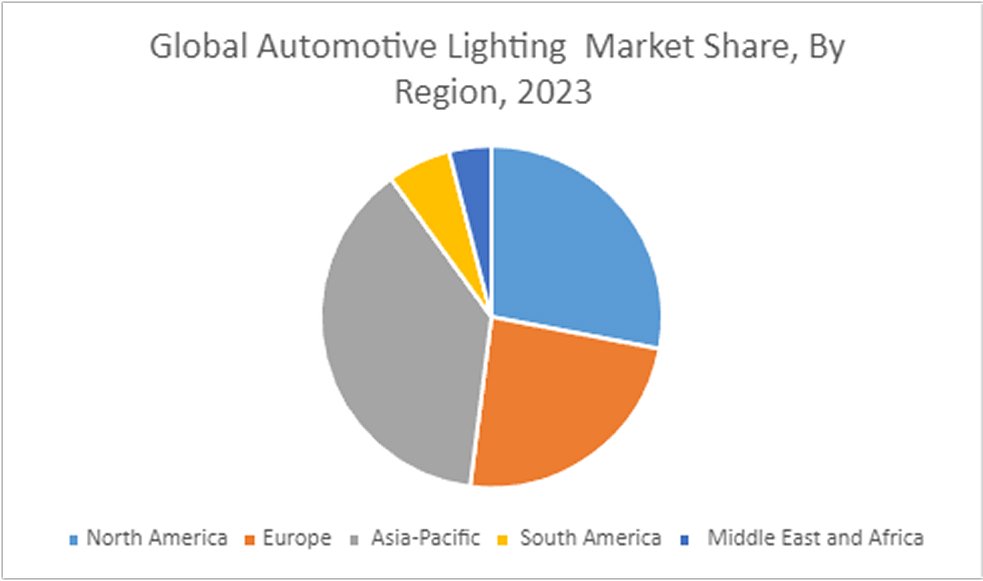
Throughout the forecast period, Asia Pacific is anticipated to be the automotive lighting market with the highest profitability. Over the past few years, Asia Pacific countries like China and India have seen notable increases in automotive manufacturing and sales, primarily in the medium-to premium luxury car segment. Asia Pacific is predicted to see an increase in the manufacturing of passenger cars, with India experiencing the strongest growth rate. Depending on the state of the national economy, the area offers a suitable selection of both high-end and cheap cars. For instance, there is a substantial demand for halogen, Xenon/HID, and LED since China and India produce more economy and mid-range automobiles. On the other hand, luxury car adoption rates are greater in South Korea and Japan, where LED lighting is the norm.
COVID-19 Impact Analysis on the Global Automotive Lighting Market:
A brief shadow was thrown by COVID-19 over the worldwide automotive lighting market. Production was stopped by lockdowns and supply chain disruptions, while luxury lighting upgrades were shelved by consumers on a tight budget. Resources became scarce, and R&D stagnated. Still, the market is recovering thanks to resurgent demand and rearranged priorities. While energy-efficient LEDs are being pushed towards adoption by sustainability, safety concerns are driving interest in features like pedestrian detection and adaptive headlights. The digital push of the epidemic creates opportunities for intelligent, networked lighting systems that may interact with infrastructure and other cars. Ultimately, the industry is positioned to shine brighter, focused on safety, sustainability, and a connected future, even though the pandemic dimmed its brilliance.
Recent Trends and Developments in the Global Automotive Lighting Market:
A development collaboration between OSRAM Continental and REHAU aims to incorporate lighting into external components, providing automobile manufacturers with innovative lighting options that improve functionality and design flexibility. For rear combination lamps, Hella unveiled a revolutionary lighting innovation called Hella FlatLight technology. A Memorandum of Understanding (MoU) was signed by Samvardhana Motherson Automotive Systems Group BV (SMRPBV), a division of Motherson Group, and Marelli Automotive Lighting to investigate a technology collaboration focused on intelligently lighted external body components. Valeo debuted their revolutionary 360° lighting system at the Shanghai Auto Show. This technology surrounds the car with a band of light, projecting instantaneous, clear signs that other drivers can see from a distance. Pedestrians, cyclists, and scooter riders are especially susceptible to these signals
Report Code: VMR-203 | Published Date: July 2025 | Format: Excel and PDF
The 3D Scanning Market was valued at USD 2.28 billion in 2024 and is projected to reach a market size of USD 5.37 billion by the end of 2030. Over the forecast period of 2025-2030, the market is projected to grow at a CA...
Report Code: VMR-14818 | Published Date: July 2024 | Format: Excel and PDF
The Global Passwordless Authentication Market is expected to grow from USD 22.70 billion in 2025 to approximately USD 49.13 billion by 2030, at a 16.7% CAGR from 2026-2030.
Report Code: VMR-435 | Published Date: March 2024 | Format: Excel and PDF
The Equity Management Software Market was valued at USD 591.85 million in 2023. Over the forecast period of 2024-2030, it is projected to reach USD 1508.47 million by 2030, growing at a CAGR of 14.3%.
Report Code: VMR-15816 | Published Date: March 2024 | Format: Excel and PDF
The global intellectual property (IP) services market was valued at USD 2.8 billion and is projected to reach a market size of USD 6.38 billion by the end of 2030. Over the forecast period of 2024–2030, the market is pro...
“We received a complex piece of work for our niche market from Virtue Market research in short period of time. I appreciate the quality and content of the final files we received. Thanks for the support”
Medical Devices Company based in Europe
“We received a complex piece of work for our niche market from Virtue Market research in short period of time. I appreciate the quality and content of the final files we received. Thanks for the support”
Medical Devices Company based in Europe
“We received a complex piece of work for our niche market from Virtue Market research in short period of time. I appreciate the quality and content of the final files we received. Thanks for the support”
Medical Devices Company based in Europe
“We received a complex piece of work for our niche market from Virtue Market research in short period of time. I appreciate the quality and content of the final files we received. Thanks for the support”
Medical Devices Company based in Europe
“We received a complex piece of work for our niche market from Virtue Market research in short period of time. I appreciate the quality and content of the final files we received. Thanks for the support”
Medical Devices Company based in Europe
“We received a complex piece of work for our niche market from Virtue Market research in short period of time. I appreciate the quality and content of the final files we received. Thanks for the support”