Automotive Photonics Market Research Report – Segmentation By Product (Waveguides, Optical Modulators, Optical Interconnects, LEDs, Wavelength Division Multiplexer (WDM) Filters, Photo Detectors, Lasers Amplifiers), application (Displays, Information, Measure and Machine Vision, Lighting, Communication, Defense and Security, Optical component); and Region; - Size, Share, Growth Analysis | Forecast (2024– 2030)
AUTOMOTIVE PHOTONICS MARKET (2023 -2030)
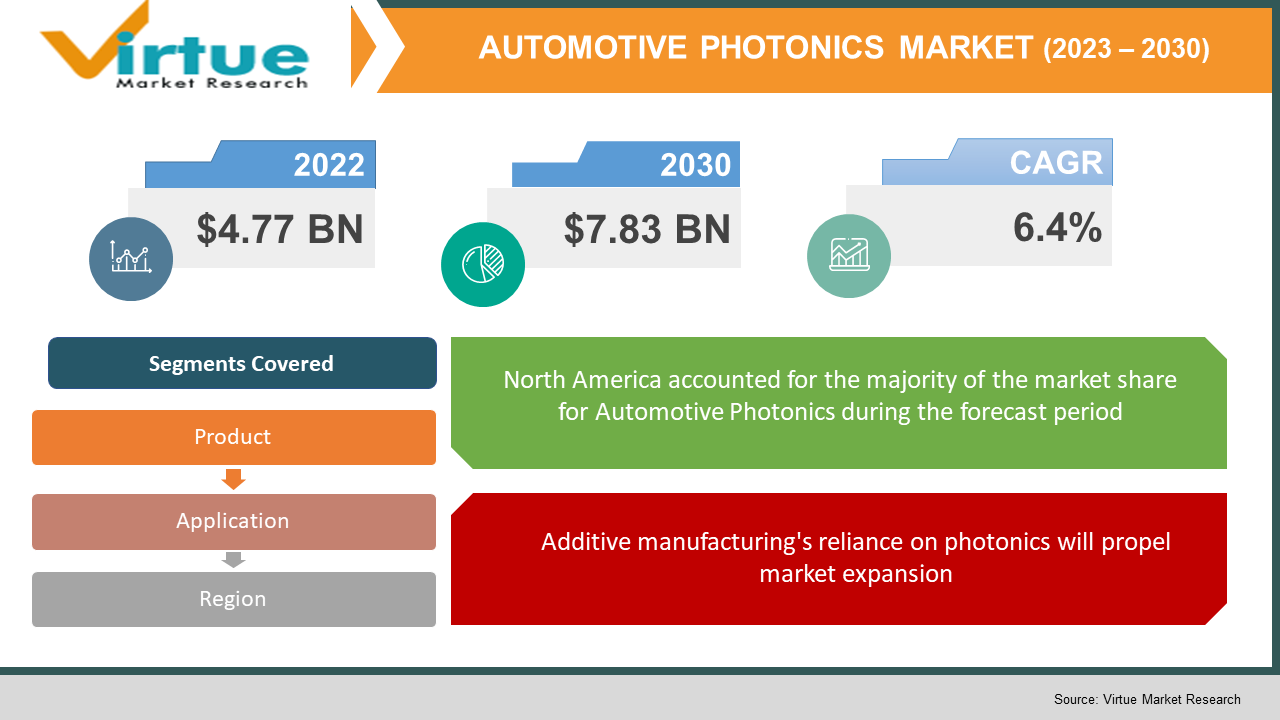
In 2022, the Global Automotive Photonics Market was valued at $4.77 Billion and is projected to reach a market size of $7.83 Billion by 2030. Over the forecast period of 2023-2030, the market is projected to grow at a CAGR of 6.4%.
INDUSTRY OVERVIEW
Photonics is a branch of science and technology that relates to the production, detection, transmission, switching, amplifying, passing of signals, and modulation of light. The word photonics is derived from the Greek word "phos," which means light, and the root word "photo," and it first appeared in the 1960s. who wanted to use light to do a variety of tasks based on light. Electronics have always been used in the sectors of communication and information technology. The 1970s were a pivotal decade for the invention of diodes. Optical fibers are utilized for information transfer in telecommunications operations and are afterwards supported for the construction of Internet processors. The term "photonics" was frequently used in the networking industry in the 1980s to describe the transport of information through optical data fiber lines. The information, communication, and technology (ICT) sectors were the exclusive focus of the photonics industry in 2001, with several inventions and technical applications.
In recent years, photonics has experienced a revolution in the automobile sector, moving beyond its original focus on lighting to offer cutting-edge technology for imaging, sensing, smart displays, and media communication networks. As a result, photonics has expanded significantly beyond vehicle illumination to include quality assurance and industrial processes. That the automobile sector is becoming more interested in cutting-edge, photonics-based technology is not estimated. The lighting market is growing at a rate of roughly 5% per year due to a variety of growth prospects. The market for automotive photonics is anticipated to experience even larger growth. The worldwide photonics market is expanding because of the growing and increased utilization of the disposable market. Solid State Lightning is based on technology such as Light Emitting Diodes (LEDs), Organic Light Emitting Diodes (OLEDs), and many more. Solid State Lightning is often utilized for the utilization of light in various applications and the use of photonics. Solid state lighting decreases energy consumption while enhancing symbolic development and quality.
The major application of photonics is the creation of light, including its emission, transmission, amplification, detection, and modification. The market has grown thanks to the invention of technologies based on light sources, which are guided by photonics. The main components of photonics are optical fibers, lasers, and lights used in homes, hotels, computer displays, automobiles, televisions, and theatres. It is a branch of science and technology that produces, controls, modifies, and creates. The hunt for light by scientists’ dates back many years. In the medical field, for instance, photonics may be used to investigate and evaluate diseases, detect issues, and even find a solution to a crime. This has boosted the usage of photonics and improved the market economy.
COVID-19 IMPACT ON THE AUTOMOTIVE PHOTONICS MARKET
The forecast for the 3D printing business is still positive, despite the pandemic's negative effects on the majority of sectors. The use of this technology in laser, optical scanning system, and image solution applications is becoming more and more intriguing. Due to supply chain issues, the rollout of 5G in many countries may be delayed, and the cost of fiber optic cable may go up as a result of adverse effects on countries like China that produce fiber optic cable.
MARKET DRIVERS:
Additive manufacturing's reliance on photonics will propel market expansion
Beam creation and beam steering are not the only applications of photonics. Laser beam diagnostics and accurate performance metrics based on photonics are aids to the growing industrial maturity of the technology. According to some background, even little adjustments to the beam and scanning parameters might cause serious quality losses to occur during the constructing process. The market is continuously seeing new additive processes emerge, which has sped up production and expanded the range of available materials. Additionally, more industries employ technology.
On the other hand, AM methods are utilized by the mechanical engineering, automotive, aerospace, energy, and chemical plant industries. They employ extra procedures to indirectly produce axle housing and wheel hub molds in addition to prototypes and tools. Additionally, it employs process design flexibility and manufactures increasingly complicated car components in tiny numbers. A well-thought-out design can enable the sandwiching together of several separate components into a single section. As a result, there is less effort involved in certification, quality control, and storage. Additionally, the sandwich structure technique uses a laser to expose the metal powder exactly where the component's intended structure calls for it, greatly decreasing the component's weight and enabling the integration of additional features. This can include everything from lubricant supply optimization tools to cooling ducts. It is more intriguing to not retain spare parts and instead print as required based on recorded design data the more specialized the equipment or vehicle. With the advent of Industry 4.0, sensor-monitored mechanical components may be pre-printed toward the end of their useful lives and proactively put together before expensive flaws or equipment failures occur during maintenance.
MARKET RESTRAINTS:
Few raw materials face strict environmental regulations, limiting market expansion
The efficiency of photonics products is being hampered by strict environmental regulations. Even though the majority of goods are environmentally friendly, some performance-enhancing substances are thought to be hazardous to the environment. By REACH and the RoHS, toxic compounds like boron oxide and arsenic oxide are restricted. Arsenic oxide is a component of UV detectors, sensors, and other goods. Chemical registration, evaluation, authorization, and limitation are governed by the REACH regulation of the European Union. It controls the production and use of chemical substances, such as boron oxide and arsenic oxide, because of the possible consequences on human health and the environment. In the creation of electrical and electronic products, RoHS restricts or outright prohibits the use of cadmium, lead, mercury, flame retardants, polybrominated biphenyls (PBB), and polybrominated diphenyl ethers (PBDE), and chromium VI. Products and services that use photonics are expensive. Devices with photonics capabilities perform better and use less energy than comparable products.
AUTOMOTIVE PHOTONICS MARKET REPORT COVERAGE:
REPORT METRIC
DETAILS
Market Size Available
2022 - 2030
Base Year
2022
Forecast Period
2023 - 2030
CAGR
6.4%
Segments Covered
By Product, Application, and Region
Various Analyses Covered
Global, Regional & Country Level Analysis, Segment-Level Analysis, DROC, PESTLE Analysis, Porter’s Five Forces Analysis, Competitive Landscape, Analyst Overview on Investment Opportunities
Regional Scope
North America, Europe, APAC, Latin America, Middle East & Africa
This research report on the Automotive Photonics Markethasbeen segmented and sub-segmented based on Product, Application and By Region.
AUTOMOTIVE PHOTONICS MARKET – BY PRODUCT
Waveguides
Optical Modulators
Optical Interconnects
LEDs
Wavelength Division Multiplexer (WDM) Filters
Photo Detectors
Lasers
Amplifiers
Based on application, the automotive photonics market is segmented into Waveguides, Optical Modulators, Optical Interconnects, LEDs, Wavelength Division Multiplexer (WDM) Filters, Photo Detectors, Lasers and Amplifiers. Due to its benefits including mass productivity, high port counts, and low loss, WDM filters are estimated to become a dominating product category throughout the projection period. The development of modern photonic networks, such as optical cross-connect and optical add/drop multiplexing systems, is thought to be considerably aided by WDM filters. Throughout the forecast period, it is anticipated that demand for photodetectors would increase significantly. As they provide increased involvement with the machine environment interface, photodetectors are being employed more often in a variety of devices. These items serve as a low-volume, low-mass replacement for bulky conventional detectors and sensors used in the production facility. Over the forecast period, high brightness LEDs, which are transforming the lighting sector, are anticipated to dominate the market for LEDs. Since they have a wide range of applications, high-brightness LEDs have become more and more in demand. The incorporation of LEDs into automobiles to improve their lighting, displays, and energy economy is a new trend in the market. For the continued growth of a low carbon economy, these items are essential which is eventually driving the market growth.
AUTOMOTIVE PHOTONICS MARKET - BY APPLICATION
Displays
Information
Measure and Machine Vision
Lighting
Communication
Defense and Security
Optical component
Based on application, the automotive photonics market is segmented into displays, information, measure and machine vision, lighting, communication, defense and security, and optical component. The market's largest segment is displayed, and it is anticipated that they will continue to rule the market during the projected period. The main industrial photonic applications are laser-based semiconductor manufacture, metrology, and microelectronic production. Common applications include photolithography, laser-based machinery for flexible and high-density interconnects (HDIs), printed circuit boards (PCBs), through drilling, IC packaging, and the manufacturing and processing of displays used in the automobile industry.
In aerospace and military applications, such as ring laser gyroscopes for aerial and maritime navigation and guiding systems for missile and UAV (drone) guidance, lasers are utilized in mission-critical inertial navigation systems. When it comes to sensing and imaging in challenging environments, photonics is especially crucial for military equipment that is airborne, spaceborne, or on the ground. However, when using bulk optical components, high energy and expense are significant disadvantages.
AUTOMOTIVE PHOTONICS MARKET - BY REGION
North America
Europe
The Asia Pacific
Latin America
The Middle East
Africa
By region, the Automotive Photonics Market is grouped into North America, Europe, Asia Pacific, Latin America, The Middle East and Africa. Given the area's growing adoption of cutting-edge next-generation technology, North America is projected to become a prominent market throughout the projected period. The development in the United States can be ascribed to rising government investment in research and development (R&D) and applications of laser optics and photonic-enabled technologies. Over the projected period, it is anticipated that the U.S. government would make large expenditures to work on the development of cutting-edge lasers for military vehicle purposes. The primary force behind the growth of the photonics market is anticipated to be the demand for high-speed transmission in data communication applications in an autonomous vehicle. The application of data communication is thought to be driven by the decrease in power loss, demand for high bandwidth, and availability at its low prices in various regions, including in nations like the United States and Canada.
Over the projection period, Europe is anticipated to increase significantly. To foster a vibrant and competitive photonics sector in the area, member states from throughout the region have made a long-term commitment to public-private partnerships (PPP). To work on the creation of novel photonics-based component manufacturing processes, the area is progressively setting up pilot production facilities for research institutions and businesses.
As a result of the region's first mover advantage and growing investment in R&D and innovations, the market in the Asia Pacific is predicted to rise quickly. When it comes to significant developments and breakthroughs in the field of photonics, China in particular has been at the forefront. The majority of the top businesses are Chinese, with locally based manufacturing facilities and a solid supply chain that sells photonics parts all over the world. Since its market is well established, China is anticipated to hold a sizeable portion of the photonics market over the projection period. It is anticipated that increasing the use of this product in the creation of new integrated electronics that are quicker and more effective would drive market expansion.
AUTOMOTIVE PHOTONICS MARKET - BY COMPANIES
Some of the major players operating in the Automotive Photonics Market include:
NOTABLE HAPPENING IN THE AUTOMOTIVE PHOTONICS MARKET
PRODUCT LAUNCH- January 2021 - The development of light-carrying chips helps machine learning. In conjunction with a global team, researchers from the University of Münster are creating cutting-edge approaches and process designs to address these difficulties effectively. They have now shown that so-called photonic computers, which process data by utilizing light, are capable of processing information even quicker and in parallel than electrical chips.
ACQUISITION- In April 2019, TRUMPF finished acquiring the photonics branch of Philips, which it had disclosed in December 2018. Smartphones, digital data transfer applications, and sensors for driverless vehicles all use laser diodes from Philips Photonics. Since the acquisition, TRUMPF Photonics Components has been created. As a consequence of the purchase, TRUMPF will have access to a new market sector that will enhance its present high-power diode laser business.
PRODUCT LAUNCH- In May 2022, OSRAM AG announced the introduction of the OSLON Optimal family of LEDs for horticulture lighting. The OSLON Optimal family is based on the most recent ams OSRAM 1mm2 chip and delivers an exceptional balance of high efficiency, dependable performance, and excellent value.
To Learn more about this report,
Global automotive lighting refers to all vehicle lighting systems, from headlamps that illuminate the road to taillights that communicate movements. They guarantee motorists and other road users alike safety, visibility, and style. While taillights frequently use LEDs for improved visibility, headlights are available in a variety of technologies, including LED and laser. Interior illumination, DRLs, and signal lights all have a role to play. This market, which was estimated to be worth $33.64 billion in 2022, is anticipated to rise to $67.39 billion by 2030 because of laws, luxury tastes, safety concerns, and technological developments like OLED taillights and adaptive headlights. Anticipate a future dominated by intelligent, connected, personalized, and sustainable lighting systems that enhance the safety, efficiency, and aesthetic appeal of automobiles.
Key Market Insights:
Car lighting works its magic to provide safety, visibility, and style. Headlights cut through the night, taillights express intent, and interiors shine with comfort. The billion-dollar global business is expected to rise due to consumer demand for high-end experiences, safer roads, and cutting-edge technology. Imagine dynamic messages being painted by taillights, headlights that adjust to the road, and interiors that customize their atmosphere. Driven by technological advancements like linked systems and laser beams, this future is calling. Anticipate even more visually attractive, environmentally friendly, and intelligent lighting to illuminate the way ahead, making cars safer, more efficient, and unquestionably cooler.
Global Automotive Lighting Market Drivers:
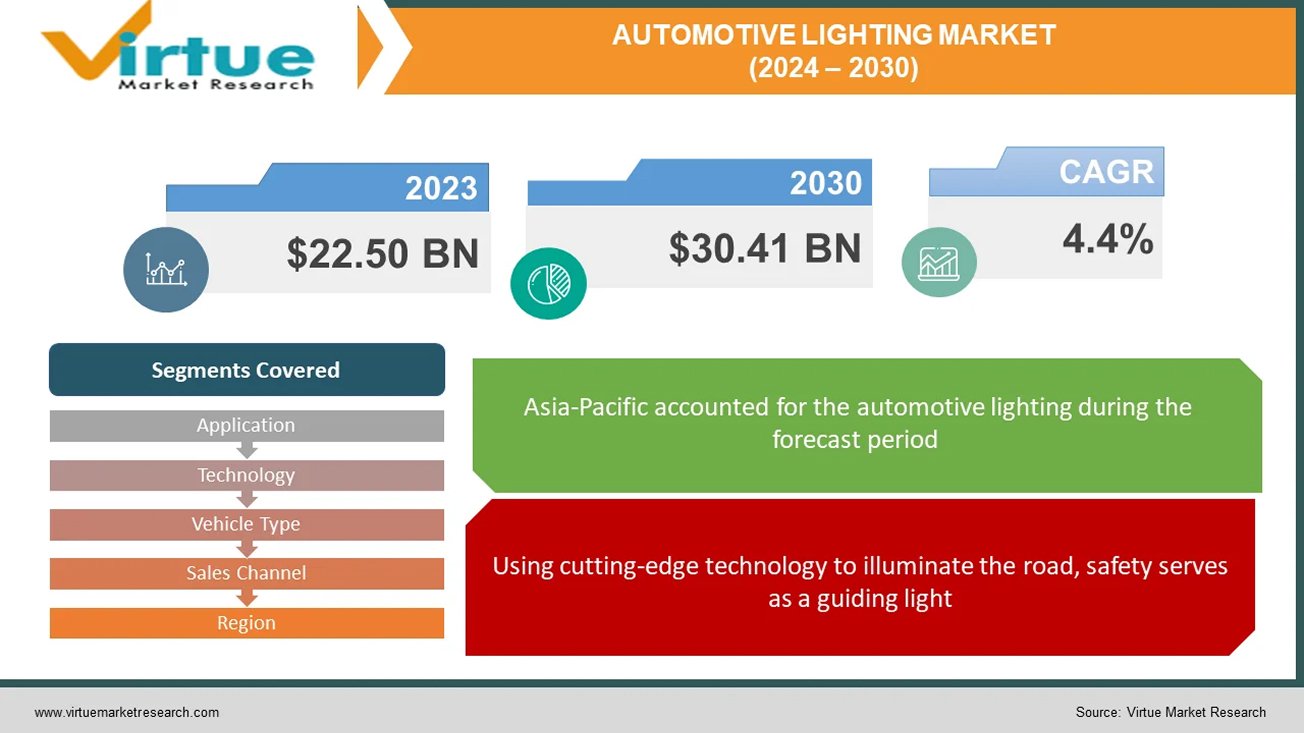
Using cutting-edge technology to illuminate the road, safety serves as a guiding light.
In the market for automobile lighting, safety is the driving force behind demand from the public and laws. While automated high beams smoothly react to traffic, adaptive headlights modify their beams so as not to blind other people. With visually striking displays, dynamic taillights convey intentions for braking and turning. Beyond these developments, integrated pedestrian identification and lane departure alerts will soon make roads safer and brighter for everyone.
Beyond Performance-Based Luxuries Redefined by Light.
Luxurious automobile lighting creates a distinct visual identity that goes beyond simple illumination. Personalized interior lighting customizes the driving experience by setting the mood with a range of colours and intensities, while intricate designs and distinctive DRLs modify exteriors. As you approach your automobile at night, welcoming lights lead the way, resulting in an interior that is perfectly lit. Not only is this symphony of light aesthetically pleasing, but it also stands as a tribute to luxury. Upcoming developments like gesture-controlled lighting and holographic displays promise to further enhance the experience.
Fuel Efficiency Takes the Lead: Illuminating Sustainability
The worldwide automotive lighting market is undergoing a significant transition towards energy-efficient solutions, as environmental concerns gain prominence. LED technology is leading the way, providing a ray of hope for the environment and drivers alike. LED lights beam brighter and use a lot less energy than conventional halogen lamps. There are some tangible advantages to this. For drivers, this translates to increased fuel economy, which lowers petrol prices and lessens reliance on fossil fuels. Greater air quality and a reduction in the transport sector's contribution to climate change are the results of reduced overall emissions.
To Learn more about this report,
Global Automotive Lighting Market Restraints and Challenges:
Although the global automotive lighting business is booming, there are still unknowns. Difficulties impede growth even as innovation propels it with eye catching features like laser beams and adaptable headlights. These technologies are luxury items due to their high cost and difficult integration, which puts producers' abilities to the test. The worldwide patchwork created by unclear legislation limits the potential of innovation. Durability issues persist, particularly when complex systems are subjected to challenging conditions. Ultimately, a lot of drivers still don't fully understand how these improvements can help them. Together, we can overcome these obstacles. The keys to reducing costs are improved production, more seamless integration, and unified regulations. Their full potential can be realized by educating customers about the safety, efficiency, and aesthetic value of these lighting wonders. By working together, we can pave the way for an even brighter and safer future for vehicle lighting.
Global Automotive Lighting Market Opportunities:
It is made possible by advanced LED technology, which gives drivers the ability to customize their illumination for the highest level of comfort and flair. Consumers that care about the environment want greener products, and vehicle lighting complies. While solar- and self-powered lighting technologies offer a future powered by clean energy, energy-efficient LEDs lower pollution. The advent of connected lighting systems heralds a new age. Envision automobiles interacting with infrastructure and one another to minimize accidents and enhance traffic efficiency. Integrated headlights with pedestrian recognition provide unmatched safety, while dramatic taillights with eye-catching displays alert onlookers to your intentions. The possibilities are endless in the future. Gesture-controlled interior illumination, holographic displays projected onto the road, and even light fixtures with self-healing capabilities.
AUTOMOTIVE LIGHTING MARKET REPORT COVERAGE:
To Learn more about this report,
Global Automotive Lighting Market Segmentation: By Application
Exterior Lighting
Interior Lighting
Due to laws requiring safety features like headlights, taillights, and brake lights, exterior lighting presently holds the most market share in the vehicle lighting industry. The dominance of this market is partly attributed to advancements in safety-focused technologies such as adaptive headlights and daytime running lights. The market value of external lighting is increased by the quick adoption of technology like LED bulbs and laser lights, which improve performance and aesthetics. Conversely, the interior lighting market is expected to increase at the fastest rate in the upcoming years. Innovations like ambient lighting and technology breakthroughs like LED and OLED displays, driven by consumer demand for comfort and personalisation, open new possibilities. The spread of sophisticated interior lighting systems is further driven by the growing emphasis on safety and the expansion of the luxury car market.
Global Automotive Lighting Market Segmentation: By Technology
Halogen
LED (Light-Emitting Diode)
Xenon
Emerging Technologies
The worldwide vehicle lighting market is currently dominated by halogen because of its more affordable price, advanced technology, and useful illumination. With its dependable supply chain and affordable option for manufacturers and cost-conscious customers, halogen holds the biggest market share. The fastest-growing market right now is LEDs, which are predicted to shortly overtake halogen. The rapid expansion of LEDs is driven by their higher efficiency, longer lifespan, flexibility in design, and technological breakthroughs including enhanced brightness. Because LEDs use less energy and produce fewer emissions and better fuel economy, they are becoming more and more popular in the changing automotive lighting market.
Global Automotive Lighting Market Segmentation: By Vehicle Type
Passenger Cars
Commercial Vehicles
Passenger automobiles rule the worldwide automotive lighting market. The sheer number of passenger cars produced which surpasses that of business vehicles and fuels the need for lighting systems is the primary cause of this popularity. The growing demand for personal automobiles in developing nations is a result of rising disposable income, which in turn drives the rise of the passenger car market. The importance that consumers place on safety and aesthetics elements helps to drive market expansion. But in the upcoming years, the market for electric and hybrid cars is expected to develop at the quickest rate. The exponential rise of the worldwide electric car market, which is still expanding and shows no signs of slowing down, is what is driving this surge. Specialised lighting solutions are required since electric and hybrid vehicles have different lighting requirements because of their specific functionality and design aesthetics.
Global Automotive Lighting Market Segmentation: By Sales Channel
OEM (Original Equipment Manufacturers)
Aftermarket
Most lighting systems sold nowadays are sold by OEMs (Original Equipment Manufacturers), primarily because manufacturers pre-install lighting systems in new cars. But in the next years, the aftermarket is expected to develop at the quickest rate. This spike in demand for replacement parts, especially lighting systems, can be linked to several variables, one of them being the average age of cars. The industry is expanding because of consumers' growing desire to personalise their cars with aftermarket lighting upgrades such LED upgrades and decorative lighting. The availability and affordability of technologies like adaptive headlights and laser lights in the aftermarket, together with other advancements in lighting technology, are driving demand even more. Moreover, the growing market for electric cars (EVs).
To Learn more about this report,
Global Automotive Lighting Market Segmentation: By Region
North America
Asia-Pacific
Europe
South America
Middle East and Africa
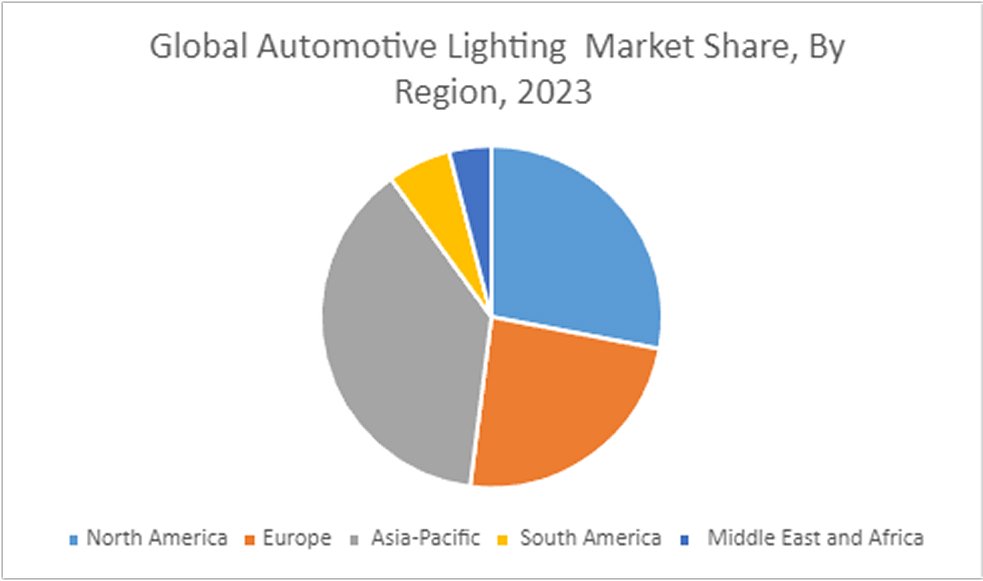
Throughout the forecast period, Asia Pacific is anticipated to be the automotive lighting market with the highest profitability. Over the past few years, Asia Pacific countries like China and India have seen notable increases in automotive manufacturing and sales, primarily in the medium-to premium luxury car segment. Asia Pacific is predicted to see an increase in the manufacturing of passenger cars, with India experiencing the strongest growth rate. Depending on the state of the national economy, the area offers a suitable selection of both high-end and cheap cars. For instance, there is a substantial demand for halogen, Xenon/HID, and LED since China and India produce more economy and mid-range automobiles. On the other hand, luxury car adoption rates are greater in South Korea and Japan, where LED lighting is the norm.
COVID-19 Impact Analysis on the Global Automotive Lighting Market:
A brief shadow was thrown by COVID-19 over the worldwide automotive lighting market. Production was stopped by lockdowns and supply chain disruptions, while luxury lighting upgrades were shelved by consumers on a tight budget. Resources became scarce, and R&D stagnated. Still, the market is recovering thanks to resurgent demand and rearranged priorities. While energy-efficient LEDs are being pushed towards adoption by sustainability, safety concerns are driving interest in features like pedestrian detection and adaptive headlights. The digital push of the epidemic creates opportunities for intelligent, networked lighting systems that may interact with infrastructure and other cars. Ultimately, the industry is positioned to shine brighter, focused on safety, sustainability, and a connected future, even though the pandemic dimmed its brilliance.
Recent Trends and Developments in the Global Automotive Lighting Market:
A development collaboration between OSRAM Continental and REHAU aims to incorporate lighting into external components, providing automobile manufacturers with innovative lighting options that improve functionality and design flexibility. For rear combination lamps, Hella unveiled a revolutionary lighting innovation called Hella FlatLight technology. A Memorandum of Understanding (MoU) was signed by Samvardhana Motherson Automotive Systems Group BV (SMRPBV), a division of Motherson Group, and Marelli Automotive Lighting to investigate a technology collaboration focused on intelligently lighted external body components. Valeo debuted their revolutionary 360° lighting system at the Shanghai Auto Show. This technology surrounds the car with a band of light, projecting instantaneous, clear signs that other drivers can see from a distance. Pedestrians, cyclists, and scooter riders are especially susceptible to these signals
Report Code: VMR-17330 | Published Date: July 2024 | Format: Excel and PDF
The Global Acoustic and Thermal Insulation for Electric Vehicles Market was valued at USD 218 million in 2023 and is projected to reach a market size of USD 446.93 million by the end of 2030. The market is anticipated to...
Report Code: VMR-12973 | Published Date: December 2024 | Format: Excel and PDF
The Global online used car market was valued at USD 28.19 billion in 2022 and is projected to reach a market size of USD 75 billion by the end of 2030. Over the forecast period of 2023-2030, the market is projected to gr...
Report Code: VMR-16118 | Published Date: November 2023 | Format: Excel and PDF
The Autonomous Taxi Services Market was valued at USD 0.78 Billion in 2023 and is projected to reach a market size of USD 58.29 Billion by the end of 2030. Over the forecast period of 2024-2030, the market is projected t...
Report Code: VMR-18523 | Published Date: July 2025 | Format: Excel and PDF
The Trucks Market was valued at USD 8.31 trillion in 2024 and is projected to reach a market size of USD 11.29 trillion by the end of 2030. Over the forecast period of 2025-2030, the market is projected to grow at a CAGR...
Report Code: VMR-4959 | Published Date: June 2024 | Format: Excel and PDF
The Global Automotive Telematics Market was valued at USD 76.66 billion in 2023 and is projected to reach a market size of USD 274.69 billion by the end of 2030. Over the cast period of 2024 – 2030, the figure for reques...
“We received a complex piece of work for our niche market from Virtue Market research in short period of time. I appreciate the quality and content of the final files we received. Thanks for the support”
Medical Devices Company based in Europe
“We received a complex piece of work for our niche market from Virtue Market research in short period of time. I appreciate the quality and content of the final files we received. Thanks for the support”
Medical Devices Company based in Europe
“We received a complex piece of work for our niche market from Virtue Market research in short period of time. I appreciate the quality and content of the final files we received. Thanks for the support”
Medical Devices Company based in Europe
“We received a complex piece of work for our niche market from Virtue Market research in short period of time. I appreciate the quality and content of the final files we received. Thanks for the support”
Medical Devices Company based in Europe
“We received a complex piece of work for our niche market from Virtue Market research in short period of time. I appreciate the quality and content of the final files we received. Thanks for the support”
Medical Devices Company based in Europe
“We received a complex piece of work for our niche market from Virtue Market research in short period of time. I appreciate the quality and content of the final files we received. Thanks for the support”