Automotive Miniweb Radar Market Research Report – Segmented By Range(Long Range RADAR (LRR), Short & Medium Range RADAR (S&MRR) ); Frequency (2X-GHz, 7X-GHz); Application (Autonomous Emergency Braking (AEB), Blind Spot Detection (BSD), Forward Collision Warning System, Adaptive Cruise Control (ACC), Intelligent Park Assist, Other ADAS Applications) and Region - Size, Share, Growth Analysis | Forecast (2023 – 2030)
Global Automotive Miniweb Radar Market Size (2023 - 2030)
As per our research report, the global automotive miniweb radar market size was valued at USD 5.14 billion, and is expected to reach USD 12.73 billion at a whooping CAGR of 12% from 2023 to 2030. Rising consumer demand for premium vehicles, an increase in the number of RADAR sensors used per vehicle, a rise in the use of long-range RADAR, and an increase in the deployment of autonomous vehicles are some of the key factors propelling the market's expansion.
Industry Overview:
Automotive RADAR is one of the major technologies as it provides very precise and accurate information, including speed and range detection, when compared to many other alternative sensors, particularly visual sensors. Radar-enabled driver assistance systems offer comprehensive information about a vehicle's surroundings and assist drivers in foreseeing potential hazards. The principal sensor for adaptive cruise control in automobiles is RADAR, and this sensor is a key component of the advanced driver aid system. It is vital to remember that automotive radars are primarily used to provide drivers with safe navigational experiences and to reduce the danger of traffic fatalities, injuries, collisions, and pedestrians, among other things. The automotive RADAR market is predicted to grow at a high rate over the forecast period owing to the rising demand for vehicles with safety features.RADAR and cameras are the main sensors used on automobiles, with ultrasonic technology and LiDAR being employed for autonomous driving. Ultrasonic technology plays a significant role in short spans at lower velocities. RADAR is widely used owing to its outstanding features. RADAR can determine an object's distance with accuracy. Automotive long-range RADARs can provide distance estimates for objects that are up to 500 meters away. The use of RADAR makes it possible to measure important characteristics like relative speed. As a result, it also provides a measurement of range and speed.With many antennas, modern car radar systems have already surpassed the barrier of range and field of view restrictions, making room for adaptive cruise control. However, self-driving cars require a solution that not only avoids weather interferences but also has a smaller automotive radar. Start-ups are claiming that vehicle radars will have endless possibilities due to the abundance of advancements.
Global automotive mini web radar market growth has been spurred by rising concerns about pedestrian, driver, passenger, and vehicle safety as well as by growing ecosystem player involvement. One significant aspect that has aided in the expansion of this sector is the push toward autonomous vehicles. The increasing use of advanced driver assistance systems (ADAS) in vehicles and favorable government rules for the use of radars are the main reasons propelling the business forward. Recently, Europe has pushed for and encouraged a strict regulatory structure that has enabled its roads to become the world's safest. ADAS (Advanced Driver Assistance Systems) are now feasible owing to the extensive use of cutting-edge radar technology. Blind spot and side-impact detection, as well as radars with long- and mid-range characteristics for adaptive cruise control, are all being made possible by automotive radar-based safety systems. The rise of the automotive radar market is attributable to an increase in investments made for the expansion of the automotive sector in nations like China, Japan, Germany, the UK, India, and the United States. The market for automotive RADAR is propelled by rising consumer demand for vehicle comfort and safety features. The growing demand for luxury automobiles, higher adoption of ADAS technology, and an increase in the number of RADAR sensors are all factors in the expansion of the automotive miniweb RADAR market.
COVID-19 pandemic impact on automotive miniweb radar Market
The COVID-19 pandemic negatively affected the auto industry. The unified global automotive sector has had a drastic impact as a result. Only a small portion of the workforce was permitted to work in the factories as a result of the coronavirus outbreak and there was a dramatic decline in non-essential item imports and exports. There have been significant production interruptions across Europe, a halt to the export of Chinese automotive components, and the closure of assembly factories in the U.S. This impacted the funding sources designated for R&D and the adoption of novel technology like vehicle radar. The strict pandemic regulations also had an impact on system testing. These led to a significant supply-demand gap for RADAR-related goods and services. The demand for new automobiles and their manufacture were both badly damaged, which resulted in a decline in the automotive industry's sales. This affected the funding sources designated for R&D and the adoption of emerging technology like the automobile RADAR. Automotive miniweb radar-backed solutions are predicted to witness a significant increase in demand following the pandemic since they provide vehicles with greater safety and comfort.
MARKET DRIVERS:
The market for automotive miniweb RADAR is being driven by the increase in demand for safety features in cars.
The need for safety features such as lane departure warnings, collision avoidance systems, traction control, parking assistance, electronic stability control, tire pressure monitors, airbags, and telematics is on the rise due to an increase in traffic accidents around the world. The advanced driver assistance systems (ADAS), which can identify and categorize certain road objects and warn the driver of their proximity and the state of the road, heavily rely on the automotive radar as one of their key components. As per the conditions of the road, these technologies can also automatically slow down or stop the car. A significant global cause of death is traffic accidents. The number of deaths caused by traffic accidents has significantly increased. For instance, 1.3 million people die in automobile accidents each year, according to data from the World Health Organization. To satisfy consumer demand, businesses in the automotive industry are creating and implementing safety measures. Automotive radar is developing as a key technology supporting the operation of smart and autonomous features in contemporary vehicles, for instance, lowering driver stress, relieving drivers of repetitive tasks, and incorporating life-saving automatic interventions. Automotive radar is a crucial application of complementary metal-oxide semiconductors (CMOS) radar. These advantages are anticipated to boost the penetration of automobile radars during the projected term.
The market is expanding owing to the growing demand for ADAS features and the deployment of autonomous vehicles in the Mobility as a Service (MaaS) model.
The rapid adoption of autonomous vehicles under the mobility as a service (MaaS) paradigm is generating lucrative opportunities for the automotive radar market. Furthermore, as the rides provided by autonomous vehicles will be more affordable than those provided by conventional cars, a significant number of them will be used in shared mobility services. The increasing need for ADAS features in vehicles is the primary factor propelling the growth of the automotive radar market. Radars are more in demand as autonomous vehicle sales increase as they enable several features that rely heavily on advanced radar systems for their functionality, such as eye-tracking, speech recognition, driver monitoring, virtual assistance, natural language interfaces, and gesture recognition. The development of ADAS, which has radar-enabled detection units, is also contributing to the market's increasing demand for automotive miniweb radar systems.
The adoption of Long-range RADAR and rising demand for comfortable driving are propelling market expansion.
Consumers today tend to prefer comfort when driving. To provide drivers with more comfort, automakers are putting safety technologies like adaptive cruise control and parking help systems into high-end vehicles. However, the driver always has the option to override the system. Other systems, such as night-vision systems, and others, that assist the driver in lateral vehicle control are constantly being developed. These systems use automotive radar to precisely and accurately detect the area around the automobile. Additionally, the spike in consumer spending power in recent years has considerably raised the demand for driver aid programs, which has led customers to switch to more comfortable driving experiences. As a result of the development in the economies of numerous industrialized nations, including the United States and several European nations, consumer per capita income has increased. The increased comfort provided by vehicle radar-assisted systems is anticipated to drive the market for automotive RADAR during the anticipated period. The use of long-range radars is the most prevalent trend in the automotive radar sector (LRRs). Such devices can detect things in their path up to 150 meters away, which is a major improvement over short- and medium-range radars. As a result, LRRs are increasingly being used in autonomous vehicles owing to their improved object detecting capabilities, which also contribute to safer driving.
MARKET RESTRAINTS:
The high price of devices and services installation limits the development of automotive RADAR as it increases the overall cost of the automobile
For error-free driving, autonomous sensors are essential. Each sensor has a special capacity that complements other sensors to create a robust sensor suite for autonomous vehicles. Radars are the second-most expensive sensor to be included in autonomous vehicles, after LiDARs, and are essential for determining the position, speed, and trajectory of an approaching vehicle.For auto radar technology to advance and spread, unit production costs must decrease, barring the emergence of other technologies that provide alternatives.
Automobile radar has significant difficulties with equipment calibration and testing which can affect the market growth
Although premium models have predominantly featured automotive radar, more effective development is required for the market to expand. For adequate wireless coverage concentrated in a certain area, packages of integrated antennas need to be calibrated. Since antennas must be oriented in the direction of focused power to get clear coverage without interference, the more antennas utilized in a wireless application, the greater the power efficiency. Radar steering controls allow for the tracking and testing of several targets within the coverage region. This ability is improved by automotive radar, which enables the communication between moving vehicles. Multiple combinations of sending and receiving antennas are increasingly needed to give the requisite coverage as vehicle radar equipment becomes more complicated.
AUTOMOTIVE MINIWEB RADAR MARKET REPORT COVERAGE:
REPORT METRIC
DETAILS
Market Size Available
2022 - 2030
Base Year
2022
Forecast Period
2023 - 2030
CAGR
12%
Segments Covered
By Range, Frequency, Application, and Region
Various Analyses Covered
Global, Regional & Country Level Analysis, Segment-Level Analysis, DROC, PESTLE Analysis, Porter’s Five Forces Analysis, Competitive Landscape, Analyst Overview on Investment Opportunities
Regional Scope
North America, Europe, APAC, Latin America, Middle East & Africa
Key Companies Profiled
Analog Devices, Continental, Autoliv, Delphi Automotive LLP, Fujitsu, Infineon Technologies, NXP Semiconductors, Denso Corporation, Robert Bosch GmbH, STMicroelectronics, Valeo S.A., Texas Instruments, and ZF TRW Automotive.
This research report on the global automotive miniweb radar Market has been segmented based on range, frequency, application, and region.
Automotive Miniweb Radar Market – By Range
Long Range RADAR (LRR)
Short & Medium Range RADAR (S&MRR)
Based on Range, the Automotive Miniweb Radar Market is segmented into Long Range RADAR (LRR) and Short & Medium Range RADAR (S&MRR). In 2021, the worldwide automotive miniweb radar market was dominated by Short & Medium Range RADAR (S&MRR), which was also predicted to increase at the fastest rate over the next few years. The car safety system heavily relies on these radars. The S&MRR system has several advantages, including blind spot identification, lane change assistance, and park assistance. In the upcoming years, the segment's growth is projected to be significantly accelerated by falling prices as well as the requirement to install more than two RADARs per vehicle to improve safety. Other vehicles' speed and distance are measured using long-range RADARs. It operates at 77 GHz, which offers superior resolution and precision, between 76 and 81 GHz. It is used to identify items in a wider view and gauge the speed and distance of other cars. It requires directed antennas since they offer better resolution. Wide ranges of 80 to 200 meters are offered by long-range radar.
Automotive Miniweb Radar Market- By Frequency
2X-GHz
7X-GHz
Based on Frequency, the Automotive Miniweb Radar Market is segmented into 2X-GHz and 7X-GHz. Short-range applications are primarily using the 2X-GHz frequency ranges. It is inexpensive without sacrificing any of its high-end features. Lane Change Assistance (LCA), Blind Spot Detection (BSD), Collision Mitigation (CM), Rear Cross Traffic Alert (RCTA), Parking Aid (PA), and Traffic Sign Recognition are among the major uses of 2X-GHz RADAR systems (TSR). The 77-GHz and 79-GHz bands of the LCD 7X-GHz sensors can be used simultaneously for mid-range and long-range capabilities. Automotive systems can monitor the area around the car to assist prevent collisions owing to the long- and mid-range capabilities provided by the 77-GHz RADAR technology. Adaptive cruise control (ACC), Forward Collision Warning (FCW), Headway alert, mitigation, and brake support are just a few of the safety features that may be implemented using a single 77-GHz RADAR sensor. It is predicted that this market would grow at the highest rate owing to the lower cost and technical superiority of the 77-GHz RADAR sensor over other bands.
Automotive Miniweb Radar Market – By Application
Autonomous Emergency Braking (AEB)
Blind Spot Detection (BSD)
Forward Collision Warning System
Adaptive Cruise Control (ACC)
Intelligent Park Assist
Other ADAS Applications
Based on the Application, the Automotive Miniweb Radar Market is segmented into Autonomous Emergency Braking (AEB), Blind Spot Detection (BSD), Forward Collision Warning System, Adaptive Cruise Control (ACC), Intelligent Park Assist, and Other ADAS Applications. The intelligent park assist application is the most significant source of revenue, accounting for about 52% of the market's overall revenue in 2021. Parking sensors are in more demand owing to the rise in the need for parking assistance to prevent backside collisions. Although parking sensors can be externally added to operating automobiles to increase their functions, smart driver aid systems are very prevalent in modern and electric vehicles. The adaptive cruise control (ACC) segment, on the other hand, is anticipated to expand at a notable rate during the forecast period as a result of its widespread adoption in important automotive markets including Germany, China, the United States, and the United Kingdom, among others. Furthermore, it offers significant advantages for vehicle automation and safety. The ACC systems are among the top ten vehicle safety enhancements, according to the U.S. National Transport Safety Board. Similar to this, Europe has also taken into account the ACC system as required safety measures for advanced vehicle safety. As radars can operate in bad weather, there is an increasing demand for ACC systems with radar in semi-autonomous vehicles.
Automotive Miniweb Radar Market - By Region:
North America
Europe
Asia-Pacific
Rest of the World
Geographically, the North American Automotive Miniweb Radar Market accounted for a sizeable revenue share, and it is anticipated to maintain this trend throughout the forecast period due to the expansion of autonomous vehicle research and development, which is fueling the region's high demand for radars. Governments are developing several rules and providing financial incentives for the adoption of such devices, along with the major regional automakers, to encourage the use of such devices.
Europe dominated the global automotive miniweb RADAR market in 2021 and is predicted to continue to do so in the years to come. Government programs for green and smart transportation in Germany, the United Kingdom, and other European nations are largely driving the region's enormous growth. The regional administration sought to lessen both the number of accidents and air pollution. For the same reason, public incentives to adopt electric and intelligent mobility led to an increase in the number of electric vehicles in the area. Currently, the most common use of cutting-edge vehicle safety systems and equipment is in electric vehicles.
The Asia Pacific Automotive Miniweb Radar Market is anticipated to develop at the highest CAGR during the forecast period owing to increasing initiatives and investments in the automobile industry as well as the green revolution changing transportation in the region. China, South Korea, India, and Japan are a few of the Asian nations that have adopted smart mobility solutions heavily to improve vehicle safety and lower the environmental pollution. Automakers are utilizing automobile radar sensors, which will direct the driver along the route, to guarantee vehicle and driver safety. To ease traffic and increase transportation convenience overall, businesses that operate in the market are giving their cutting-edge transport solutions.
Major Key Players in the Market
Some of theleading players in the global automotive miniweb radar market are
Analog Devices
Continental
Autoliv
Delphi Automotive LLP
Fujitsu
Infineon Technologies
NXP Semiconductors
Denso Corporation
Robert Bosch GmbH
STMicroelectronics
Valeo S.A.
Texas Instruments
ZF TRW Automotive
Notable happenings in the Global Automotive Miniweb Radar Market in the recent past:
Product Launch- In January 2022,DENSO revealed that it has created the Global Safety Package 3*1, an active safety system intended to increase vehicle safety by enhancing its environment-sensing abilities.
Acquisition- In May 2022, Infineon Technologies AG introduced In-cabin monitoring systems (ICMS) equipped with the XENSIVTM 60 GHz automobile radar sensor. Highly dependable in-cabin monitoring systems are made possible by the XENSIVTM 60 GHz radar sensor for automobiles. The small and reasonably priced chipset can also be used for applications like front-end radar for gesture sensing, high-resolution frequency modulated continuous wave (FMCW) radars for distance measurement, hidden sensing applications, and short-range sensing operation.
Collaboration- In June 2022, Valeo and the BMW Group signed a significant contract regarding advanced driving assistance technologies. As part of a significant partnership, Valeo and the BMW group have agreed to supply the ADAS domain controller, sensors, and parking and maneuvering software for the "Neue Klasse"* platform generation that will be introduced by BMW in 2025.
Product Launch- In January 2021,DENSO announced a partnership with Aeva, a U.S. business that specializes in LiDAR and perception systems, to create the next generation of sensing and perception technologies. Together, the firms will develop FMCW LiDAR, a ground-breaking technology that measures velocity in addition to depth and reflectivity, and introduce it to the mass vehicle market.
Product Launch- In December 2020, NXP Semiconductors, unveiled a full line of new radar sensor chipset solutions that can enclose vehicles in a 360-degree safety cocoon and allow imaging radar's identification and classification capabilities. The solutions made up of brand-new NXP radar processors and 77GHz transceivers, give automakers adaptable and scalable configurations that meet NCAP standards for corner and front radar applications as well as the first approach to mass production for 4D imaging radar. Radar technology that uses 4D imaging can now measure direction, angle of arrival, and elevation in addition to range and speed. Together, these solutions demonstrate radar's progress as a key component of driver assistance systems and the aim to decrease the 1.3 million annual road fatalities.
Expansion- In April 2019, Infineon Technologies AG announced its decision to increase the capacity of its Linz, Austria, production facility, which produces 77 gigahertz (GHz) radar chips for ADAS systems. The plant's expansion is anticipated to be finished in the summer of 2020.
Investment- In September 2019, DENSO CORP. declared that it will spend USD 100.9 million (JPY 11 billion) to increase the production capacity of its Hokkaido manufacturing facility by 2025. The company aims to address the increasing demand for semiconductor sensors for radars and other automotive components with this expansion.
To Learn more about this report,
Global automotive lighting refers to all vehicle lighting systems, from headlamps that illuminate the road to taillights that communicate movements. They guarantee motorists and other road users alike safety, visibility, and style. While taillights frequently use LEDs for improved visibility, headlights are available in a variety of technologies, including LED and laser. Interior illumination, DRLs, and signal lights all have a role to play. This market, which was estimated to be worth $33.64 billion in 2022, is anticipated to rise to $67.39 billion by 2030 because of laws, luxury tastes, safety concerns, and technological developments like OLED taillights and adaptive headlights. Anticipate a future dominated by intelligent, connected, personalized, and sustainable lighting systems that enhance the safety, efficiency, and aesthetic appeal of automobiles.
Key Market Insights:
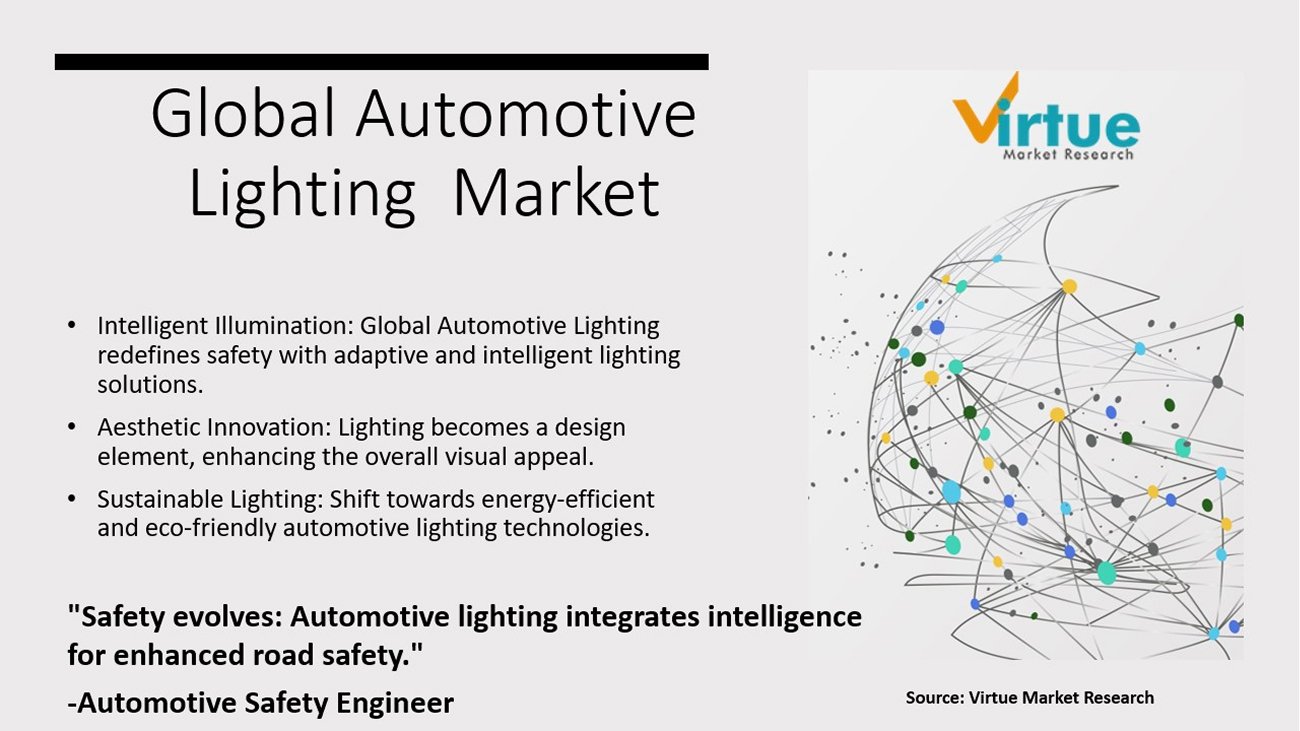
Car lighting works its magic to provide safety, visibility, and style. Headlights cut through the night, taillights express intent, and interiors shine with comfort. The billion-dollar global business is expected to rise due to consumer demand for high-end experiences, safer roads, and cutting-edge technology. Imagine dynamic messages being painted by taillights, headlights that adjust to the road, and interiors that customize their atmosphere. Driven by technological advancements like linked systems and laser beams, this future is calling. Anticipate even more visually attractive, environmentally friendly, and intelligent lighting to illuminate the way ahead, making cars safer, more efficient, and unquestionably cooler.
Global Automotive Lighting Market Drivers:
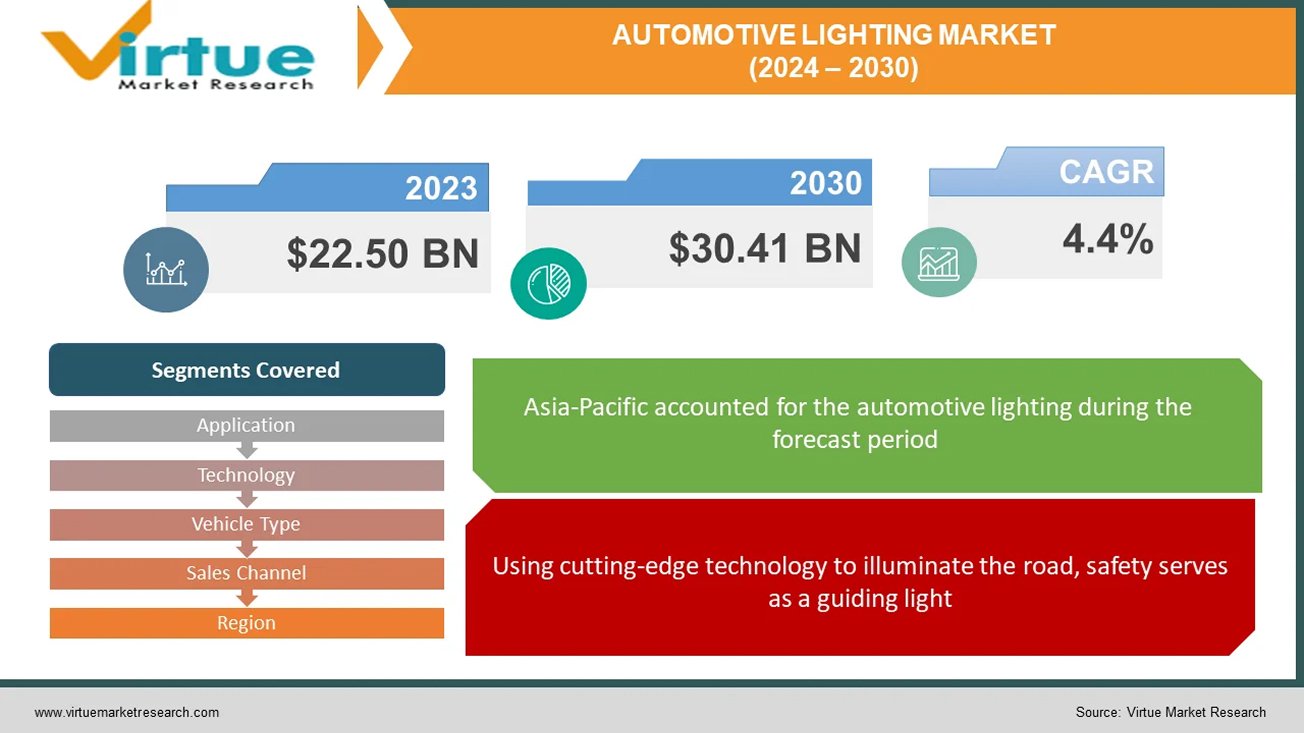
Using cutting-edge technology to illuminate the road, safety serves as a guiding light.
In the market for automobile lighting, safety is the driving force behind demand from the public and laws. While automated high beams smoothly react to traffic, adaptive headlights modify their beams so as not to blind other people. With visually striking displays, dynamic taillights convey intentions for braking and turning. Beyond these developments, integrated pedestrian identification and lane departure alerts will soon make roads safer and brighter for everyone.
Beyond Performance-Based Luxuries Redefined by Light.
Luxurious automobile lighting creates a distinct visual identity that goes beyond simple illumination. Personalized interior lighting customizes the driving experience by setting the mood with a range of colours and intensities, while intricate designs and distinctive DRLs modify exteriors. As you approach your automobile at night, welcoming lights lead the way, resulting in an interior that is perfectly lit. Not only is this symphony of light aesthetically pleasing, but it also stands as a tribute to luxury. Upcoming developments like gesture-controlled lighting and holographic displays promise to further enhance the experience.
Fuel Efficiency Takes the Lead: Illuminating Sustainability
The worldwide automotive lighting market is undergoing a significant transition towards energy-efficient solutions, as environmental concerns gain prominence. LED technology is leading the way, providing a ray of hope for the environment and drivers alike. LED lights beam brighter and use a lot less energy than conventional halogen lamps. There are some tangible advantages to this. For drivers, this translates to increased fuel economy, which lowers petrol prices and lessens reliance on fossil fuels. Greater air quality and a reduction in the transport sector's contribution to climate change are the results of reduced overall emissions.
To Learn more about this report,
Global Automotive Lighting Market Restraints and Challenges:
Although the global automotive lighting business is booming, there are still unknowns. Difficulties impede growth even as innovation propels it with eye catching features like laser beams and adaptable headlights. These technologies are luxury items due to their high cost and difficult integration, which puts producers' abilities to the test. The worldwide patchwork created by unclear legislation limits the potential of innovation. Durability issues persist, particularly when complex systems are subjected to challenging conditions. Ultimately, a lot of drivers still don't fully understand how these improvements can help them. Together, we can overcome these obstacles. The keys to reducing costs are improved production, more seamless integration, and unified regulations. Their full potential can be realized by educating customers about the safety, efficiency, and aesthetic value of these lighting wonders. By working together, we can pave the way for an even brighter and safer future for vehicle lighting.
Global Automotive Lighting Market Opportunities:
It is made possible by advanced LED technology, which gives drivers the ability to customize their illumination for the highest level of comfort and flair. Consumers that care about the environment want greener products, and vehicle lighting complies. While solar- and self-powered lighting technologies offer a future powered by clean energy, energy-efficient LEDs lower pollution. The advent of connected lighting systems heralds a new age. Envision automobiles interacting with infrastructure and one another to minimize accidents and enhance traffic efficiency. Integrated headlights with pedestrian recognition provide unmatched safety, while dramatic taillights with eye-catching displays alert onlookers to your intentions. The possibilities are endless in the future. Gesture-controlled interior illumination, holographic displays projected onto the road, and even light fixtures with self-healing capabilities.
AUTOMOTIVE LIGHTING MARKET REPORT COVERAGE:
To Learn more about this report,
Global Automotive Lighting Market Segmentation: By Application
Exterior Lighting
Interior Lighting
Due to laws requiring safety features like headlights, taillights, and brake lights, exterior lighting presently holds the most market share in the vehicle lighting industry. The dominance of this market is partly attributed to advancements in safety-focused technologies such as adaptive headlights and daytime running lights. The market value of external lighting is increased by the quick adoption of technology like LED bulbs and laser lights, which improve performance and aesthetics. Conversely, the interior lighting market is expected to increase at the fastest rate in the upcoming years. Innovations like ambient lighting and technology breakthroughs like LED and OLED displays, driven by consumer demand for comfort and personalisation, open new possibilities. The spread of sophisticated interior lighting systems is further driven by the growing emphasis on safety and the expansion of the luxury car market.
Global Automotive Lighting Market Segmentation: By Technology
Halogen
LED (Light-Emitting Diode)
Xenon
Emerging Technologies
The worldwide vehicle lighting market is currently dominated by halogen because of its more affordable price, advanced technology, and useful illumination. With its dependable supply chain and affordable option for manufacturers and cost-conscious customers, halogen holds the biggest market share. The fastest-growing market right now is LEDs, which are predicted to shortly overtake halogen. The rapid expansion of LEDs is driven by their higher efficiency, longer lifespan, flexibility in design, and technological breakthroughs including enhanced brightness. Because LEDs use less energy and produce fewer emissions and better fuel economy, they are becoming more and more popular in the changing automotive lighting market.
Global Automotive Lighting Market Segmentation: By Vehicle Type
Passenger Cars
Commercial Vehicles
Passenger automobiles rule the worldwide automotive lighting market. The sheer number of passenger cars produced which surpasses that of business vehicles and fuels the need for lighting systems is the primary cause of this popularity. The growing demand for personal automobiles in developing nations is a result of rising disposable income, which in turn drives the rise of the passenger car market. The importance that consumers place on safety and aesthetics elements helps to drive market expansion. But in the upcoming years, the market for electric and hybrid cars is expected to develop at the quickest rate. The exponential rise of the worldwide electric car market, which is still expanding and shows no signs of slowing down, is what is driving this surge. Specialised lighting solutions are required since electric and hybrid vehicles have different lighting requirements because of their specific functionality and design aesthetics.
Global Automotive Lighting Market Segmentation: By Sales Channel
OEM (Original Equipment Manufacturers)
Aftermarket
Most lighting systems sold nowadays are sold by OEMs (Original Equipment Manufacturers), primarily because manufacturers pre-install lighting systems in new cars. But in the next years, the aftermarket is expected to develop at the quickest rate. This spike in demand for replacement parts, especially lighting systems, can be linked to several variables, one of them being the average age of cars. The industry is expanding because of consumers' growing desire to personalise their cars with aftermarket lighting upgrades such LED upgrades and decorative lighting. The availability and affordability of technologies like adaptive headlights and laser lights in the aftermarket, together with other advancements in lighting technology, are driving demand even more. Moreover, the growing market for electric cars (EVs).
To Learn more about this report,
Global Automotive Lighting Market Segmentation: By Region
North America
Asia-Pacific
Europe
South America
Middle East and Africa
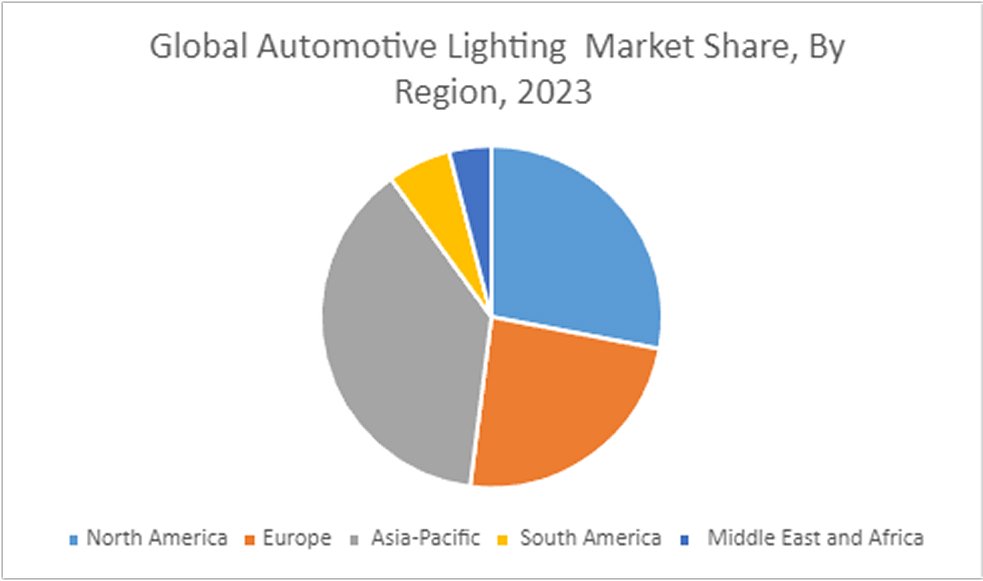
Throughout the forecast period, Asia Pacific is anticipated to be the automotive lighting market with the highest profitability. Over the past few years, Asia Pacific countries like China and India have seen notable increases in automotive manufacturing and sales, primarily in the medium-to premium luxury car segment. Asia Pacific is predicted to see an increase in the manufacturing of passenger cars, with India experiencing the strongest growth rate. Depending on the state of the national economy, the area offers a suitable selection of both high-end and cheap cars. For instance, there is a substantial demand for halogen, Xenon/HID, and LED since China and India produce more economy and mid-range automobiles. On the other hand, luxury car adoption rates are greater in South Korea and Japan, where LED lighting is the norm.
COVID-19 Impact Analysis on the Global Automotive Lighting Market:
A brief shadow was thrown by COVID-19 over the worldwide automotive lighting market. Production was stopped by lockdowns and supply chain disruptions, while luxury lighting upgrades were shelved by consumers on a tight budget. Resources became scarce, and R&D stagnated. Still, the market is recovering thanks to resurgent demand and rearranged priorities. While energy-efficient LEDs are being pushed towards adoption by sustainability, safety concerns are driving interest in features like pedestrian detection and adaptive headlights. The digital push of the epidemic creates opportunities for intelligent, networked lighting systems that may interact with infrastructure and other cars. Ultimately, the industry is positioned to shine brighter, focused on safety, sustainability, and a connected future, even though the pandemic dimmed its brilliance.
Recent Trends and Developments in the Global Automotive Lighting Market:
A development collaboration between OSRAM Continental and REHAU aims to incorporate lighting into external components, providing automobile manufacturers with innovative lighting options that improve functionality and design flexibility. For rear combination lamps, Hella unveiled a revolutionary lighting innovation called Hella FlatLight technology. A Memorandum of Understanding (MoU) was signed by Samvardhana Motherson Automotive Systems Group BV (SMRPBV), a division of Motherson Group, and Marelli Automotive Lighting to investigate a technology collaboration focused on intelligently lighted external body components. Valeo debuted their revolutionary 360° lighting system at the Shanghai Auto Show. This technology surrounds the car with a band of light, projecting instantaneous, clear signs that other drivers can see from a distance. Pedestrians, cyclists, and scooter riders are especially susceptible to these signals
Report Code: VMR-17330 | Published Date: July 2024 | Format: Excel and PDF
The Global Acoustic and Thermal Insulation for Electric Vehicles Market was valued at USD 218 million in 2023 and is projected to reach a market size of USD 446.93 million by the end of 2030. The market is anticipated to...
Report Code: VMR-12973 | Published Date: December 2024 | Format: Excel and PDF
The Global online used car market was valued at USD 28.19 billion in 2022 and is projected to reach a market size of USD 75 billion by the end of 2030. Over the forecast period of 2023-2030, the market is projected to gr...
Report Code: VMR-16118 | Published Date: November 2023 | Format: Excel and PDF
The Autonomous Taxi Services Market was valued at USD 0.78 Billion in 2023 and is projected to reach a market size of USD 58.29 Billion by the end of 2030. Over the forecast period of 2024-2030, the market is projected t...
Report Code: VMR-18523 | Published Date: July 2025 | Format: Excel and PDF
The Trucks Market was valued at USD 8.31 trillion in 2024 and is projected to reach a market size of USD 11.29 trillion by the end of 2030. Over the forecast period of 2025-2030, the market is projected to grow at a CAGR...
Report Code: VMR-4959 | Published Date: June 2024 | Format: Excel and PDF
The Global Automotive Telematics Market was valued at USD 76.66 billion in 2023 and is projected to reach a market size of USD 274.69 billion by the end of 2030. Over the cast period of 2024 – 2030, the figure for reques...
“We received a complex piece of work for our niche market from Virtue Market research in short period of time. I appreciate the quality and content of the final files we received. Thanks for the support”
Medical Devices Company based in Europe
“We received a complex piece of work for our niche market from Virtue Market research in short period of time. I appreciate the quality and content of the final files we received. Thanks for the support”
Medical Devices Company based in Europe
“We received a complex piece of work for our niche market from Virtue Market research in short period of time. I appreciate the quality and content of the final files we received. Thanks for the support”
Medical Devices Company based in Europe
“We received a complex piece of work for our niche market from Virtue Market research in short period of time. I appreciate the quality and content of the final files we received. Thanks for the support”
Medical Devices Company based in Europe
“We received a complex piece of work for our niche market from Virtue Market research in short period of time. I appreciate the quality and content of the final files we received. Thanks for the support”
Medical Devices Company based in Europe
“We received a complex piece of work for our niche market from Virtue Market research in short period of time. I appreciate the quality and content of the final files we received. Thanks for the support”