Artificial Intelligence in Microgrid Control Systems Market Research Report – Segmented By Type (On-grid, Off-grid, Hybrid); End Users (Utilities, Cities & Municipalities, Defense, Industrial, Others); and Region - Size, Share, Growth Analysis | Forecast (2024 – 2030)
Global Artificial Intelligence in Microgrid Control Systems Market Size (2024 – 2030)
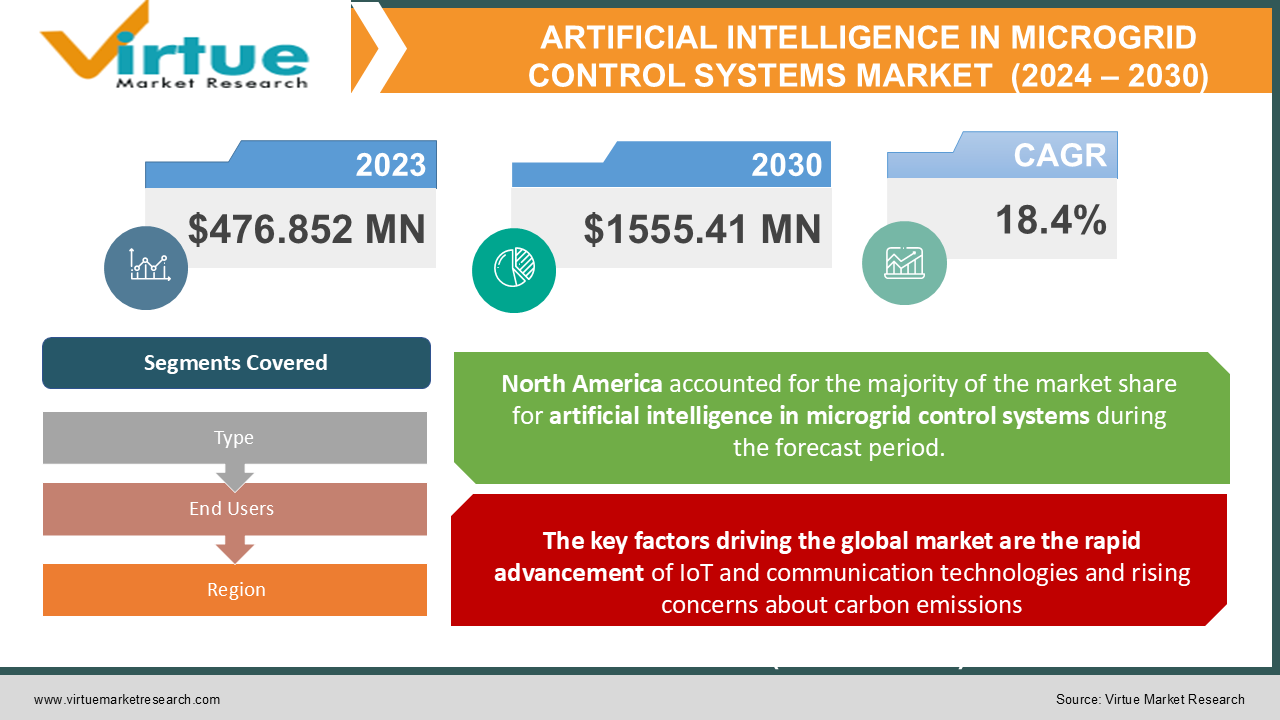
In 2023, the Global Artificial Intelligence in Microgrid Control Systems Market was valued at $476.852 million, and is projected to reach a market size of $1555.41 million by 2030. Over the forecast period of 2024-2030, market is projected to grow at a CAGR of 18.4%.
Industry Overview:
The increased need for sustainable energy to support the transition to net zero is one of the factors driving the growth of microgrids. Microgrids are self-contained electrical networks connecting distributed energy resources (DERs) and loads, working as a single controllable entity, and can operate on either grid-connected or islanded/isolated modes. The ability to do real-time optimization on today's sophisticated microgrids enables use cases like frequency regulation and demand response, which often require an optimization step to be performed in less than one second. AI aids in the faster and more accurate forecasting of changes in the energy supply and demand throughout a microgrid. A microgrid can successfully manage a complicated energy structure with AI, even when new factors like quickly fluctuating energy costs or renewable power generation are present. There is a need for effective and dependable control systems that can manage the complexity of these new systems because microgrids are now being installed in many areas and combined with cutting-edge technology, such as fuel cells. As a result, there is a growing demand for efficient, centralized microgrid controllers. Traditional grids are thought to be extremely inefficient because of their long-distance lines. The demand for efficient systems is growing as a result of rising fuel and energy prices, which in turn is accelerating the development of microgrid systems. The newest microgrids have an intelligent design. These sophisticated microgrids have a microgrid controller, which controls the neighborhood's batteries, generators, and building energy systems with increased sophistication. The industry is seeing an increase in demand for smart microgrid controllers and control systems. Increased investments in transmission and distribution infrastructure, a rise in energy demand, and government programs aimed at expanding access to electricity are all factors that can be ascribed to this growth.
COVID-19 pandemic impact on Artificial Intelligence in Microgrid Control Systems Market
Energy production, prices, and consumption have all changed significantly as a result of the coronavirus epidemic, which forced governments all over the world to impose restrictions on commercial activity to slow the spread of the virus. Residential or domestic electricity demand has increased as a result of individuals staying at home due to the coronavirus epidemic. As a result, there is a greater need for AI in micro-grid backup solutions because more people are working from home and require an uninterrupted and continuous supply of electricity. However, the pandemic limits have reduced the use of such systems in sectors including manufacturing, aviation, and transportation. Worldwide, distribution system operators have experienced low electricity consumption, waivers of interest on bills, and prohibitions on disconnecting during lockdowns. The integration and curtailment of photovoltaic power output have been negatively impacted by the overall fall and changes in load demand and sequencing, which has in turn reduced the use of microgrid control approaches during the pandemic.
MARKET DRIVERS:
Revolutionizing Microgrid Operations with AI: Enhancing Decision-Making and Efficiency
Advanced microgrids control a variety of factors to create the cleanest, most effective, and most dependable electricity. Even under the best-case scenario, a grid-connected microgrid may have a difficult time sorting through the enormous volumes of data that are generated by the weather, shifting patterns of energy production and consumption, and constantly shifting fuel and electricity prices. AI is useful for microgrid operators, equipment suppliers, and integrators since it may be used during the planning, implementation, and operating phases of a microgrid. AI provides the quick calculation for real-time modeling of enormous amounts of data for microgrid developers, assisting them in capacity sizing choices regarding grid equipment, solar and wind configurations, and the use of electric vehicle charging infrastructure. AI offers simulation and modeling for the optimal use of controllers, solar inverters, battery systems, and other distributed energy grid resources for equipment suppliers. AI eliminates the need for grid operators and asset managers to interfere in microgrid operations, which benefits microgrid operators. AI modeling and simulation results aid in guiding microgrid management choices. To assist all stakeholders who manage microgrids in making wise decisions, machine learning and artificial intelligence are used to process the vast amounts of available data. They may use AI to assist them to weigh options for manual vs. autonomous operations, power distribution and storage, managing renewable variability, improving forecasting, lowering energy costs, and enhancing resilience.
The key factors driving the global market are the rapid advancement of IoT and communication technologies and rising concerns about carbon emissions
The increased use of microgrid control systems in large power plants and the manufacturing sector is also having an impact on the market for these systems globally. The global microgrid control system market is anticipated to develop shortly as a result of an increase in clean energy projects and an increase in the adoption of renewable energy sources globally. The majority of homeowners and small and medium-sized businesses select micro-grid control systems to meet their needs because of how affordable this option is. Massive and complicated grid systems are being used by educational institutions and the defence industry due to their successful operation and outcomes. In addition, major investments are being made in the micro-grid system by firms who wish to build their private power network to provide backup power and an uninterrupted power supply.
MARKET RESTRAINTS:
A significant challenge to the market could arise from the high cost of the installation and upkeep of the AI in the microgrid control system
The market for AI in microgrid control systems may be seriously threatened by the high installation and maintenance costs involved. Due to the special need for professional staff during the procedure, the cost of routine maintenance is relatively expensive. The system's running expenses will consequently rise as a result of this. Small manufacturing enterprises are looking for affordable solutions for a steady supply of power as a result. The enormous benefits that microgrid control systems provide to consumers more than offset their high costs. Also, there is a need to create some awareness among the industries about micro-grid control systems about the new technological advancements.
ARTIFICIAL INTELLIGENCE IN MICROGRID CONTROL SYSTEMS MARKET REPORT COVERAGE:
REPORT METRIC
DETAILS
Market Size Available
2023 - 2030
Base Year
2023
Forecast Period
2024 - 2030
CAGR
18.4%
Segments Covered
By Type, End Users and Region
Various Analyses Covered
Global, Regional & Country Level Analysis, Segment-Level Analysis, DROC, PESTLE Analysis, Porter’s Five Forces Analysis, Competitive Landscape, Analyst Overview on Investment Opportunities
Regional Scope
North America, Europe, APAC, Latin America, Middle East & Africa
Key Companies Profiled
Woodward Inc., S&C Electric Company,RT Soft, Emerson Electric,Schneider Electric, Eaton Corporation, Ontech Electric Corporation, Siemens, General Electric, Schweitzer Engineering Laboratories, Inc., ABB
This research report on the global Artificial Intelligence in Microgrid Control Systems Market has been segmented and sub-segmented based on type, end users, and region.
Artificial Intelligence in Microgrid Control Systems Market – By Type
On-grid
Off-grid
Hybrid
Based on Type, the Artificial Intelligence in Microgrid Control Systems is bifurcated into On-grid, Off-grid, and Hybrid. The off-grid segment is anticipated to experience rapid expansion through 2030 due to the fast advancements in PV and wind power technologies for off-grid hybrid systems, which are estimated to reduce the negative consequences of utilizing diesel to generate electricity in distant off-grid settlements. This is because remote/island microgrid control systems are being adopted widely as a result of the growing electrification of rural and distant locations worldwide. Remote and island networks can function without external power sources and offer power security in the event of a power outage. This level of energy self-sufficiency supports the widespread use of remote/island microgrid systems.
A grid network that is fully connected and built to deliver electricity following the needs of the relevant end user is referred to as being grid-connected or grid-tied. Among the available microgrid alternatives, the specific advantage of being a cost-effective solution has led the majority of homeowners and small-sized businesses to pick grid-connected microgrid systems to meet their respective power needs. The military and defence sector, as well as university campuses, have large-scale grid-tied microgrid networks, which has accelerated the market's adoption of control systems. Due to the upcoming shifts toward the development of a connected society, manufacturers have made substantial expenditures to build a private network of electricity in case conventional sources of power fail.
Artificial Intelligence in Microgrid Control Systems Market – By End Users
Utilities
Cities & Municipalities
Defense
Industrial
Others
Based on End Users, the Artificial Intelligence in Microgrid Control Systems is bifurcated into Utilities, Industrial, Cities & Municipalities, Defense, and Others. In 2021, the Utility sector accounted for a sizable portion of the global market owing to an increase in government spending on microgrid management systems. Several commercial companies have set up power microgrid control systems to meet the domestic electricity demand thanks to rising primary energy consumption and financial incentives from governments. This expansion is linked to increased electrification project investments, which heavily utilize microgrid technology.
Artificial Intelligence in Microgrid Control Systems Market - By Region:
North America
Europe
Asia-Pacific
Rest of the World
North America is the market leader for artificial intelligence in microgrid control systems globally due to the increased focus on grid modernization and the rise in investments in the country's grid technology upgrade. The market expansion in this region is being fueled by increased use of sustainable power sources and expanding smart grid activities. The market for conventional grids is coming under more and more strain. The market for integrated renewable energy microgrid control systems is being further stimulated by the US EPA's (Environmental Policy Agency) significant greenhouse gas legislation and the country's urgent need to upgrade its outdated infrastructure. The demand from institutions or campus applications has expanded as a result of the growing government assistance in the form of financing and state-level resilience programs, which is a key driver for the expansion of the US market.
Europe is also a lucrative region of the global Artificial Intelligence in the microgrid control system market. It is currently investing heavily in the modernization of the electrical grid. In nations like Germany and the UK, there is a renewed emphasis on renewable energy sources. Investors and project developers adopted the microgrid control system owing to enticing incentives such as tax credits, feed-in tariffs, and the commercialization of the technology. The region's microgrid control system market will also be driven by factors like rising power demand, government regulations on energy efficiency, the inflow of renewable energy sources into the energy mix, and rehabilitation, modernization, and upgrade of aging grid infrastructure. To fulfill the EU's new aim of reducing emissions by up to 55% by 2030, TenneT, the transmission operator in the Netherlands and Germany, is creating new connections, reinforcing and expanding its grid, and modernizing system operations.
The Asia Pacific Artificial Intelligence in Microgrid Control Systems Market is anticipated to expand significantly with a CAGR of 5.7%, over the forecast period. The modernization of electrical infrastructure, rising investments in smart micro-grid control technology, and growing reliance on renewable energy sources are the factors responsible for this growth. To keep up with the rising power demand, nations like China and India are making significant investments in electrification projects, network moderation, and network upgrades.
Major Key Players in the Market
Woodward Inc.
S&C Electric Company
RT Soft
Emerson Electric
Schneider Electric
Eaton Corporation
Ontech Electric Corporation
Siemens
General Electric
Schweitzer Engineering Laboratories, Inc.
ABB
Notable happenings in the Artificial Intelligence in Microgrid Control Systems Market in the recent past:
Product Launch- In January 2021, Schneider Electric announced the availability of its EcoStruxure Microgrid Solution for small and medium buildings in Canada to increase energy resilience, minimize energy costs, and lower the carbon footprint of industrial buildings, educational institutions, and healthcare facilities.
Partnership- In May 2021- Ameresco and Fort Hunter teamed up to install a resilient, secure, and sustainable microgrid project.
To Learn more about this report,
Global automotive lighting refers to all vehicle lighting systems, from headlamps that illuminate the road to taillights that communicate movements. They guarantee motorists and other road users alike safety, visibility, and style. While taillights frequently use LEDs for improved visibility, headlights are available in a variety of technologies, including LED and laser. Interior illumination, DRLs, and signal lights all have a role to play. This market, which was estimated to be worth $33.64 billion in 2022, is anticipated to rise to $67.39 billion by 2030 because of laws, luxury tastes, safety concerns, and technological developments like OLED taillights and adaptive headlights. Anticipate a future dominated by intelligent, connected, personalized, and sustainable lighting systems that enhance the safety, efficiency, and aesthetic appeal of automobiles.
Key Market Insights:
Car lighting works its magic to provide safety, visibility, and style. Headlights cut through the night, taillights express intent, and interiors shine with comfort. The billion-dollar global business is expected to rise due to consumer demand for high-end experiences, safer roads, and cutting-edge technology. Imagine dynamic messages being painted by taillights, headlights that adjust to the road, and interiors that customize their atmosphere. Driven by technological advancements like linked systems and laser beams, this future is calling. Anticipate even more visually attractive, environmentally friendly, and intelligent lighting to illuminate the way ahead, making cars safer, more efficient, and unquestionably cooler.
Global Automotive Lighting Market Drivers:
Using cutting-edge technology to illuminate the road, safety serves as a guiding light.
In the market for automobile lighting, safety is the driving force behind demand from the public and laws. While automated high beams smoothly react to traffic, adaptive headlights modify their beams so as not to blind other people. With visually striking displays, dynamic taillights convey intentions for braking and turning. Beyond these developments, integrated pedestrian identification and lane departure alerts will soon make roads safer and brighter for everyone.
Beyond Performance-Based Luxuries Redefined by Light.
Luxurious automobile lighting creates a distinct visual identity that goes beyond simple illumination. Personalized interior lighting customizes the driving experience by setting the mood with a range of colours and intensities, while intricate designs and distinctive DRLs modify exteriors. As you approach your automobile at night, welcoming lights lead the way, resulting in an interior that is perfectly lit. Not only is this symphony of light aesthetically pleasing, but it also stands as a tribute to luxury. Upcoming developments like gesture-controlled lighting and holographic displays promise to further enhance the experience.
Fuel Efficiency Takes the Lead: Illuminating Sustainability
The worldwide automotive lighting market is undergoing a significant transition towards energy-efficient solutions, as environmental concerns gain prominence. LED technology is leading the way, providing a ray of hope for the environment and drivers alike. LED lights beam brighter and use a lot less energy than conventional halogen lamps. There are some tangible advantages to this. For drivers, this translates to increased fuel economy, which lowers petrol prices and lessens reliance on fossil fuels. Greater air quality and a reduction in the transport sector's contribution to climate change are the results of reduced overall emissions.
To Learn more about this report,
Global Automotive Lighting Market Restraints and Challenges:
Although the global automotive lighting business is booming, there are still unknowns. Difficulties impede growth even as innovation propels it with eye catching features like laser beams and adaptable headlights. These technologies are luxury items due to their high cost and difficult integration, which puts producers' abilities to the test. The worldwide patchwork created by unclear legislation limits the potential of innovation. Durability issues persist, particularly when complex systems are subjected to challenging conditions. Ultimately, a lot of drivers still don't fully understand how these improvements can help them. Together, we can overcome these obstacles. The keys to reducing costs are improved production, more seamless integration, and unified regulations. Their full potential can be realized by educating customers about the safety, efficiency, and aesthetic value of these lighting wonders. By working together, we can pave the way for an even brighter and safer future for vehicle lighting.
Global Automotive Lighting Market Opportunities:
It is made possible by advanced LED technology, which gives drivers the ability to customize their illumination for the highest level of comfort and flair. Consumers that care about the environment want greener products, and vehicle lighting complies. While solar- and self-powered lighting technologies offer a future powered by clean energy, energy-efficient LEDs lower pollution. The advent of connected lighting systems heralds a new age. Envision automobiles interacting with infrastructure and one another to minimize accidents and enhance traffic efficiency. Integrated headlights with pedestrian recognition provide unmatched safety, while dramatic taillights with eye-catching displays alert onlookers to your intentions. The possibilities are endless in the future. Gesture-controlled interior illumination, holographic displays projected onto the road, and even light fixtures with self-healing capabilities.
AUTOMOTIVE LIGHTING MARKET REPORT COVERAGE:
To Learn more about this report,
Global Automotive Lighting Market Segmentation: By Application
Exterior Lighting
Interior Lighting
Due to laws requiring safety features like headlights, taillights, and brake lights, exterior lighting presently holds the most market share in the vehicle lighting industry. The dominance of this market is partly attributed to advancements in safety-focused technologies such as adaptive headlights and daytime running lights. The market value of external lighting is increased by the quick adoption of technology like LED bulbs and laser lights, which improve performance and aesthetics. Conversely, the interior lighting market is expected to increase at the fastest rate in the upcoming years. Innovations like ambient lighting and technology breakthroughs like LED and OLED displays, driven by consumer demand for comfort and personalisation, open new possibilities. The spread of sophisticated interior lighting systems is further driven by the growing emphasis on safety and the expansion of the luxury car market.
Global Automotive Lighting Market Segmentation: By Technology
Halogen
LED (Light-Emitting Diode)
Xenon
Emerging Technologies
The worldwide vehicle lighting market is currently dominated by halogen because of its more affordable price, advanced technology, and useful illumination. With its dependable supply chain and affordable option for manufacturers and cost-conscious customers, halogen holds the biggest market share. The fastest-growing market right now is LEDs, which are predicted to shortly overtake halogen. The rapid expansion of LEDs is driven by their higher efficiency, longer lifespan, flexibility in design, and technological breakthroughs including enhanced brightness. Because LEDs use less energy and produce fewer emissions and better fuel economy, they are becoming more and more popular in the changing automotive lighting market.
Global Automotive Lighting Market Segmentation: By Vehicle Type
Passenger Cars
Commercial Vehicles
Passenger automobiles rule the worldwide automotive lighting market. The sheer number of passenger cars produced which surpasses that of business vehicles and fuels the need for lighting systems is the primary cause of this popularity. The growing demand for personal automobiles in developing nations is a result of rising disposable income, which in turn drives the rise of the passenger car market. The importance that consumers place on safety and aesthetics elements helps to drive market expansion. But in the upcoming years, the market for electric and hybrid cars is expected to develop at the quickest rate. The exponential rise of the worldwide electric car market, which is still expanding and shows no signs of slowing down, is what is driving this surge. Specialised lighting solutions are required since electric and hybrid vehicles have different lighting requirements because of their specific functionality and design aesthetics.
Global Automotive Lighting Market Segmentation: By Sales Channel
OEM (Original Equipment Manufacturers)
Aftermarket
Most lighting systems sold nowadays are sold by OEMs (Original Equipment Manufacturers), primarily because manufacturers pre-install lighting systems in new cars. But in the next years, the aftermarket is expected to develop at the quickest rate. This spike in demand for replacement parts, especially lighting systems, can be linked to several variables, one of them being the average age of cars. The industry is expanding because of consumers' growing desire to personalise their cars with aftermarket lighting upgrades such LED upgrades and decorative lighting. The availability and affordability of technologies like adaptive headlights and laser lights in the aftermarket, together with other advancements in lighting technology, are driving demand even more. Moreover, the growing market for electric cars (EVs).
To Learn more about this report,
Global Automotive Lighting Market Segmentation: By Region
North America
Asia-Pacific
Europe
South America
Middle East and Africa
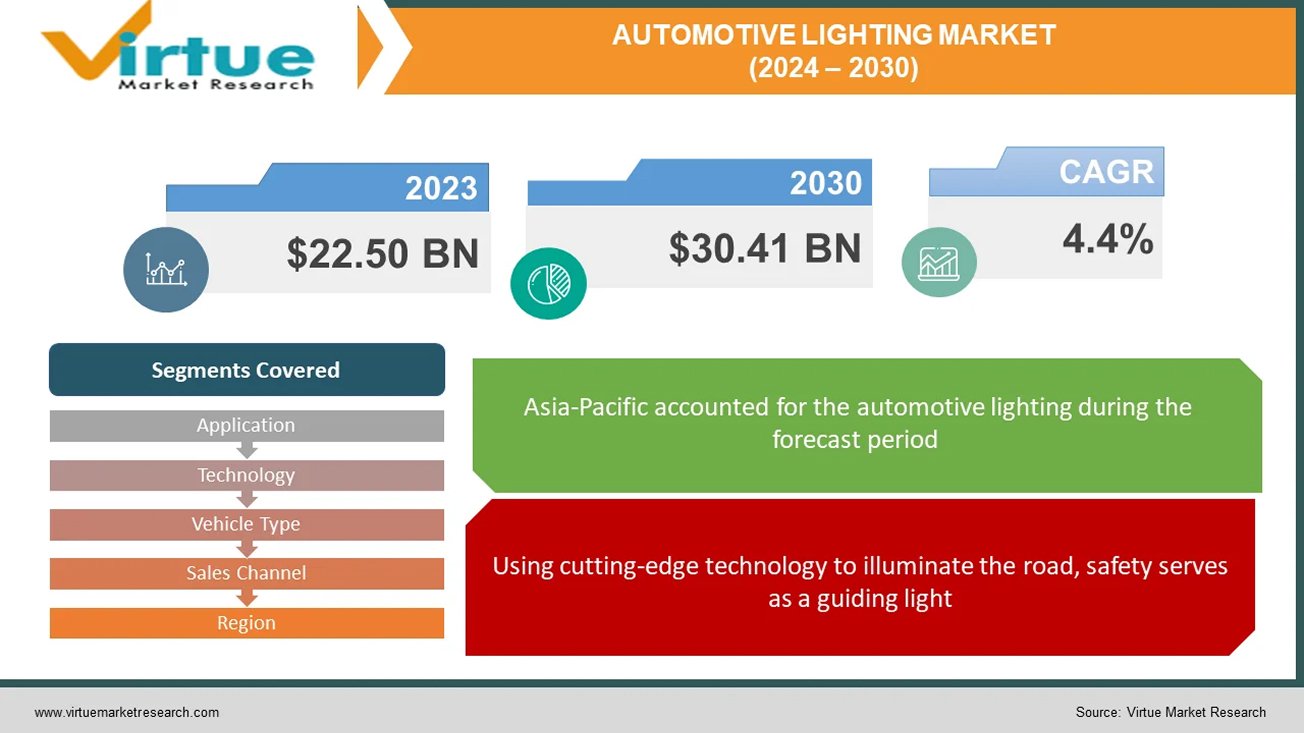
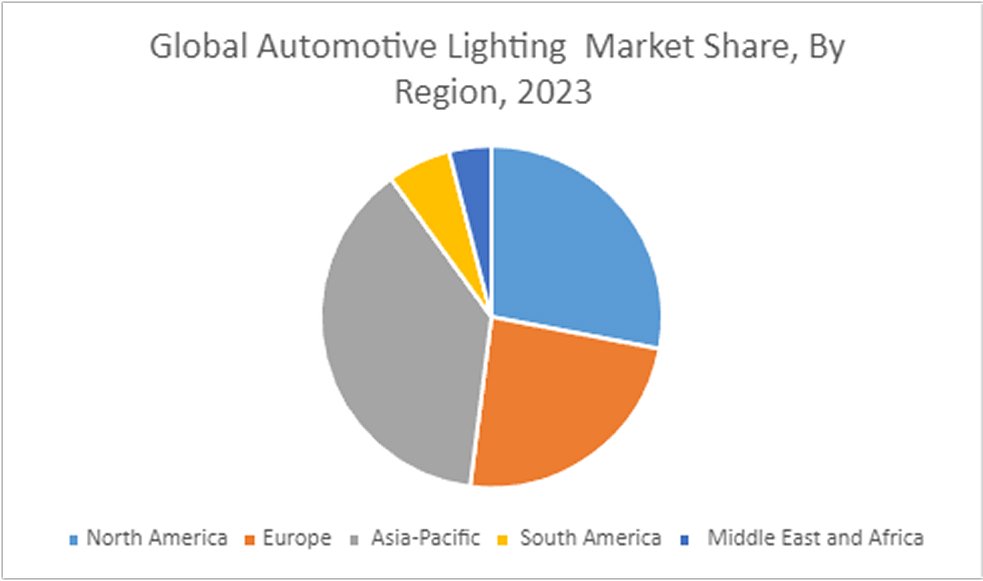
Throughout the forecast period, Asia Pacific is anticipated to be the automotive lighting market with the highest profitability. Over the past few years, Asia Pacific countries like China and India have seen notable increases in automotive manufacturing and sales, primarily in the medium-to premium luxury car segment. Asia Pacific is predicted to see an increase in the manufacturing of passenger cars, with India experiencing the strongest growth rate. Depending on the state of the national economy, the area offers a suitable selection of both high-end and cheap cars. For instance, there is a substantial demand for halogen, Xenon/HID, and LED since China and India produce more economy and mid-range automobiles. On the other hand, luxury car adoption rates are greater in South Korea and Japan, where LED lighting is the norm.
COVID-19 Impact Analysis on the Global Automotive Lighting Market:
A brief shadow was thrown by COVID-19 over the worldwide automotive lighting market. Production was stopped by lockdowns and supply chain disruptions, while luxury lighting upgrades were shelved by consumers on a tight budget. Resources became scarce, and R&D stagnated. Still, the market is recovering thanks to resurgent demand and rearranged priorities. While energy-efficient LEDs are being pushed towards adoption by sustainability, safety concerns are driving interest in features like pedestrian detection and adaptive headlights. The digital push of the epidemic creates opportunities for intelligent, networked lighting systems that may interact with infrastructure and other cars. Ultimately, the industry is positioned to shine brighter, focused on safety, sustainability, and a connected future, even though the pandemic dimmed its brilliance.
Recent Trends and Developments in the Global Automotive Lighting Market:
A development collaboration between OSRAM Continental and REHAU aims to incorporate lighting into external components, providing automobile manufacturers with innovative lighting options that improve functionality and design flexibility. For rear combination lamps, Hella unveiled a revolutionary lighting innovation called Hella FlatLight technology. A Memorandum of Understanding (MoU) was signed by Samvardhana Motherson Automotive Systems Group BV (SMRPBV), a division of Motherson Group, and Marelli Automotive Lighting to investigate a technology collaboration focused on intelligently lighted external body components. Valeo debuted their revolutionary 360° lighting system at the Shanghai Auto Show. This technology surrounds the car with a band of light, projecting instantaneous, clear signs that other drivers can see from a distance. Pedestrians, cyclists, and scooter riders are especially susceptible to these signals
Key Players:
AMS Osram
Cree
Hella
Hyundai Mobis
Koito
Luminus Devices
Magneti Marelli
Osram Licht AG
Stanley Electric
Valeo
Chapter 1. Artificial Intelligence in Microgrid Control Systems Market – Scope & Methodology
1.1. Market Segmentation
1.2. Assumptions
1.3. Research Methodology
1.4. Primary Sources
1.5. Secondary Sources
Chapter 2. Artificial Intelligence in Microgrid Control Systems Market – Executive Summary
Report Code: VMR-18936 | Published Date: December 2025 | Format: Excel and PDF
In 2025, the global Distribution Grid Automation Market was valued at approximately USD 18.4 billion. The market is projected to expand at a compound annual growth rate of around 11.7% during 2026–2030, reaching USD 32.1...
Report Code: VMR-9988 | Published Date: October 2024 | Format: Excel and PDF
The Global Energy Storage Systems Market was valued at USD 45.3 billion in 2023 and is projected to grow at a CAGR of 10.3% from 2024 to 2030, reaching approximately USD 90 billion by 2030.
Report Code: VMR-6921 | Published Date: October 2024 | Format: Excel and PDF
The Thermal Energy Storage Market was valued at USD 6.8 Billion in 2024 and is projected to reach a market size of USD 14.11 Billion by the end of 2030. Over the forecast period of 2025-2030, the market is projected to g...
Report Code: VMR-18636 | Published Date: September 2025 | Format: Excel and PDF
The Space Battery Market was valued at USD 3.38 Billion in 2024 and is projected to reach a market size of USD 5.88 Billion by the end of 2030. Over the forecast period of 2025-2030, the market is projected to grow at a...
Report Code: VMR-19022 | Published Date: January 2026 | Format: Excel and PDF
The Electricity Infrastructure Single-Point-of-Failure Analysis Market was valued at USD 478.5 Million in 2025 and is projected to reach a market size of USD 1142.83 Million by the end of 2030. Over the forecast period o...
“We received a complex piece of work for our niche market from Virtue Market research in short period of time. I appreciate the quality and content of the final files we received. Thanks for the support”
Medical Devices Company based in Europe
“We received a complex piece of work for our niche market from Virtue Market research in short period of time. I appreciate the quality and content of the final files we received. Thanks for the support”
Medical Devices Company based in Europe
“We received a complex piece of work for our niche market from Virtue Market research in short period of time. I appreciate the quality and content of the final files we received. Thanks for the support”
Medical Devices Company based in Europe
“We received a complex piece of work for our niche market from Virtue Market research in short period of time. I appreciate the quality and content of the final files we received. Thanks for the support”
Medical Devices Company based in Europe
“We received a complex piece of work for our niche market from Virtue Market research in short period of time. I appreciate the quality and content of the final files we received. Thanks for the support”
Medical Devices Company based in Europe
“We received a complex piece of work for our niche market from Virtue Market research in short period of time. I appreciate the quality and content of the final files we received. Thanks for the support”